London Boroughs Budget Shortfalls Deepen as Councils Face Fresh 2026/27 Overspends
 Published By
Ben
Published By
Ben
Published:
Table of Contents
London boroughs are facing renewed financial pressure in 2026/27, with eight councils in the capital listed for more than £530 million of Exceptional Financial Support and fresh monitoring reports showing that some authorities are already forecasting millions of pounds of additional overspending.
The latest figures underline why London boroughs budget shortfalls remain a major concern even after the government introduced its first multi-year local government funding settlement in a decade.
Haringey Council is among the clearest examples. A finance report due before its Cabinet on 15 September 2026 says the council is forecasting a £21.7 million General Fund overspend after just the first quarter of the financial year.
That comes despite Haringey’s £353 million budget already incorporating £84.3 million of government Exceptional Financial Support, raising fresh questions about whether emergency financial measures will be enough to stabilise some London councils.
Haringey Forecasts £21.7 Million Overspend
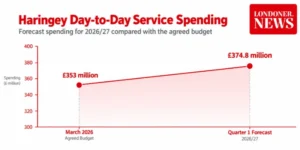
Haringey’s official Quarter 1 finance report forecasts that spending on day-to-day services will reach approximately £374.8 million, compared with the £353 million budget agreed in March.
The report attributes the pressure partly to higher demand and costs in children’s social care and temporary accommodation, but another substantial factor is the failure to deliver all previously agreed savings.
Of the £21.7 million forecast General Fund overspend, approximately £16.7 million relates to underlying budget pressures, while almost £5 million relates to savings expected not to be delivered.
The council warns that its existing £84.3 million Exceptional Financial Support allocation may not be enough if the position does not improve.
Its report also says every £1 million of EFS funded through borrowing could add around £86,000 a year to revenue costs for 20 years, illustrating why emergency support can solve an immediate budget problem while creating longer-term financing costs.
Haringey is not alone.
Ealing Council’s Cabinet was told on 9 September that it was forecasting a £7.797 million General Fund overspend for 2026/27.
It also reported a £16.498 million forecast Dedicated Schools Grant deficit, although its Housing Revenue Account was expected to record a small underspend.
Eight London Boroughs Listed for More Than £530 Million of Emergency Support
The government’s latest Exceptional Financial Support figures show particularly significant exposure across London.
As of the government’s August update, the London boroughs listed for 2026/27 General Fund support were Barnet, Croydon, Haringey, Havering, Hillingdon, Lambeth, Redbridge and Waltham Forest.
Together, their in-principle support amounts to approximately £530.6 million.
The individual amounts include £119 million for Croydon, £84 million for Haringey, £79.6 million for Barnet, £77 million for Havering, £70 million for Redbridge and £62 million for Hillingdon.
Lambeth has £20 million listed and Waltham Forest £19 million.
The City of London separately has £2.65 million of in-principle support relating to its Housing Revenue Account.
Nationally, government statistics say 35 councils were granted £1.5 billion of Exceptional Financial Support for 2026/27, although councils do not necessarily draw down every pound made available.
See the government’s 2026/27 Exceptional Financial Support figures
Barnet Review Warns of Serious Long-Term Financial Risks
Barnet provides another indication of how serious the structural problem has become.
An independent CIPFA external assurance review published by the Ministry of Housing, Communities and Local Government in August described Barnet as being in a “highly fragile financial position” with significant long-term sustainability risks.
The review said Barnet’s projected deficits increased from £79.3 million in 2026/27 to £243.5 million by 2030/31, while recurring savings identified at the time were substantially below the scale required.
Adult social care, children’s services and temporary accommodation were identified as three of the largest sources of pressure. The review also warned that relatively low reserves reduced Barnet’s ability to absorb further financial shocks.
Responding to the review, Barnet’s Cabinet Member for Financial Sustainability, Cllr Simon Radford, said:
“We have current council spend under control and have already reduced our call on Exceptional Financial Support by £10m.”
However, Radford also argued that demand for statutory services was rising much faster than the council’s income, meaning wider reform would still be required.
Why Are London Council Budgets Under So Much Pressure?
There is no single cause behind the financial difficulties.
Temporary accommodation has become one of the most significant pressures.
London councils have statutory responsibilities towards homeless households, while high private rents, a shortage of suitable housing and expensive nightly-paid accommodation can substantially increase costs.
Adult social care and children’s social care are also demand-led statutory services. Councils cannot simply stop providing them when budgets become tight.
SEND provision, staff and supplier costs, borrowing expenses and difficulties delivering planned savings are adding further pressure in individual boroughs.
These factors mean that an increase in government funding does not automatically translate into a council having more discretionary money to spend.
The government’s final 2026/27 settlement introduced the first three-year local government settlement in a decade, giving authorities greater certainty over funding through to 2028/29.
But current borough-level monitoring shows that financial stress has not disappeared.
What Happened to the £4.7 Billion London Funding Gap?
London Councils, the cross-party organisation representing the capital’s local authorities, warned in October 2025 that boroughs could face a cumulative £4.7 billion funding gap between 2025/26 and 2028/29.
At that point it estimated an approximately £1 billion gap for 2025/26, potentially rising to almost £1.5 billion in 2026/27. It also warned that as many as half of London’s boroughs could ultimately require emergency support by 2028.
Those figures need to be read carefully today.
They were forecasts prepared before the final 2026/27 Local Government Finance Settlement, so the £4.7 billion should not be described as the current combined deficit of London’s councils.
The final settlement changed funding allocations, and the position varies significantly by borough.
Enfield, for example, said its 2026/27 government grant funding was expected to rise by around £55 million compared with 2025/26.
The council said the improved settlement meant it no longer expected to require Exceptional Financial Support for 2026/27, although it continues to face substantial social care, housing and inflation pressures.
This difference between boroughs is important: London has a serious overall local-government finance problem, but not every council has the same funding gap or level of financial risk.
Could Council Tax Rise Further?
Council tax remains one of the main sources of locally generated council revenue.
For most London boroughs, government referendum principles for 2026/27 allow a core increase of up to 3%, with social-care authorities also able to levy an additional 2% adult social care precept without triggering a referendum.
However, council tax increases alone are unlikely to close the largest structural gaps.
The government has also indicated it can consider requests for additional council tax flexibility from authorities experiencing severe financial difficulty.
Longer term, the debate over how London contributes to local government funding is likely to continue.
London’s councils are already disputing aspects of the planned High Value Council Tax Surcharge, which is due to affect homes worth £2 million or more from April 2028.
What Happens Next?
The immediate focus will be on councils’ Quarter 2 and Quarter 3 budget monitoring reports.
Haringey’s latest position is particularly important because its £21.7 million forecast overspend sits on top of a budget already dependent on £84.3 million of Exceptional Financial Support.
If boroughs cannot reduce overspending, deliver planned efficiencies or contain demand-led costs, they could face tougher spending controls, greater use of reserves, asset sales or further borrowing.
London Councils’ earlier £4.7 billion forecast should therefore not be treated as an up-to-date deficit figure for every town hall.
But the latest government support figures and council monitoring reports show that the underlying problem remains substantial.
For Londoners, that matters because prolonged financial instability can ultimately affect the money available for housing, social care, children’s services, environmental services and other day-to-day council responsibilities.
About the Journalist
Ben covers business, transport and global developments for Londoner. His reporting focuses on London’s economy, major companies, infrastructure, public transport and international stories that may affect people and businesses across the capital. He explains complex developments clearly using reliable sources and relevant context.