How Much Is PIP Per Month in 2026? Current PIP Rates Explained
 Published By
Henry
Published By
Henry
Published:
Updated:

Table of Contents
If you are trying to work out how much PIP is per month, the key point is that Personal Independence Payment is not normally paid once per calendar month.
PIP is usually paid every four weeks, meaning most claimants receive 13 payments during a full year.
For the 2026/27 tax year, PIP ranges from £30.30 to £194.60 per week, depending on whether someone receives the daily living component, mobility component or both.
At the maximum rate, someone receiving enhanced daily living and enhanced mobility gets £778.40 every four weeks. Averaged across a full year, this is about £843.27 per calendar month.
How Much Is PIP Per Month in 2026?
The official PIP rates are weekly amounts, although payments are normally made every four weeks.
| PIP Component | Weekly Rate | Every 4 Weeks | Average Monthly Equivalent |
| Standard Daily Living | £76.70 | £306.80 | About £332.37 |
| Enhanced Daily Living | £114.60 | £458.40 | About £496.60 |
| Standard Mobility | £30.30 | £121.20 | About £131.30 |
| Enhanced Mobility | £80.00 | £320.00 | About £346.67 |
The monthly figures are budgeting estimates rather than the amount DWP normally deposits.
For example, someone receiving standard daily living would usually get £306.80 every four weeks, not £332.37 once per calendar month.
How Much PIP Do You Get If You Receive Both Components?
Some claimants receive both daily living and mobility payments.
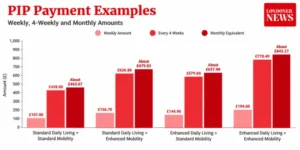
| PIP Award | Weekly Amount | Every 4 Weeks | Monthly Equivalent |
| Standard Daily Living + Standard Mobility | £107.00 | £428.00 | About £463.67 |
| Standard Daily Living + Enhanced Mobility | £156.70 | £626.80 | About £679.03 |
| Enhanced Daily Living + Standard Mobility | £144.90 | £579.60 | About £627.90 |
| Enhanced Daily Living + Enhanced Mobility | £194.60 | £778.40 | About £843.27 |
The highest PIP payment in 2026/27 is therefore £778.40 every four weeks, equivalent to £10,119.20 over 52 weeks.
Why Is PIP Paid Every Four Weeks Instead of Monthly?
A four-week payment period contains 28 days, while calendar months generally contain 30 or 31 days.
There are 52 weeks in a year, creating 13 four-week PIP payment periods.
For someone receiving the maximum award:
- Weekly: £194.60
- Every Four Weeks: £778.40
- Yearly: £10,119.20
- Average Per Calendar Month: About £843.27
This explains why the monthly equivalent is higher than an individual four-week payment.
It also means there may occasionally be two PIP payments within the same calendar month. This is not an extra DWP payment, but simply the result of the four-week schedule.
What Are the PIP Rates for 2026/27?
PIP rates increased for the 2026/27 benefit year.
| Component | 2025/26 Weekly Rate | 2026/27 Weekly Rate |
| Standard Daily Living | £73.90 | £76.70 |
| Enhanced Daily Living | £110.40 | £114.60 |
| Standard Mobility | £29.20 | £30.30 |
| Enhanced Mobility | £77.05 | £80.00 |
The maximum combined award increased from £187.45 to £194.60 per week.
Someone receiving both enhanced components now gets £778.40 every four weeks, compared with £749.80 under the previous rates.
What Is the Daily Living Part of PIP?
The daily living component supports people whose long-term condition or disability makes everyday activities more difficult.
For 2026/27, the rates are:
| Daily Living Award | Weekly | Every 4 Weeks |
| Standard | £76.70 | £306.80 |
| Enhanced | £114.60 | £458.40 |
The assessment considers activities including preparing food, washing, dressing, managing treatment, communicating, interacting with people and managing money.
Entitlement depends on how the condition affects these activities rather than simply the name of a diagnosis.
Generally, 8 to 11 points results in the standard daily living rate, while 12 points or more can qualify for the enhanced rate.
How Much Is PIP Mobility Per Month?
The mobility component is assessed separately.
| Mobility Award | Weekly | Every 4 Weeks | Average Monthly Equivalent |
| Standard Mobility | £30.30 | £121.20 | About £131.30 |
| Enhanced Mobility | £80.00 | £320.00 | About £346.67 |
Mobility assessments consider someone’s ability to plan and follow journeys and their ability to move around.
Someone generally needs 8 to 11 mobility points for the standard rate and at least 12 for the enhanced rate.
How Does DWP Decide How Much PIP You Get?
There is no fixed PIP payment attached to a particular medical condition.
DWP considers how a condition affects specific daily living and mobility activities, with points awarded according to the level of difficulty.
| Points | Award |
| 0–7 | No award for that component |
| 8–11 | Standard rate |
| 12 or more | Enhanced rate |
Daily living and mobility are assessed separately.
This is why two people with the same condition can receive different PIP amounts.
Can You Receive PIP While Working?
Yes. PIP is not an unemployment benefit and it is not means-tested.
Someone can receive PIP while working, and their award is not automatically reduced because they earn a salary or have savings.
The key consideration is how their long-term health condition or disability affects the activities covered by the PIP assessment.
Work circumstances may still be considered if information appears inconsistent with the difficulties described in a claim.
Does PIP Affect Universal Credit?
PIP and Universal Credit are separate benefits.
PIP itself is not normally treated as earnings that reduce Universal Credit. A person may therefore receive both benefits if they independently meet the eligibility rules.
Universal Credit will still depend on circumstances such as:
- Earnings
- Housing Costs
- Children
- Savings
- Health-Related Entitlement
- Household Circumstances
PIP can therefore form one part of a claimant’s overall household income without replacing Universal Credit.
Is PIP Higher in London?
No. There is no separate London PIP rate.
Eligible claimants living in London receive the same rates as people elsewhere in England and Wales.
Higher housing, transport or general living costs in the capital do not automatically increase a PIP award.
A London claimant receiving enhanced daily living and enhanced mobility therefore receives the same £778.40 every four weeks as someone with an equivalent award elsewhere.
Who Can Claim PIP, When Is It Paid and Can the Amount Change?
A person can generally claim PIP if they are aged 16 or over and have a long-term physical or mental health condition or disability that makes certain daily living activities or mobility more difficult.
The difficulties normally need to meet the required duration rules, and a new claimant will generally need to be below State Pension age. People living in Scotland usually claim Adult Disability Payment instead.
PIP is usually paid directly into a bank, building society or credit union account every four weeks. A claimant’s decision letter should confirm important details including:
- Payment Date
- Awarded Component
- Standard Or Enhanced Rate
- Award Length
- Review Information
Because PIP follows a four-week cycle, the actual calendar payment date can shift from month to month. Payments due around weekends or bank holidays may also be made earlier.
PIP is tax-free and not means-tested, meaning employment income or savings do not directly reduce the rate someone has been awarded.
However, a PIP award can change following a review or if relevant circumstances change.
The outcome could mean the award:
- Stays The Same
- Increases
- Decreases
- Ends
The wider Timms Review of PIP is examining areas including assessments, evidence, fluctuating conditions and award reviews. However, proposals under consideration should not be treated as current rules.
For 2026/27, the existing weekly PIP rates remain £76.70 and £114.60 for daily living, and £30.30 and £80.00 for mobility.
How Much Is PIP Per Month: The Bottom Line
For anyone asking how much is PIP per month in 2026, the answer depends on the component and rate awarded.
PIP is usually paid every four weeks rather than monthly.
The lowest current component is £30.30 per week, while the highest combined award is £194.60 per week.
Someone receiving enhanced daily living and enhanced mobility gets £778.40 every four weeks, equal to about £843.27 per calendar month when averaged across the year.
For Londoners, the rates are exactly the same as elsewhere in England and Wales. The amount someone receives depends on their assessed daily living and mobility needs rather than where they live.
About the Journalist
Henry is the editorial head and lead author at Londoner. He oversees the publication’s editorial direction, article quality, source verification and corrections process. He also reviews major stories before publication to ensure they meet Londoner’s standards for accuracy, fairness and transparency.