If I Work 16 Hours A Week, How Much Universal Credit Will I Get in 2026?
 Published By
Olivia
Published By
Olivia
Published:
Updated:

Table of Contents
Working 16 hours a week does not automatically stop Universal Credit. There is no fixed 16-hour limit. Your payment mainly depends on your earnings, household circumstances, rent, children, childcare costs, health conditions and savings.
For 2026/27, Universal Credit is generally reduced by 55p for every £1 of earnings taken into account. If you have children or a qualifying health condition, you may receive a work allowance, meaning some earnings are ignored before the 55% reduction applies.
For someone aged 21 or over earning the £12.71 National Living Wage and working 16 hours a week:
| Calculation | Amount |
| Hourly Pay | £12.71 |
| Weekly Gross Pay | £203.36 |
| Average Monthly Pay | About £881.23 |
| Annual Pay | About £10,574.72 |
Based on average monthly earnings of £881.23, the approximate Universal Credit reduction could be:
- No Work Allowance: £484.67 per month
- £427 Work Allowance: £249.82 per month
- £710 Work Allowance: £94.18 per month
These figures show the reduction from your maximum Universal Credit entitlement, not your final payment.
The amount you actually receive will depend on your full household circumstances and earnings during each monthly assessment period.
There Is No 16-Hour Rule for Universal Credit
The idea that benefits stop when someone works 16 hours comes mainly from older benefit rules. Universal Credit works differently.
GOV.UK confirms that there is no limit on how many hours you can work while receiving Universal Credit.
What matters is your earnings rather than simply the number of hours on your employment contract.
Someone working 10 hours at a high hourly wage could therefore have a larger Universal Credit earnings reduction than someone working 16 hours at a lower wage.
Likewise, two people both working exactly 16 hours could receive completely different UC payments because one may:
- Have children
- Pay eligible rent
- Have a partner who works
- Qualify for a work allowance
- Receive a health-related Universal Credit element
- Pay registered childcare costs
- Have savings or other income
- Have deductions being taken from their award
Universal Credit is calculated for the household, so a partner’s earnings can also affect how much is paid.
How Much Will You Earn Working 16 Hours a Week?
The National Minimum Wage depends on age. From 1 April 2026, the statutory hourly rates are £12.71 for workers aged 21 and over, £10.85 for workers aged 18 to 20 and £8 for workers under 18.
The apprentice rate is also £8 where the relevant apprentice rules apply.
Working 16 hours each week would therefore produce approximately:
| Worker | 2026 Hourly Rate | Weekly Gross Earnings | Average Monthly Gross Earnings |
| Age 21 And Over | £12.71 | £203.36 | £881.23 |
| Age 18 To 20 | £10.85 | £173.60 | £752.27 |
| Under 18 | £8.00 | £128.00 | £554.67 |
| Qualifying Apprentice | £8.00 | £128.00 | £554.67 |
These figures assume the worker is paid exactly the minimum rate for 16 hours every week.
Universal Credit normally works from your actual net employment income reported through PAYE.
Workplace pension contributions should normally already be reflected because Universal Credit calculations are based on net take-home pay.
For a worker aged 21 or over earning £12.71 for 16 hours a week, annual earnings would normally remain below the standard Personal Allowance and the main employee National Insurance threshold if this were their only employment income.
However, circumstances such as another job, bonuses or other taxable pay could change the position.
How Is Universal Credit Reduced When You Work 16 Hours?
Your Universal Credit calculation starts with the elements your household qualifies for.
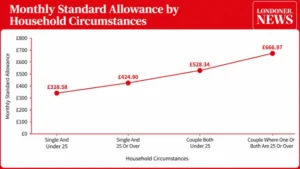
The standard monthly allowances for 2026/27 are:
| Household Circumstances | Monthly Standard Allowance |
| Single And Under 25 | £338.58 |
| Single And 25 Or Over | £424.90 |
| Couple Both Under 25 | £528.34 |
| Couple Where One Or Both Are 25 Or Over | £666.97 |
Additional amounts can then potentially be included for rent, children, childcare, caring responsibilities and limited capability for work, depending on your circumstances.
Your earnings are then taken into account.
If You Do Not Have a Work Allowance
Most claimants without children and without a qualifying health condition do not receive a work allowance.
Their Universal Credit is reduced by 55p for each £1 of earnings.
For example, someone aged 25 or over working 16 hours a week at £12.71 could earn around £881.23 a month.
The approximate earnings reduction would be:
£881.23 × 55% = £484.67
If that person only qualified for the £424.90 standard allowance and had no housing element or other UC additions, their earnings reduction would be greater than their maximum award.
Their Universal Credit would therefore normally fall to £0 for that assessment period.
However, someone with eligible housing costs could still receive Universal Credit because their maximum award could be substantially higher.
If You Have a Work Allowance
A work allowance may apply where you or your partner are responsible for a child or young person, or where a disability or health condition affects your ability to work.
For 2026/27, the monthly allowances are:
- £427 if your Universal Credit includes help with housing costs
- £710 if you do not receive a Universal Credit housing amount
These increased from £411 and £684 respectively in 2025/26.
Consider a claimant aged 21 or over earning approximately £881.23 a month from 16 hours of work.
With the £427 work allowance:
£881.23 − £427 = £454.23
£454.23 × 55% = £249.82 reduction
With the £710 work allowance:
£881.23 − £710 = £171.23
£171.23 × 55% = £94.18 reduction
This can make a significant difference to the amount of Universal Credit retained while working.
What Could Your Universal Credit Payment Look Like?
The easiest way to understand the calculation is to separate your maximum Universal Credit award from the earnings deduction.
Imagine your household’s total Universal Credit entitlement before earnings is £1,100 a month.
If your 16-hour job produces £881.23 in monthly earnings, the result could look roughly like this:
| Circumstances | Earnings Deduction | UC Remaining From £1,100 Maximum |
| No Work Allowance | £484.67 | £615.33 |
| £427 Work Allowance | £249.82 | £850.18 |
| £710 Work Allowance | £94.18 | £1,005.82 |
This is only an illustration. It does not mean someone working 16 hours will automatically have a £1,100 maximum award.
Your starting entitlement could be much higher or lower.
Housing costs can be particularly important for London households.
A claimant entitled to support towards rent may continue receiving Universal Credit at earnings levels where a person receiving only the standard allowance would receive nothing.
Eligible childcare costs can also increase the maximum award.
For 2026/27, the maximum Universal Credit childcare element is £1,071.09 a month for one child and £1,836.16 for two or more children, subject to the normal eligibility rules and the percentage of eligible costs covered.
What Else Can Change the Amount You Receive?
The number of hours worked is only one small part of the calculation.
Your final Universal Credit payment may be affected by:
- Your Partner’s Earnings: A joint claim considers earnings across the household
- Housing Costs: Eligible rent can increase your maximum Universal Credit award
- Children: Qualifying households can receive child elements and may receive a work allowance
- Health Conditions: Certain claimants can receive additional amounts and may qualify for a work allowance
- Childcare Costs: Working parents may be able to receive help with registered childcare
- Savings: Capital above £6,000 can reduce entitlement, while capital over £16,000 will normally prevent entitlement to Universal Credit
- Other Income: Some pensions and other income can affect the calculation
- Deductions: Advance repayments, benefit overpayments and certain debts can reduce the amount actually paid
- Pay Dates: Receiving more earnings than usual inside one assessment period can temporarily reduce that month’s UC payment
The £6,000 lower capital threshold and £16,000 upper capital limit remain in place for Universal Credit in 2026/27.
Weekly and four-weekly workers should pay particular attention to assessment periods.
Because Universal Credit is calculated monthly, there can occasionally be an assessment period containing more paydays than usual. GOV.UK warns that this can cause Universal Credit to fall for that month before changing again in a later assessment period.
Does Working 16 Hours Mean You Will Not Have to Look for More Work?
Not necessarily.
Universal Credit’s work requirements are also based partly on earnings rather than an old-style 16-hour threshold.
From April 2026, the Administrative Earnings Threshold (AET) is £991 per assessment period for an individual claimant and £1,597 for a couple.
The AET is measured using earnings before deductions for Income Tax, National Insurance and qualifying pension contributions.
Someone aged 21 or over working exactly 16 hours a week at the £12.71 National Living Wage earns an average of about £881 a month, which is below the individual £991 AET.
Depending on their circumstances, they may therefore still be expected to discuss increasing their earnings, finding additional hours or looking for better-paid work with their work coach.
That does not apply identically to everyone. Claimant commitments can differ considerably for parents, carers and people with health conditions or other circumstances affecting their work requirements.
The important distinction is that working 16 hours does not automatically determine either your Universal Credit payment or your work-related requirements.
For someone asking, “if I work 16 hours a week how much Universal Credit will I get?”, the most useful calculation is therefore:
Maximum Universal Credit entitlement − applicable earnings reduction − other deductions = estimated Universal Credit payment.
Your monthly Universal Credit statement provides the actual calculation for each assessment period, while a benefits calculator can provide a more personalised estimate before you change your working hours.
About the Journalist
Olivia covers London life, culture and lifestyle for Londoner. Her work includes food, shopping, neighbourhood trends, attractions, local experiences and practical guides for residents and visitors. She focuses on engaging stories that reflect everyday life across the capital.