Universal Credit Loophole £1500: DWP Rules Explained as Old Scam Claims Resurface
 Published By
Jermaine
Published By
Jermaine
Published:
Updated:

Table of Contents
Claims about a Universal Credit loophole £1500 payment have resurfaced online, creating confusion over whether people receiving benefits can legitimately claim an extra £1,500 from the Department for Work and Pensions.
The important answer for claimants in 2026 is that there is no official £1,500 Universal Credit loophole, bonus or automatic payment available under current DWP rules.
The phrase largely relates to an older form of Universal Credit fraud in which criminals exploited the benefits system to obtain advance payments, sometimes using other people’s identities.
DWP subsequently strengthened its anti-fraud controls. Government records show that an attack involving hijacked identities in May 2020 resulted in 152,000 fraudulent claims being suspended, preventing an estimated £1.9 billion from being paid to suspected scammers.
There are legitimate Universal Credit advances available today, but these are repayable and subject to eligibility rules. They should not be confused with claims of a free £1,500 payment.
The issue has renewed relevance as the DWP benefits closure programme moves more people from older means-tested benefits onto Universal Credit.
What Is the Universal Credit £1,500 Loophole?
The term Universal Credit £1,500 loophole is not an official DWP scheme.
It became associated with fraud targeting the Universal Credit advance-payment system, particularly during the period when benefit services faced exceptional pressure during the Covid pandemic.
Contemporary reports described criminals exploiting the system to secure advance payments, sometimes involving sums of around £1,500.
The Government later confirmed that organised criminals had used stolen identities and fraudulent Universal Credit claims during the pandemic.
That historical fraud appears to be the main reason searches for terms such as “Universal Credit loophole £1500” continue to circulate.
It should not be interpreted as a legitimate way for current claimants to obtain an additional £1,500.
Can Universal Credit Claimants Get an Extra £1,500 in 2026?
There is no standard £1,500 additional payment available simply because someone receives Universal Credit.
Universal Credit awards are calculated according to household circumstances, including age, relationship status, children, housing costs, earnings, health conditions and caring responsibilities.
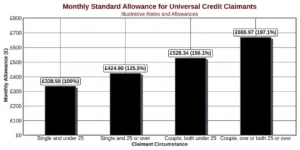
For 2026/27, the standard monthly Universal Credit allowances are:
| Circumstances | Monthly standard allowance |
| Single and under 25 | £338.58 |
| Single and 25 or over | £424.90 |
| Couple, both under 25 | £528.34 |
| Couple, one or both 25 or over | £666.97 |
Additional elements can increase a household’s total Universal Credit award, so some households may receive more than £1,500 in a month.
However, receiving a monthly award of £1,500 because of housing, children, health-related elements or other legitimate entitlement is completely different from an alleged £1,500 loophole payment.
Household finances also need to be viewed against the wider cost of living in London, where rent, energy, transport and everyday expenses can place considerably more pressure on low-income households.
Is There a Legitimate Universal Credit Advance?
Yes. There are legitimate Universal Credit advance payments, but they are effectively interest-free advances that normally have to be repaid.
Someone waiting for their first Universal Credit payment can apply for an advance if they need help covering bills or other costs.
The maximum first-payment advance is based on the amount of the claimant’s estimated first Universal Credit payment. There is no universal £1,500 maximum or guaranteed amount applying to everyone.
The amount therefore depends on individual circumstances.
For example, a household entitled to a larger Universal Credit award could potentially qualify for a larger advance than a single claimant receiving only the standard allowance.
But an advance is not free money.
Does a Universal Credit Advance Have to Be Repaid?
Yes.
A first-payment Universal Credit advance must normally be repaid from future Universal Credit awards.
Repayments usually begin from the claimant’s first payment and can continue over the permitted repayment period.
People experiencing difficulty with repayments may be able to discuss their circumstances with Universal Credit, but receiving an advance still creates an obligation to repay the money.
That is another important difference between a genuine Universal Credit advance and social-media claims suggesting there is a hidden £1,500 grant available to claimants.
What About the Universal Credit Budgeting Advance?
Existing Universal Credit claimants may also qualify for a Budgeting Advance if they face certain one-off costs.
This can be used for expenses such as furniture, essential household items, clothing, home repairs, funeral costs or some moving expenses.
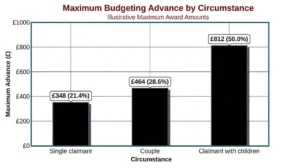
For 2026, the maximum Budgeting Advance amounts are:
| Circumstances | Maximum Budgeting Advance |
| Single claimant | £348 |
| Couple | £464 |
| Claimant with children | £812 |
The minimum available is £100.
This means the legitimate Budgeting Advance scheme also does not provide a standard £1,500 payment.
A Budgeting Advance normally has to be repaid through future Universal Credit payments.
Why Did the £1,500 Loophole Claim Start?
The £1,500 figure can be traced to reports about fraudulent Universal Credit advance claims rather than a special DWP entitlement.
During the pandemic, the Universal Credit system had to process an unprecedented surge in applications.
The Government said normal face-to-face checks were unavailable during parts of 2020 and that organised criminals attempted to exploit the system using stolen identities.
DWP later reported that its Cyber Resilience Centre identified a major attack in May 2020 and that intervention prevented around £1.9 billion from reaching people attempting to defraud the system.
The department also said fraud instruction material had been shared on social media, including material encouraging fraudulent benefit claims.
This history helps explain why references to a Universal Credit “loophole” continue to appear online years later.
Has the DWP Closed the £1,500 Universal Credit Loophole?
The emergency conditions that contributed to fraud risks during the pandemic are no longer the current operating model.
DWP reinstated standard verification procedures and developed additional systems for identifying suspicious claims.
The department has continued expanding fraud and error detection as Universal Credit becomes the main means-tested working-age benefit.
That transition has accelerated as Income Support, income-based Jobseeker’s Allowance and several other legacy benefits have either closed or moved into their final migration stages.
Not all benefit overpayments are fraud. Official DWP statistics distinguish between fraud, claimant error and official error.
Could Someone Be Asked to Repay a Fraudulent Universal Credit Payment?
Yes.
Money received through an incorrect or fraudulent claim can be recovered.
Universal Credit overpayments can result in money being deducted from future payments, while penalties may also apply depending on the circumstances.
Serious benefit fraud can result in investigation and prosecution.
People should therefore be particularly cautious about anyone offering methods to obtain money by submitting inaccurate information or manipulating a Universal Credit claim.
What If Someone Offers to Get You a £1,500 Universal Credit Payment?
Claimants should be wary if another person claims they can secure a guaranteed £1,500 Universal Credit payment in exchange for personal information, access to a Universal Credit account or part of the money.
The historical fraud associated with the supposed loophole involved identity abuse and fraudulent claims.
Claimants should never give someone sensitive information allowing them to take control of a Universal Credit account or submit false information on their behalf.
Applications for legitimate advances can be made through official Universal Credit channels.
There is no need to pay a third party to access a genuine DWP advance.
What Genuine Financial Help Can Universal Credit Claimants Get?
Although the £1,500 loophole is not a legitimate benefit, several official forms of support may be available depending on circumstances.
| Type of help | What it does |
| First-payment advance | Helps while waiting for the first Universal Credit payment |
| Budgeting Advance | Helps with qualifying one-off essential costs |
| Hardship payment | May help where Universal Credit has been reduced or stopped in specified circumstances |
| Change-of-circumstances advance | May be available when entitlement is due to increase |
| Job expense support | May help with certain costs connected with starting or remaining in work |
Claimants struggling with wider household costs may also have access to council support or other cost-of-living schemes depending on where they live and their circumstances.
Transport costs can also form a substantial part of household spending. Separate Government measures include plans for the £2 bus fare cap to return across participating services in England outside London from January 2027.
These measures are genuine forms of assistance or cost reduction, unlike claims of a hidden £1,500 Universal Credit payment.
Have Universal Credit Repayment Rules Changed?
One significant change already affecting Universal Credit households is the Fair Repayment Rate.
From 30 April 2025, the Government reduced the overall maximum amount normally deducted from the Universal Credit standard allowance for certain debts from 25% to 15%.
The change was intended to allow affected households to keep more of their monthly Universal Credit payment while still repaying qualifying debts and advances.
These repayment changes are genuine developments within Universal Credit, but they do not create a £1,500 entitlement.
Universal Credit Loophole £1500 Facts at a Glance
| Claim | Current position in 2026 |
| Everyone on Universal Credit can claim £1,500 | False |
| There is an official £1,500 loophole | No |
| The £1,500 claim has links to historic fraud reports | Yes |
| Universal Credit advances exist | Yes |
| A first-payment advance is free money | No |
| First-payment advances normally have to be repaid | Yes |
| Maximum Budgeting Advance with children | £812 |
| Maximum first-payment advance | Up to the estimated first UC payment |
| DWP investigates fraudulent claims | Yes |
Can Universal Credit Payments Be More Than £1,500 a Month?

Yes, but this should not be confused with the supposed loophole.
Universal Credit consists of a standard allowance plus any additional elements for which the household qualifies.
Depending on circumstances, these can include amounts connected with:
- children;
- rent or other eligible housing costs;
- caring responsibilities;
- childcare costs; and
- qualifying health conditions.
As a result, some households can legitimately receive total monthly awards above £1,500.
There is therefore an important difference between a household being legally entitled to more than £1,500 in Universal Credit and a supposed hidden £1,500 payment that anybody can obtain through a loophole.
The second claim is not supported by current Universal Credit rules.
What Happens if Someone’s Wages Increase?
Universal Credit is means-tested, meaning earnings can affect the amount a claimant receives.
For employees, Universal Credit generally reduces as earnings rise once any applicable work allowance has been taken into account.
That means a pay rise can increase gross wages while also changing the amount of Universal Credit received.
For example, some London healthcare workers receiving Universal Credit alongside employment could see their entitlement change following the latest NHS pay rise.
The precise impact depends on earnings, household circumstances, applicable work allowances and other elements in the Universal Credit award.
What Should Claimants Do If They Think They Are Missing Money?

People who believe their Universal Credit payment has been calculated incorrectly should use official channels rather than online “loopholes”.
A claimant can check their Universal Credit statement and journal to see how their award has been calculated.
Universal Credit amounts can change because of:
- earnings;
- deductions;
- housing costs;
- children;
- childcare;
- health-related elements;
- caring responsibilities; and
- changes in household circumstances.
Where a claimant believes a formal Universal Credit decision is wrong, they may also have the right to request a mandatory reconsideration.
Why Claimants Should Be Careful With Social Media Advice?

Universal Credit rules are complex, which can make misleading social-media posts appear convincing.
Posts describing a “hack”, “method”, “trick” or “loophole” should be treated particularly carefully when they involve:
- changing information on a claim;
- falsely reporting housing costs;
- inventing dependants or childcare expenses;
- allowing another person into a Universal Credit account;
- using somebody else’s identity;
- hiding income or savings; or
- paying someone a percentage of a supposed benefit payment.
A legitimate entitlement does not require a claimant to provide false information.
Where extra support exists, it will normally be explained through DWP, GOV.UK, a claimant’s Universal Credit journal or another recognised support service.
The £1,500 Universal Credit Claim Is Not a New DWP Payment
For anyone seeing headlines or social posts about a Universal Credit loophole £1500, the most important point is that there is no new £1,500 DWP payment available to every claimant in 2026.
The phrase is primarily connected with historical fraud involving Universal Credit advance payments rather than a current benefit rule.
Legitimate financial assistance does exist. Someone waiting for their first Universal Credit payment may qualify for a first-payment advance, while existing claimants facing qualifying one-off expenses may be eligible for a Budgeting Advance.
Both are subject to eligibility requirements and normally have to be repaid.
Claimants should therefore use their official Universal Credit account, Jobcentre or GOV.UK guidance when seeking extra help and should be cautious of anyone presenting the historic £1,500 loophole as a legitimate route to free government money.
About the Journalist
Jermaines covers crime, legal affairs and money-related stories for Londoner. His reporting includes police updates, court cases, consumer rights, personal finance and cost-of-living issues. He handles sensitive subjects carefully and clearly distinguishes confirmed facts from allegations, estimates and ongoing investigations.