DWP Benefits Closure: Which Benefits Have Ended and What Happens Next?
 Published By
Henry
Published By
Henry
Published:

Table of Contents
The DWP’s closure of legacy benefits has reached its final stages, with Income Support and income-based Jobseeker’s Allowance already ended and most remaining claimants being moved to Universal Credit. Income-related Employment and Support Allowance and most working-age Housing Benefit cases are also being closed, although important exceptions remain for some people in temporary or supported accommodation and claimants who require additional help to manage their benefits.
The Department for Work and Pensions has moved closer to completing one of the biggest changes to the working-age benefits system in decades.
Under the Move to Universal Credit programme, several older means-tested benefits — commonly described as legacy benefits — have been replaced by Universal Credit.
In its official announcement on the closure of historical benefits, the DWP confirmed that more than 1.9 million people had been moved from legacy benefits through the managed migration programme since migration restarted in May 2022.
That figure included around 135,000 people receiving Income Support or income-related Jobseeker’s Allowance.
For claimants, however, references to a “DWP benefits closure” can be confusing because different benefits have ended at different stages and some exceptions continue to apply.
The changes also come while household finances remain under pressure from housing, energy, food and transport costs. Separate measures affecting everyday spending include plans for capped bus fares across England outside London to fall to £2 from January 2027.
Which DWP Benefits Have Closed?

The government’s Universal Credit rollout was designed to bring several means-tested working-age benefits into one system rather than continuing separate claims administered through different parts of government and local authorities.
The main legacy benefits affected have included:
- Income Support
- income-based Jobseeker’s Allowance
- income-related Employment and Support Allowance
- Housing Benefit for most working-age claimants
- Working Tax Credit
- Child Tax Credit
Tax credits ended earlier in the migration process, while Income Support and income-based JSA ended by 31 March 2026.
The remaining stage has principally involved people receiving income-related ESA and working-age Housing Benefit.
Income Support and Income-Based JSA
Income Support and income-based Jobseeker’s Allowance are now closed as legacy benefits.
The DWP said the closure marked the end of two benefits introduced decades ago and formed part of its transition towards Universal Credit as the principal means-tested benefit for people of working age.
Importantly, the closure concerns income-based JSA, rather than every form of Jobseeker’s Allowance.
New Style JSA continues to exist separately and is based mainly on a claimant’s National Insurance contribution record rather than being one of the income-related legacy benefits replaced through managed migration.
The same distinction is important when considering ESA.
Is Employment and Support Allowance Closing?

References to the DWP benefits closure do not mean every form of Employment and Support Allowance has disappeared.
The legacy benefit being phased out is income-related Employment and Support Allowance, often abbreviated to ESA(IR).
People receiving income-related ESA have been among the final groups moved through the managed migration programme.
According to the DWP’s June 2026 update on the Move to Universal Credit programme, 879,000 households receiving income-related ESA had been issued Migration Notices by December 2025, with most already having made a Universal Credit claim.
Does New Style ESA Still Exist?
Yes. New Style ESA is different from income-related ESA.
New Style ESA is primarily contribution-based and is not being abolished as part of the legacy-benefit closure programme.
This distinction is particularly important for people searching online for information about an “ESA closure”. A person receiving New Style ESA should not assume their benefit is ending simply because income-related ESA is being replaced.
For those moving directly from income-related ESA to Universal Credit, existing Work Capability Assessment decisions can also continue to be relevant in certain circumstances.
The government’s Migration Notice guidance explains that some claimants who move without a break and have already completed a Work Capability Assessment will not automatically need another assessment simply because they have moved onto Universal Credit.
A further assessment could still become necessary where a review is due or circumstances change.
Has Housing Benefit Closed in 2026?

Housing Benefit requires particularly careful explanation because it has not disappeared for everybody.
The government introduced legal changes closing working-age Housing Benefit for most people outside particular categories from 1 July 2026.
The DWP’s official guidance on the closure of working-age Housing Benefit confirms that the closure generally applies to working-age claimants who are not living in temporary accommodation or specified accommodation.
In many standard private and social rented housing situations, help with eligible rent is now instead dealt with through the housing-cost element of Universal Credit.
However, significant exceptions remain.
Who Can Still Receive Housing Benefit?
Housing Benefit can continue in circumstances including certain temporary and supported accommodation cases.
This matters because the way accommodation is classified can determine whether housing costs continue to be paid through the local authority Housing Benefit system or are included within Universal Credit.
The government also states that Housing Benefit awarded to people over the qualifying age for Pension Credit is not abolished by the working-age closure order.
Certain protected mixed-age couples are also outside the general closure rule.
There are additional limited exceptions for particular working-age cases. These include certain claimants receiving income-related ESA who had, or needed, an appointee immediately before the closure date, as well as some people in prison or hospital under specified circumstances.
Someone uncertain about whether their accommodation counts as supported or temporary accommodation should therefore contact their local council rather than assuming their Housing Benefit must end.
What Happens When Someone Receives a Migration Notice?
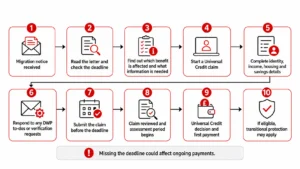
A Migration Notice is a formal DWP letter telling a claimant that one or more existing benefits are ending and that they need to claim Universal Credit.
It should not be treated as a general information letter.
The deadline shown on the Migration Notice is important because a claimant is not automatically transferred onto Universal Credit.
Government guidance for people who receive a Migration Notice says a Universal Credit claim normally needs to be made by the deadline stated in the letter to continue receiving financial support and qualify for any applicable transitional protection.
If a person chooses not to claim Universal Credit, the legacy benefit can still end.
Can the Migration Deadline Be Extended?
A person who has a genuine reason why they cannot make their Universal Credit claim by the stated deadline may be able to ask for additional time.
The request should normally be made before the existing deadline expires.
Extensions are not automatic and depend on the claimant’s circumstances, so anyone struggling to complete a claim should contact the Migration Notice Helpline or use the contact details included in their letter as early as possible.
The DWP has also identified a relatively small group requiring more substantial assistance.
Its June 2026 local authority bulletin said around 500 claimants had been identified as needing additional support through a Personal or Corporate Acting Body.
Those claimants were temporarily exempted from the June closure deadline while appropriate arrangements were put in place.
That exemption was described as temporary rather than indefinite.
What Is Transitional Protection?

One of the biggest concerns for people moving from legacy benefits is whether their income will immediately fall.
Universal Credit has different rules, allowances and calculations from the benefits it replaces, which means entitlement does not necessarily match pound-for-pound.
Transitional protection is intended to reduce the immediate financial impact for eligible managed-migration claimants.
Where someone’s calculated Universal Credit entitlement is lower than the amount covered by their previous benefits, a transitional element may be added to their Universal Credit award.
A claimant generally does not need to submit a separate application for the transitional element.
However, receiving a Migration Notice and making the Universal Credit claim within the required timeframe can be crucial to eligibility.
Transitional protection should also not be interpreted as a guarantee that someone will permanently receive exactly the same amount. The transitional element can change or erode over time as other elements of the Universal Credit award increase or circumstances change.
Claimants concerned about the amount they may receive can use an independent benefits calculator, although calculator results are estimates and should not be treated as a final DWP decision.
Which Benefits Are Not Closing?
The phrase “DWP benefits closure” can create the mistaken impression that Universal Credit is replacing virtually every benefit administered by the department.
It is not.
Several major benefits operate separately from Universal Credit.
For example, Personal Independence Payment is not being abolished through the legacy-benefit migration programme.
PIP is intended to help eligible people with additional costs associated with long-term health conditions or disabilities and is assessed separately from Universal Credit.
Carer’s Allowance also remains a separate benefit, while New Style ESA and New Style JSA continue under their respective eligibility rules.
State Pension is likewise not being replaced by Universal Credit.
The government’s main Universal Credit information should therefore be checked alongside information about the specific benefit a person currently receives.
What Should Claimants Do Now?
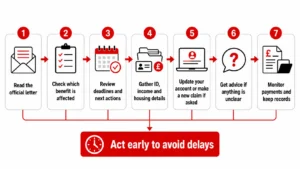
Anyone affected by the DWP benefits closure should first identify exactly which benefit they currently receive.
Similar names can refer to benefits operating under very different rules. Income-related ESA and New Style ESA, for example, should not be treated as interchangeable.
People should then check whether they have received a Migration Notice.
Where a notice has arrived, the deadline printed on it should be treated seriously. Claimants who need extra help should contact the official support channels listed by the DWP before the deadline rather than waiting until payments have stopped.
Those receiving Housing Benefit should also establish whether they live in temporary or specified supported accommodation before assuming that their housing support is moving entirely to Universal Credit.
Most importantly, claimants should rely on correspondence from the DWP, their local council and current GOV.UK benefit guidance, rather than acting solely on social-media posts or headlines saying that “DWP benefits are closing”.
The legacy-benefit system is nearing the end of its long transition, but the position remains more nuanced than a single closure date.
Income Support and income-based JSA have ended, income-related ESA is being replaced through migration, and most working-age Housing Benefit outside specified exceptions has closed.
Other benefits — including PIP, New Style ESA, New Style JSA and Housing Benefit for certain accommodation categories — continue to operate.
About the Journalist
Henry is the editorial head and lead author at Londoner. He oversees the publication’s editorial direction, article quality, source verification and corrections process. He also reviews major stories before publication to ensure they meet Londoner’s standards for accuracy, fairness and transparency.