London Palestine Student Protest: 11 Arrested After Russell Square Clashes
 Published By
Henry
Published By
Henry
Published:
Updated:
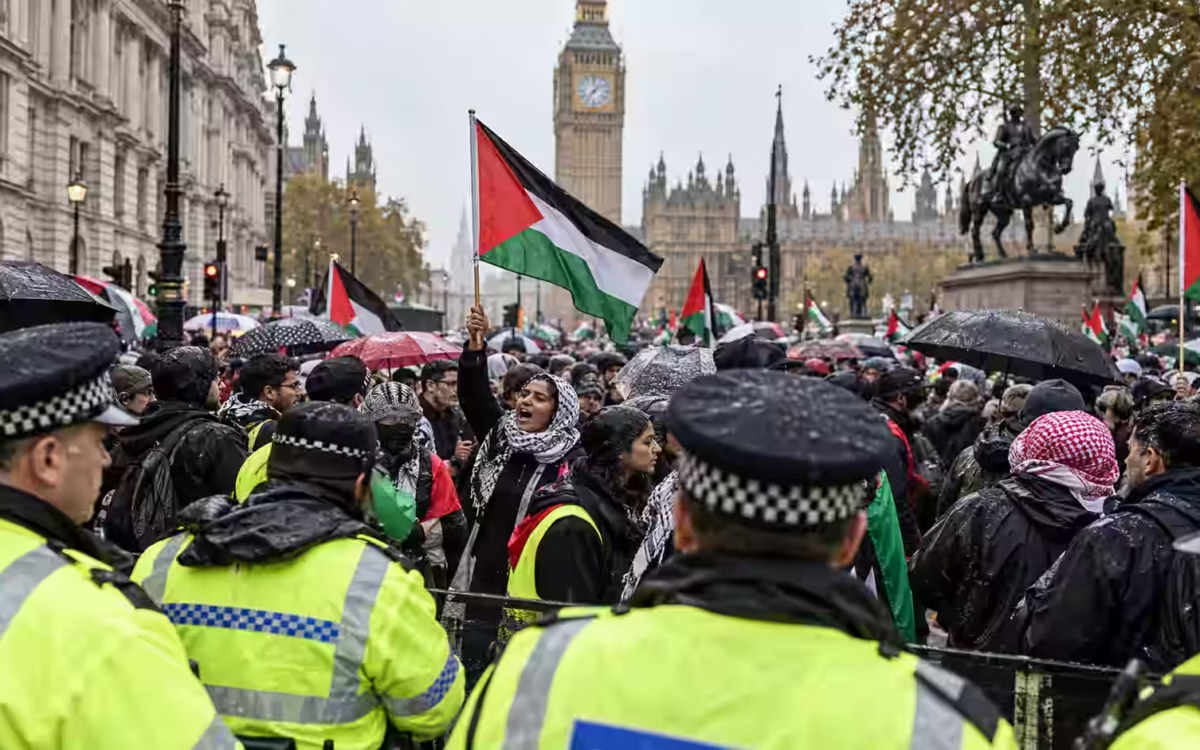
Table of Contents
Eleven people were arrested during demonstrations across London as pro-Palestinian student protesters marched towards Russell Square on the third anniversary of the October 7 Hamas attacks on Israel, despite repeated requests from police and political figures for the protest to be moved to another day.
Around 100 pro-Palestinian demonstrators took part in the central London march on Wednesday, 7 October, according to reporting from the scene, travelling from Lincoln’s Inn Fields towards Russell Square under strict conditions imposed by the Metropolitan Police.
Counter-protesters carrying Israeli flags gathered near Russell Square, where the two sides exchanged chants as a significant police presence attempted to keep the groups apart.
The student demonstration was organised under the banner of the University of London Coalition, which brings together pro-Palestinian student groups from universities across the capital.
The coalition had urged supporters to “take to the street” and said it wanted to “demand an end to the Palestinian genocide”, describing its campaign as one supporting Palestinian liberation.
The timing proved highly contentious because Wednesday marked exactly three years since Hamas-led militants attacked southern Israel on 7 October 2023, killing around 1,200 people and taking 251 hostages.
Jewish organisations and politicians had therefore urged students to demonstrate on another date, while protesters argued that the continuing consequences of the war in Gaza made it necessary to continue publicly campaigning for Palestinians.
The march nevertheless went ahead.
Students carrying Palestinian flags moved through central London while chanting slogans including “free, free Palestine” and “free the people, free the land”.
A group towards the rear of the demonstration also carried a banner reading:
“Holocaust survivor descendants against Gaza genocide.”
Counter-demonstrators gathered around Russell Square with Israeli flags, and verbal confrontations developed between some members of the two groups.
Police officers positioned themselves between demonstrators as tensions increased. Both the main student protest and the nearby counter-demonstration had largely dispersed by around 2pm.
Why Were 11 People Arrested?
The final arrest figure covered several demonstrations taking place in London rather than only the Russell Square student march.
This distinction is important because early reports referred to two or three arrests before the Metropolitan Police later confirmed a total of 11 across the day’s demonstrations.
Police said five people were arrested for alleged incitement to racial hatred during a separate spontaneous protest outside the Board of Deputies of British Jews in Camden.
Officers said the arrests related to people allegedly shouting or chanting slogans calling for “intifada”.
Those arrests were separate from the main University of London Coalition procession between Lincoln’s Inn Fields and Russell Square.
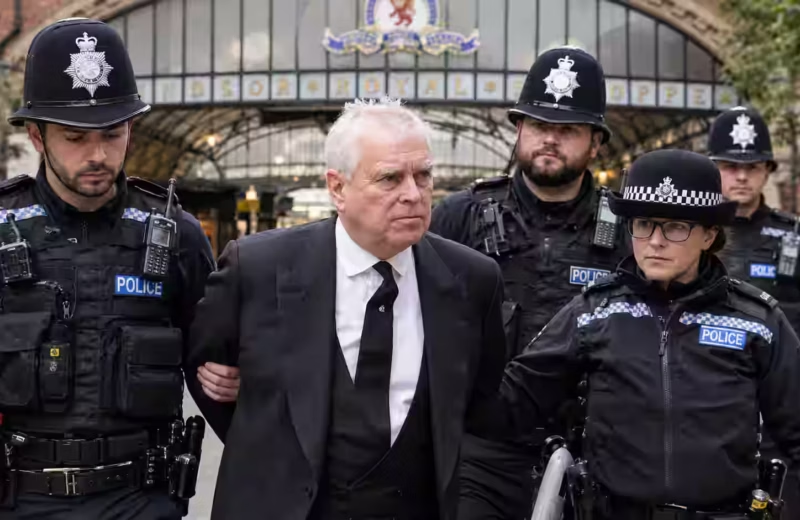
At the student march itself, the Met later said five people had been arrested for breaching protest conditions.
A further person was arrested under Section 60AA of the Criminal Justice and Public Order Act after allegedly failing to remove a face covering when required by an officer.
That brought the total across the various demonstrations to 11.
Police acknowledged criticism that officers had not immediately arrested everyone wearing face coverings.
The force said officers first engaged with demonstrators and instructed them to remove coverings concealing their identities. According to the Met, most complied with those warnings, while one person who allegedly failed to do so was arrested.
Three students were also seen being placed into a police van near Tottenham Court Road station after the main demonstrations had largely dispersed, according to reporting from the scene.
The arrests followed unusually detailed restrictions imposed by Scotland Yard before the march even began.
Participants were required to assemble in Lincoln’s Inn Fields by 12.30 pm.
From there, police ordered demonstrators to follow one prescribed route:
Lincoln’s Inn Fields → Remnant Street → Kingsway → Southampton Row → Russell Square.
The procession was not permitted to deviate from that route.
Once protesters reached Russell Square, they were required to remain within a specified assembly area, with the rally ordered to finish by 2pm.
The Met imposed the route restriction using Section 12 of the Public Order Act 1986, while conditions governing where protesters could assemble were imposed under Section 14.
The face-covering restriction added another layer to the policing operation.
Before the march, Deputy Assistant Commissioner James Harman, who leads Met public-order operations, gave protesters a direct warning:
“Anyone who breaches these conditions or commits offences should be under no illusion they will face arrest.”
Harman also said the force had “zero tolerance for hate crime”.
Why Didn’t Police Ban the Palestine Protest?
One of the biggest questions surrounding the demonstrations was why the Metropolitan Police allowed the march to proceed after senior figures and Jewish organisations called for it to be stopped.
The legal position was more complicated than simply deciding whether the event was appropriate.
The Met stressed before Wednesday’s demonstration that police do not have an unrestricted power simply to ban a protest because its timing is controversial or distressing.
For a procession to be prohibited, police would have to conclude that there was a sufficiently serious risk of public disorder that could not be controlled through lesser measures and then seek action from the Home Secretary.
The Met’s assessment was that the threshold had not been reached.
Harman said:
“The police cannot ban protests and can only ask the Home Secretary to do so if the risk of serious disorder is so high.”
He added:
“That high bar is not met here.”
Instead, police used extensive conditions governing the march’s starting point, route, finishing time and face coverings.
That distinction also explains why calls from some politicians for the march to be “banned” did not automatically result in cancellation.
The police position was that restrictions available under public-order legislation were sufficient to manage the risks identified.
There was another unusual issue: police said they had struggled to identify an individual prepared to formally accept responsibility for organising the march.
Under Section 11 of the Public Order Act 1986, organisers of certain public processions are required to provide police with information including a name and address.
The Met said it could identify the student organisations promoting the demonstration through their social-media activity, but had not identified a specific individual willing to accept that they were the organiser.
Police said that failure did not, by itself, provide sufficient legal grounds to prohibit the entire procession.
Harman said officers could consider potential Section 11 offences once organisers had been identified.
That detail received considerably less attention than the clashes themselves but could become relevant if police continue investigating how the event was organised.
Why Did the October 7 Date Cause Such Controversy?
The march had attracted criticism long before protesters reached Russell Square.
Police repeatedly asked organisers to move it away from 7 October, arguing that the anniversary would be a day of mourning for Jewish communities.
The Met also wrote to four London universities asking them to take reasonable steps to prevent Jewish students and staff feeling targeted, unsafe or excluded around the demonstrations.
Raphi Leon, president of the Union of Jewish Students, was among the strongest critics of the chosen date.
He said:
“There are 365 days of the year. The decision to protest on this day is provocative, deliberate.”
Leon said the UJS would work to protect Jewish students amid what it regarded as increasing hostility on campuses.
Education Secretary Lucy Powell had also urged the students beforehand to “show compassion and respect for others” by moving their protest to another date.
The student coalition did not abandon the event.
Its supporters instead centred their protest on the enormous Palestinian death toll and devastation in Gaza since the war began following the 2023 attacks.
Israel’s subsequent military campaign has killed tens of thousands of Palestinians and displaced much of Gaza’s population. Gaza health authorities reported last month that the death toll had passed 74,000.
The description of Israel’s actions as “genocide”, used by the student coalition and demonstrators, remains part of an intensely contested political and legal debate; reporting the protesters’ language does not itself establish a legal finding.
The competing interpretations of October 7 were visible on London’s streets throughout Wednesday.
For Jewish groups, the date centred on remembering those murdered or abducted during the Hamas attack.
For pro-Palestinian protesters, the demonstration was also intended to highlight Palestinian deaths, displacement and the actions of the Israeli government since the attack.
That collision of meanings was one reason the Met had urged students to choose another day.
At a separate vigil near Whitehall commemorating victims of the October 7 attack, Phil Rosenberg, president of the Board of Deputies of British Jews, told those attending:
“By all means, seek to pursue peace in the Middle East, we all want that.”
He went on to strongly criticise those he believed were placing responsibility for the war solely on Israel.
Police remained deployed around the vigil and warned that hate crime directed at those attending would be dealt with using a “zero-tolerance approach”.
The demonstrations also occurred against a wider backdrop of concern about antisemitism in Britain.
Figures published by the Community Security Trust showed 1,926 antisemitic incidents across the UK during the first six months of 2026, around a fifth more than during the equivalent period a year earlier and the second-highest first-half total the organisation has recorded.
At the same time, pro-Palestinian groups continue to argue that the scale of civilian deaths and destruction in Gaza makes continued demonstrations necessary and that restrictions should not prevent legitimate political protest.
That leaves police attempting to manage several competing rights and risks simultaneously: the legal right to protest, protection against hate crime, public order and the safety of communities affected by the conflict.
Wednesday’s events showed how difficult that balance can become.
The Russell Square student Palestine protest ultimately ended without the major disorder some had feared, with the main groups dispersing around the deadline imposed by police.
But 11 arrests across London’s demonstrations, confrontations between rival protesters and disputes over whether police should have gone further ensured that the controversy did not end when demonstrators left Russell Square.
The Metropolitan Police’s handling of the march is likely to remain under scrutiny, particularly over enforcement of face-covering restrictions and whether officers used the full range of powers available to them.
What is clear from the police’s own explanation is that the decision to permit the procession was not an endorsement of its timing or message.
The force concluded that the legal threshold required to seek a ban had not been met and chose instead to impose tightly controlled conditions.
For Londoners following the demonstrations, that distinction is central to understanding what happened: police allowed a lawful protest to proceed under restrictions, while arresting individuals suspected of breaking those restrictions or committing separate offences.
As of the morning of 8 October 2026, the Met has confirmed 11 arrests across the demonstrations connected with Wednesday’s events, while investigations into the alleged offences continue.
About the Journalist
Henry is the editorial head and lead author at Londoner. He oversees the publication’s editorial direction, article quality, source verification and corrections process. He also reviews major stories before publication to ensure they meet Londoner’s standards for accuracy, fairness and transparency.