The Truth Behind Andy Burnham’s Social Care Funding Plan
 Published By
Jermaine
Published By
Jermaine
Published:
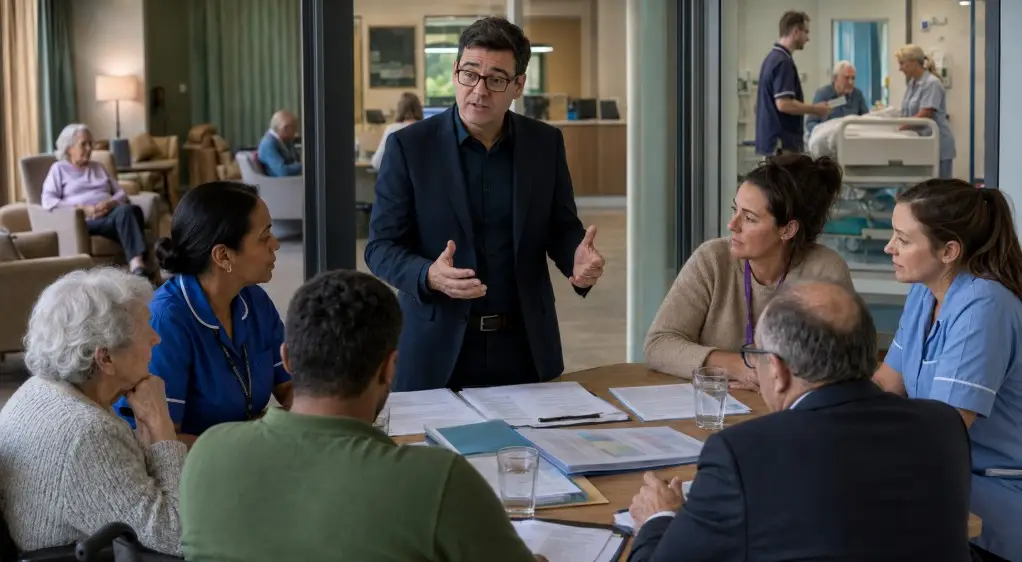
Table of Contents
Prime Minister Andy Burnham has begun a cross-party effort to reform England’s adult social care system, arguing that governments can no longer postpone decisions about how care should operate or who should pay for it.
Burnham has invited Conservative leader Kemi Badenoch and Liberal Democrat leader Ed Davey to take part in discussions intended to find common ground on long-term reform.
He is also supporting the Independent Commission on Adult Social Care, led by Baroness Louise Casey, as it develops recommendations for a National Care Service.
However, no final Andy Burnham social care funding model has been announced. The government has not confirmed a new care tax, an inheritance tax increase, an estate levy, a National Insurance rise or a date when a new care system would begin.
The confirmed announcement is the start of a political and public reform process, rather than the introduction of a fully costed funding policy.
What Has Andy Burnham Announced About Social Care?

During a care-home visit on Wednesday, 29 July 2026, Burnham is setting out his intention to seek a cross-party settlement for adult social care in England.
The official government social care announcement says the Prime Minister wants political parties to focus on “problem-solving, not point-scoring” after decades in which governments have struggled to deliver lasting reform.
Burnham said previous administrations had treated social care as too politically risky, financially difficult and administratively complicated. He argued that the consequences of continued delay were being felt by carers, families and the NHS.
The announcement confirms four immediate steps:
| Confirmed action | What it means |
| Cross-party discussions | Burnham has invited the leaders of the two main opposition parties to discuss reform |
| Independent Commission | Baroness Louise Casey will continue developing recommendations for adult social care |
| National Care Service proposals | The commission will consider how a National Care Service could be delivered |
| Big Conversation on Care | Members of the public will be invited to help shape the values and principles of a future system |
The announcement does not set a new tax rate, introduce free social care or change the current financial assessment rules.
Has Andy Burnham Announced How Social Care Will Be Funded?
No. Burnham has committed his government to pursuing reform, but the method of paying for a new system remains unresolved.
The government has not confirmed whether additional funding would come from:
- General taxation
- National Insurance
- A dedicated social care levy
- Compulsory social insurance
- Property or wealth taxation
- Inheritance tax reform
- Existing NHS and council budgets or a combination of several funding sources.
Burnham’s 29 July announcement is focused on building political agreement and beginning a public conversation. According to coverage of the cross-party social care talks, the Prime Minister is not expected to present a complete funding package at this stage.
This distinction matters because reported funding ideas should not be treated as confirmed government policy.
What Is the Big Conversation on Care?
The Big Conversation on Care is a public engagement process being launched by Baroness Louise Casey as part of the Independent Commission on Adult Social Care.
It will allow people to express their views on what an adult social care system should provide and the principles that should underpin it. The government says it will be open to everyone through a new online platform.
Responses may come from:
- People who receive care
- Disabled adults
- Older people
- Unpaid carers
- Family members
- Social care workers
- Care providers
- Local authorities
- NHS professionals and members of the wider public.
The first stage will focus on the values people should be able to expect from a care system. Later policy discussions are likely to address more difficult questions about eligibility, personal contributions, workforce conditions and public funding.
Baroness Casey has warned that reform is about more than simply putting extra money into the existing structure. She said people were already paying for the system’s failures through council tax, pressure on the NHS, personal savings, lost employment and the sale of homes.
What Is the Independent Commission on Adult Social Care?

The Independent Commission on Adult Social Care is chaired by Baroness Louise Casey and has been asked to develop practical recommendations for reform in England.
Its original terms of reference divide the work into two phases. The first phase is intended to explain how a National Care Service could be implemented and to make recommendations that can be introduced over time.
The commission is also considering:
- How existing local authority and NHS funding is used
- How can care become more preventative
- How families and care recipients can have more control
- How services for older people differ from those needed by working-age disabled adults
- How councils, the NHS and providers should be held accountable
- And how reform could be introduced over a period of several years
The commission’s official terms of reference state that its work should support the development of a National Care Service while recognising that different groups have different care needs.
What Would a National Care Service Provide?
A National Care Service could create more consistent standards across England, but its exact design has not been decided.
At present, councils commission much of England’s publicly funded adult social care. Eligibility, local provider markets and the availability of support can vary considerably between areas.
A national system could potentially introduce:
- Common eligibility principles
- National quality standards
- Clearer workforce expectations
- More consistent care-worker training
- Improved integration with the NHS
- Greater portability when someone moves between council areas
- And clearer rules about what the state and the individual must pay.
Burnham is reportedly interested in applying the “NHS principle” to social care. This may suggest a system in which more support is available according to need rather than ability to pay, although he has not yet defined precisely which services would be free.
A fully universal system, free at the point of use, would be very different from a system that only covers personal care or limits an individual’s lifetime costs.
How Is Social Care Currently Funded in England?
Adult social care in England is currently funded through a mixture of council resources, central government support and payments made by individuals.
Funding sources include:
| Current funding source | How it is used |
| Council tax | Councils use part of their general revenue to fund local services |
| Adult social care precept | Local authorities can raise additional council tax for social care |
| Government grants | Central government provides funding through settlements and targeted programmes |
| Business rates | Retained local business-rate income contributes to council budgets |
| NHS funding | NHS resources support services where health and social care overlap |
| Individual payments | People may pay part or all of their care costs following a financial assessment |
Unlike most NHS treatment, adult social care is not automatically free.
A local authority normally carries out a care-needs assessment and, where appropriate, a financial assessment. The financial assessment considers a person’s income, savings and other capital.
For the 2026/27 financial year, the upper capital limit remains £23,250, while the lower capital limit is £14,250. A person with capital above £23,250 will generally be expected to pay the full cost of permanent residential care.
A person with capital between £14,250 and £23,250 may receive support but must contribute from income and capital. Capital below £14,250 is generally disregarded, although income may still be taken into account.
The government’s 2026/27 social care charging rules explain how the limits are applied. Individual circumstances, property rules, disability-related expenses and the type of care being provided can affect the final assessment.
Why Does Social Care Funding Affect the NHS?
Burnham has warned that the NHS could become unsustainable without significant social care reform. Hospitals depend on community services, home-care providers, rehabilitation teams and care homes to support patients who are medically ready to leave.
When appropriate care cannot be arranged, patients may remain in hospital even though they no longer need an acute hospital bed.
This can contribute to:
- Delayed hospital discharges
- Pressure on emergency departments
- Ambulance handover delays
- Reduced availability of beds
- Postponed operations
- And additional pressure on NHS staff.
Burnham told the BBC that the NHS would “collapse” without social care reform, although he did not commit to completing a new system before the next general election. Reuters also reported that he sees reform as necessary because some people remain in hospital when they could be supported elsewhere.
Investment in social care could reduce some NHS pressures, but savings would not necessarily appear immediately. Councils and care providers would first need enough workers, suitable accommodation, stable contracts and effective discharge arrangements.
Could Social Care Become Free at the Point of Use?
It is one of the options being discussed, but it has not been adopted as government policy.
A fully universal model could make eligible social care free regardless of income, savings or property ownership. This would offer the greatest protection against high care costs but would also require the largest increase in public spending.
Published estimates cited in an analysis of how England could pay for social care reform suggest an NHS-style system could require around £18.5 billion a year in additional spending by 2035/36.
That figure is an estimate rather than a confirmed Burnham government budget. The eventual cost would depend on eligibility, workforce pay, demand, accommodation charges and which services were included.
Could England Adopt Scotland’s Free Personal Care Model?
A more limited option would be to fund eligible personal care while continuing to charge for some accommodation and living costs.
Scotland provides free personal care to adults who are assessed as needing it. This can cover support with personal hygiene, eating, medication and general wellbeing.
It does not mean every cost associated with residential care is paid by the state. Care-home accommodation, food and other living costs may still be charged separately.
Extending a similar model to people aged over 65 in England has been estimated to require approximately £7.5 billion in extra annual spending by 2035/36. This is a policy estimate, not an announced government commitment.
Could Burnham Introduce a Lifetime Care-Cost Cap?
A lifetime cap is another possible reform.
Under this model, the amount a person is required to spend on eligible care would be limited. Once the cap was reached, the state would take on a greater share of qualifying costs.
A previous plan would have introduced an £86,000 lifetime cap and increased the upper capital limit to £100,000. Those changes were not implemented.
A cap would not necessarily cover all spending. Daily living costs, accommodation charges and spending above the amount a council considers necessary could remain outside the limit.
A revived care-cost cap has been estimated to cost the government around £4 billion a year by 2035/36, making it less expensive than universal free care but also less comprehensive.
Is Andy Burnham Planning a 10% Estate Levy?

Burnham has not announced a 10% estate levy.
The idea has attracted attention because of a proposal associated with Burnham when he served as health secretary in 2010. One version of the proposal involved replacing inheritance tax with a lower levy applied to a wider range of estates to help fund a National Care Service.
Recent reports have suggested that the historic proposal could return. The Guardian reported that Burnham had not initially ruled out the option and that a widely applied levy might raise up to £18 billion. The Telegraph characterised the possibility as an inheritance tax “raid”.
However, the official 29 July government announcement does not mention:
- A 10% estate levy
- Inheritance tax reform
- A “death tax”
- Property taxation or a confirmed care levy.
The estate-tax discussion should therefore be understood as speculation about one possible funding route, not a policy that has been announced or enacted.
Families should not make gifting, inheritance or estate-planning decisions solely in response to political reporting. Any tax reform would require a formal government proposal, detailed legislation and clear implementation rules.
What Are the Main Social Care Funding Options?
The government and the Casey Commission could examine several approaches.
| Funding option | Potential advantage | Main concern | Current status |
| General taxation | Spreads costs across the tax system | Competes with other public spending | Not confirmed |
| National Insurance | Creates a visible contribution mechanism | Places more pressure on workers and employers | Not confirmed |
| Dedicated care levy | Makes the purpose of the tax clearer | May still be politically difficult | Not confirmed |
| Social insurance | Could provide a long-term contributory fund | Requires complex transition rules | Not confirmed |
| Estate or inheritance levy | Links contributions to accumulated wealth | Could affect estates that currently pay no inheritance tax | Not confirmed |
| Free personal care | Protects people from some major costs | Does not cover every care-home expense | Under discussion |
| Lifetime cost cap | Protects against extremely high eligible costs | Does not make care universally free | Under discussion |
| NHS-style universal care | Offers the broadest protection | Requires substantial long-term funding | Under discussion |
A final settlement could combine several of these options rather than relying on one source of revenue.
What Could Reform Mean for Families?
The effect on families will depend on which model is selected.
A more generous system could reduce the risk that individuals spend most of their savings on long-term care. It could also make costs more predictable and reduce the administrative burden involved in navigating different council, NHS and provider rules.
However, reform could also create new financial responsibilities through taxes, insurance contributions or estate charges.
Key questions still to be answered include:
- Will personal care be free?
- Will care-home accommodation remain means-tested?
- Will the family home be included in financial assessments?
- Will there be a lifetime spending cap?
- Will unpaid carers receive greater financial support?
- Will new taxes apply to workers, pensioners, estates or all taxpayers?
- Will current self-funders receive protection under transitional rules?
Until the government publishes detailed proposals, existing charging and means-testing rules continue to apply.
What Could Reform Mean for Care Workers?
A sustainable funding settlement must address the workforce as well as the cost paid by care recipients.
Care services cannot expand without enough trained workers. Providers have faced continuing difficulties involving recruitment, retention, pay, training and competition with jobs in other sectors.
A National Care Service could potentially support:
- Clearer national pay expectations
- Improved training and qualifications
- Stronger career progression
- More secure employment
- Better workforce planning and closer working between social care and NHS teams.
However, higher pay and improved conditions would add to the overall cost of reform. Funding estimates that focus only on subsidising individual care bills may not capture the full amount required to stabilise providers and improve the workforce.
Will the Changes Apply Across the UK?
Burnham’s proposals concern adult social care in England.
Social care is devolved, which means Scotland, Wales and Northern Ireland operate under different legislation, charging arrangements and eligibility rules.
A National Care Service introduced by the UK government for England would not automatically replace the systems operated by the devolved governments.
When Will Andy Burnham’s Social Care Funding Plan Be Confirmed?
There is no confirmed date for a final funding announcement or for the introduction of a National Care Service.
The next stages are expected to include:
- Cross-party discussions
- The Big Conversation on Care
- Further work by the Casey Commission
- Publication of policy recommendations
- Government decisions on eligibility and funding
- Financial analysis through a Budget or Spending Review
- Consultation and legislation
- Phased implementation.
Major reform would probably take several years because councils, care providers, NHS organisations and government departments would all need time to prepare.
Burnham has said he wants substantial change, but he has not guaranteed that a complete new system will be operational before the next general election.
At Last
Andy Burnham has made adult social care reform a major priority and has begun a formal effort to build political and public agreement. What he has not done is announce how the new system will be funded.
The National Care Service, free personal care, a lifetime cost cap, social insurance and taxation of estates are all possible models or funding routes. None should be presented as settled government policy.
The clearest current position is that Burnham has committed to finding a long-term solution, while the Casey Commission, the Big Conversation on Care, and cross-party talks will help determine what the state should provide, what individuals may still need to pay and how the additional public cost could be funded.
FAQs About The Truth Behind Andy Burnham’s Social Care Funding Plan
Has Andy Burnham Announced Free Social Care?
No. Burnham supports substantial reform and is reportedly interested in an NHS-style principle, but no universal free-care entitlement has been announced.
Has a New Social Care Tax Been Confirmed?
No. General taxation, National Insurance, social insurance and wealth-based contributions are possible funding options, but none has been formally selected.
Is the Government Introducing a 10% Death Tax?
No 10% estate levy has been announced. The claim relates to discussion of an older funding proposal and current media speculation.
Are the Current £23,250 Care Rules Changing?
No immediate change was included in Burnham’s announcement. The upper capital limit for 2026/27 remains £23,250 and the lower limit remains £14,250.
What Is Burnham’s Confirmed Social Care Policy?
His confirmed position is to pursue urgent reform, seek cross-party agreement, support the Casey Commission and begin a public conversation about a National Care Service.
Will People Still Have to Sell Their Homes to Pay for Care?
Current financial-assessment and property rules remain in place. Whether future reform will prevent people from needing to use housing wealth for care has not yet been decided.
About the Journalist
Jermaines covers crime, legal affairs and money-related stories for Londoner. His reporting includes police updates, court cases, consumer rights, personal finance and cost-of-living issues. He handles sensitive subjects carefully and clearly distinguishes confirmed facts from allegations, estimates and ongoing investigations.