Crypto Tax Warning Letters: HMRC Sends More Than 81,000 as Crackdown Intensifies
 Published By
Jermaine
Published By
Jermaine
Published:

Table of Contents
HM Revenue and Customs has dramatically increased the number of crypto tax warning letters and other compliance messages being sent to cryptocurrency investors as the tax authority steps up efforts to uncover undeclared gains.
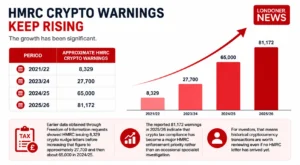
HMRC sent 81,172 letters, emails and text messages to crypto investors during the 2025/26 financial year, according to figures obtained through a Freedom of Information request and reported by the BBC. The number has almost tripled compared with 2023/24, when around 27,700 warnings were issued.
The latest figures indicate that crypto tax warning letters from HMRC are becoming an increasingly important part of the department’s compliance strategy, particularly as tax authorities gain access to more information from cryptocurrency exchanges.
The warning is particularly relevant for investors who believe tax only becomes due when cryptocurrency is converted into pounds. Under UK tax rules, exchanging Bitcoin for Ether, using cryptocurrency to make a purchase or giving crypto to another person can potentially constitute a taxable disposal.
Why Is HMRC Sending So Many Crypto Tax Warning Letters?
HMRC sends these communications when information available to the department suggests that a taxpayer may have received cryptocurrency income or made taxable gains that have not been correctly declared.
They are often described as “nudge letters” because they encourage taxpayers to review their affairs and correct mistakes before HMRC moves towards a formal investigation.
The number of warnings has risen rapidly.
UHY Hacker Young previously found that HMRC sent 64,982 crypto-related warnings during 2024/25, compared with 27,713 in 2023/24 — an increase of 134%.
The newly reported 81,172 figure for 2025/26 represents another rise of roughly 25% in a single year.
| Tax year | Crypto tax warnings reported |
| 2023/24 | Around 27,700 |
| 2024/25 | 64,982 |
| 2025/26 | 81,172 |
The figures suggest HMRC is moving away from treating cryptocurrency taxation as a relatively niche compliance issue.
Crypto ownership has become increasingly mainstream, while HMRC’s ability to link investors with their transactions has also improved.
Does Receiving an HMRC Crypto Letter Mean Tax Is Definitely Owed?
No. Receiving a warning letter does not automatically mean HMRC has established that tax is owed.
A letter may have been triggered by information suggesting there is a potential discrepancy between cryptocurrency activity and information already reported to HMRC.
Investors should therefore avoid assuming either that the letter is wrong or that the amount suggested by HMRC must automatically be correct.
The sensible first step is to reconstruct the relevant crypto transactions and determine whether taxable income or capital gains arose during the period covered.
This can become complicated where someone has used several exchanges, transferred tokens between their own wallets or carried out hundreds of transactions.
Moving crypto between wallets that belong to the same individual would not normally amount to a disposal simply because the assets have moved. However, selling, swapping or spending tokens can have different tax consequences.
Can Swapping One Cryptocurrency for Another Trigger Capital Gains Tax?
Yes. This is one of the most commonly misunderstood parts of UK cryptocurrency taxation.
HMRC states that a disposal can occur when an investor:
- Sells cryptocurrency for money.
- Exchanges one type of cryptoasset for another.
- Uses cryptocurrency to pay for goods or services.
- Gives cryptocurrency to another person, other than qualifying transfers such as certain gifts to a spouse, civil partner or charity.
That means someone does not necessarily need to withdraw pounds into a UK bank account before a Capital Gains Tax liability can arise.
For example, an investor who bought Bitcoin for £4,000 and later exchanged it for Ether when the Bitcoin was worth £10,000 may have made a £6,000 gain for tax purposes, subject to the relevant cost-basis and pooling rules.
The fact that no cash was withdrawn does not, by itself, prevent the transaction from being taxable.
How Much Crypto Profit Can Be Made Before Capital Gains Tax Is Due?
For the 2026/27 tax year, individuals generally have a Capital Gains Tax annual exempt amount of £3,000.
The main CGT rates applying to individuals are currently 18% and 24%, depending on the person’s taxable income and how much of the gain falls within the basic-rate band.
However, the £3,000 allowance applies to an individual’s total qualifying capital gains for the year, not separately to each cryptocurrency or transaction.
Someone who makes £2,500 from Bitcoin and £2,500 from shares, for example, cannot claim a separate £3,000 allowance against each investment.
Losses can also affect the calculation, which is why determining the actual liability requires looking at the investor’s overall tax position rather than simply the value withdrawn from an exchange.
Are Staking, Mining and Crypto Rewards Taxed Differently?
Potentially, yes.
Capital Gains Tax is not the only tax relevant to cryptocurrency.
HMRC states that cryptoassets received from activities including mining, staking, lending and certain decentralised finance arrangements may count as taxable income.
Depending on the circumstances, Income Tax and potentially National Insurance rules can therefore apply when the crypto is received. A later disposal of those tokens may then create a separate Capital Gains Tax calculation based on any subsequent increase or decrease in value.
This creates an additional compliance risk for investors who have concentrated only on buying and selling tokens while ignoring staking or other rewards credited to their accounts.
How Does HMRC Know About Cryptocurrency Transactions?
HMRC’s visibility over cryptocurrency activity is increasing significantly.
UK cryptoasset service providers are now subject to the Cryptoasset Reporting Framework, known as CARF.
From 1 January 2026, UK reporting cryptoasset service providers became responsible for collecting specified information about users and their transactions. That can include information such as a customer’s name, address, tax residence and tax identification details.
Providers must also collect transaction data including the type of cryptoasset, transaction type, number of units and value.
This data can be used to connect cryptocurrency activity with an individual’s tax record.
HMRC explicitly tells users that information supplied to cryptoasset service providers is used to link crypto activity to tax records, making it easier for the department to identify tax that may be due.
When Will Crypto Exchanges Start Reporting Data to HMRC?
The key change has already begun.
CARF obligations in the UK started on 1 January 2026, meaning exchanges and other qualifying providers are currently collecting information for the first reporting period.
The first period runs from 1 January to 31 December 2026, with the resulting reports due to HMRC by 31 May 2027.
UK providers must also report information concerning UK tax-resident crypto users under domestic CARF reporting rules.
This means the current rise in HMRC warning letters could represent only one stage of a much broader compliance push.
Once structured CARF data begins arriving, HMRC should be in a stronger position to compare transaction information with Self Assessment returns and previous disclosures.
What Should Someone Do After Receiving an HMRC Crypto Tax Warning Letter?
An HMRC cryptocurrency letter should not be ignored.
The recipient should first verify that the communication is genuine and carefully check the tax years and transactions it refers to.
They should then obtain transaction histories from relevant exchanges and wallets and identify sales, crypto-to-crypto exchanges, purchases, gifts, staking income, mining rewards and other potentially taxable activity.
Where calculations show that tax was omitted from an earlier year, HMRC operates a dedicated service allowing taxpayers to disclose unpaid tax relating to cryptoassets.
The service covers areas including exchange tokens, NFTs and utility tokens. HMRC warns that taxpayers who fail to disclose unpaid crypto tax can face additional interest and penalties.
After making a disclosure through the cryptoasset disclosure process, HMRC says the amount owed normally needs to be paid within 30 days.
Complex cases: particularly those involving several exchanges, DeFi activity, historic transactions or substantial gains — may justify obtaining advice from a qualified tax professional before responding.
How Serious Are the Penalties for Undeclared Crypto Tax?
HMRC’s current guidance makes clear that cryptocurrency is not outside the normal UK tax system.
Where someone should have paid tax but failed to do so, HMRC says penalties can reach up to 100% of the tax due plus interest, depending on the circumstances. Penalties involving offshore matters or transfers can potentially be higher.
The eventual outcome depends heavily on factors including why the mistake occurred, whether it was deliberate, how quickly the taxpayer corrected it and whether HMRC had already prompted the disclosure.
This is another reason why receiving a nudge letter should not be treated as routine correspondence.
Why HMRC’s Crypto Crackdown Could Become Much Bigger?
The latest crypto tax warning letters HMRC figures point towards a clear change in the department’s approach to digital assets.
Around 65,000 warnings in 2024/25 were already a record. The rise to more than 81,000 during 2025/26 indicates that HMRC is continuing to expand its crypto compliance work rather than allowing the campaign to slow down.
The introduction of CARF could prove even more significant.
Cryptocurrency exchanges and other qualifying providers are now collecting standardised user and transaction information throughout 2026, with the first reports reaching HMRC in 2027.
For investors, the practical message is increasingly difficult to ignore: cryptocurrency transactions should be treated with the same record-keeping discipline as other investments.
Simply holding crypto does not automatically create a Capital Gains Tax charge. But selling it, exchanging one token for another, spending it or receiving crypto through income-generating activities can create UK tax obligations.
With HMRC sending more than 81,000 crypto-related warnings in a single year, investors who have previously assumed that digital assets are difficult for the tax authority to trace may now have good reason to review that assumption.
About the Journalist
Jermaines covers crime, legal affairs and money-related stories for Londoner. His reporting includes police updates, court cases, consumer rights, personal finance and cost-of-living issues. He handles sensitive subjects carefully and clearly distinguishes confirmed facts from allegations, estimates and ongoing investigations.