What Restriction Would the Government Impose in a Closed Economy?
 Published By
Henry
Published By
Henry
Published:
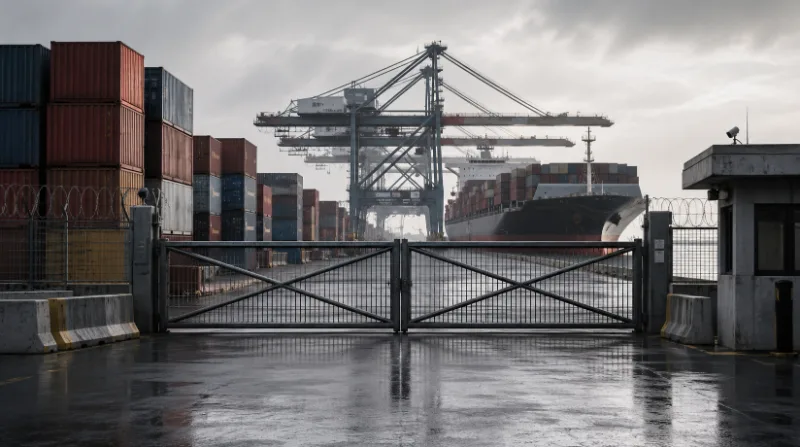
Table of Contents
The main restriction a government would impose in a closed economy is a prohibition on international trade. In simple terms, businesses and consumers would not be able to import goods and services from other countries or export domestic products overseas.
For the common multiple-choice question, “The government would prohibit trade with other nations” is the correct answer. A genuinely closed economy may also prevent or severely restrict international capital flows so that economic activity remains within national borders.
It sounds straightforward, but the idea of a closed economy is often misunderstood. It does not automatically mean that the government owns every company, fixes every price or abolishes private property. The defining issue is the economy’s relationship with the rest of the world.
What Is a Closed Economy?
A closed economy is an economic system in which a country does not trade with other countries.
That means there are effectively:
- no imports of foreign goods and services
- no exports of domestically produced goods and services
- no reliance on overseas markets for production or consumption and
- in the strictest definition, no significant international movement of financial capital.
Economists frequently use the closed-economy concept as a theoretical model rather than as a description of how most countries actually operate. Removing international trade makes it easier to study relationships between domestic consumption, investment, government expenditure and saving.
A fully closed modern economy would be extremely difficult to maintain because supply chains, financial markets, energy, technology and consumer markets are now highly interconnected.
What Restriction Would the Government Impose in a Closed Economy?
The defining restriction would be a ban on international trade.
A government attempting to create a completely closed economy would therefore need to stop goods and services crossing its economic borders for commercial purposes.
| Economic activity | What happens in a closed economy? |
|---|---|
| Imports | Prohibited |
| Exports | Prohibited |
| Domestic trade | Continues |
| Foreign goods | Generally unavailable through normal trade |
| Overseas sales by domestic companies | Prohibited |
| Foreign capital flows | Restricted or absent in a strict closed-economy model |
| Domestic production | Becomes the main source of supply |
This is why the correct answer to the widely searched question is not government price controls or restrictions on private property. International trade is the crucial distinction.
Would Imports Be Banned?
Yes. In a genuinely closed economy, businesses could not simply order products, components or raw materials from overseas suppliers.
That could include everything from consumer electronics and clothing to industrial equipment, medicines, food ingredients and manufacturing components, depending on what the country was capable of producing domestically.
Domestic producers would therefore have to meet demand that was previously supplied by foreign businesses.
This is substantially more restrictive than an ordinary import tariff.
A tariff makes foreign goods more expensive but still permits them to enter the country. A closed economy removes international trade from the economic system altogether.
Would Exports Also Be Banned?
Yes.
A closed economy is not simply an economy that blocks imports to protect domestic manufacturers. Exports must also be absent.
Companies would have to sell their output within the domestic market rather than relying on customers overseas.
That distinction is important because some countries pursue highly protectionist policies while continuing to export large quantities of goods.
Such economies may be less open, but they are not technically closed.
Are Tariffs and Import Quotas Enough to Create a Closed Economy?
Not necessarily.
Governments commonly use tariffs, quotas, licensing requirements, sanctions and local-content rules to restrict particular types of international commerce.
But there is an important difference between restricting trade and eliminating trade.
For example:
Tariff: Foreign products are allowed but taxed.
Import quota: Foreign products are allowed, but only up to a specified quantity.
Import licence: Businesses need government approval before bringing certain products into the country.
Trade embargo: Trade with a particular country or in particular products may be prohibited.
Closed economy: International trade is absent across the economy.
Several ranking explanations blur this distinction by presenting tariffs and quotas as characteristics of a closed economy. They are better understood as protectionist measures that can move an economy towards greater isolation without necessarily making it genuinely closed.
Would the Government Set Prices for Imported Goods?
This would not be the defining restriction — and in a completely closed economy, there would theoretically be no imported goods to price in the first place.
A government can impose price controls in either an open or closed economy. Price controls concern how markets operate domestically, whereas economic openness concerns whether transactions take place with the rest of the world.
This is why “the government would set prices for imported goods” is not the correct answer to the common exam question.
Would Private Property Be Banned?
Not necessarily.
This is another area where closed economies and command economies are sometimes confused.
A country could theoretically prevent international trade while still allowing:
- privately owned businesse
- private homes
- domestic competition
- private investment and
- consumer choice between domestically produced goods.
Whether private property is permitted depends on the country’s broader political and economic system, not simply whether the economy is open or closed.
Is a Closed Economy the Same as a Command Economy?
No.
The two concepts describe different things.
| Closed economy | Command economy |
|---|---|
| Describes economic interaction with foreign countries | Describes how economic decisions are made |
| International trade is absent | Government makes major production and allocation decisions |
| Private ownership can theoretically exist | State ownership may be extensive |
| Main issue is external trade | Main issue is domestic economic control |
An economy could therefore have considerable state planning while still trading internationally.
Likewise, economists can construct a closed-economy model containing households, privately owned businesses and functioning domestic markets.
Preventing trade does not automatically transform every part of the economy into state ownership.
What Happens to GDP in a Closed Economy?
The closed-economy model also changes one of the standard equations used to explain national output.
In an open economy, the expenditure approach to GDP is commonly represented as:
Y = C + I + G + NX
Where:
- Y = national output or income;
- C = consumption;
- I = investment;
- G = government spending; and
- NX = net exports.
In a closed economy there are no exports or imports, so net exports are zero.
The equation therefore becomes:
Y = C + I + G
This is one reason closed economies appear so frequently in economics courses: removing international trade creates a simpler model for examining how domestic saving and investment interact.
What Happens to Saving and Investment?
Another significant consequence is that domestic investment cannot easily be financed with money coming from overseas.
In the simplified closed-economy model:
National saving = domestic investment
or:
S = I
Businesses requiring capital therefore depend on savings generated within the domestic economy rather than drawing upon international financial markets.
An open economy has another option: capital can move across borders.
That distinction becomes particularly important for businesses financing factories, infrastructure, housing and other large investments.
Why Would a Government Want to Close an Economy?
Complete economic closure is unusual, but governments can pursue policies inspired by the idea of economic self-sufficiency.
Motivations can include:
Protecting Domestic Industries
Removing foreign competitors could increase demand for locally produced alternatives.
However, consumers could also face less competition, fewer products and potentially higher costs.
National Security
Governments may want domestic capacity in strategically important sectors such as defence, energy, food, telecommunications or critical technology.
That does not require shutting down international trade entirely, however.
Reducing Foreign Dependence
A country that imports essential commodities can become exposed to overseas supply disruptions.
Governments may therefore encourage domestic production to improve economic resilience.
Political or Ideological Isolation
Some governments have historically restricted international commerce as part of wider attempts to reduce foreign economic or political influence.
Again, considerable isolation does not necessarily mean an economy achieves complete closure.
What Would Consumers Notice?
The most immediate change would probably be what was available to buy.
Without imports, consumers would depend almost entirely on products and services that could be supplied domestically.
A country lacking particular raw materials, manufacturing expertise or agricultural conditions could struggle to replace certain imports.
At the same time, domestic companies would face less competition from foreign businesses.
That could provide temporary protection for local manufacturers, but weaker international competition can also reduce the pressure on companies to become more productive, innovative or price-competitive.
Could Britain Operate as a Closed Economy?
The idea illustrates particularly clearly why a modern economy such as Britain is far removed from the closed-economy model.
UK trade statistics show that Britain exported around £930 billion of goods and services in 2025 while importing approximately £969 billion. The European Union alone accounted for 41% of UK exports and 49% of imports during the year.
That trade supports activity ranging from manufacturing and retail to transport, professional services and finance.
For London, the implications would be particularly dramatic.
The capital’s economy contains internationally connected financial institutions, technology businesses, professional-services firms, universities, tourism businesses and multinational employers. A genuinely closed British economy would not simply mean changing customs arrangements at ports. It would fundamentally alter the way many London companies operate.
Britain leaving the European Union did not make the UK a closed economy. The country continues to import and export enormous quantities of goods and services to EU and non-EU markets.
Closed Economy vs Protectionism: The Important Difference
The two terms should not be used interchangeably.
Protectionism uses government measures to protect domestic firms from foreign competition.
Those measures can include tariffs, quotas, subsidies and regulatory barriers.
A country can therefore be strongly protectionist while remaining an open economy because international trade continues.
A closed economy, by contrast, assumes international trade does not take place.
Think of the difference as a spectrum:
Open trade → trade barriers → strong protectionism → near-autarky → closed economy
Most countries sit somewhere well before the final point.
Are There Any Completely Closed Economies Today?
Fully closed economies are primarily useful as theoretical examples because almost every modern country participates in international economic activity to some degree.
Even highly isolated states can have limited trade relationships, receive foreign goods or participate indirectly in international markets.
It is therefore safer to describe real countries as more or less economically open rather than treating “closed economy” as a simple label.
Why the Restriction Matters?
Prohibiting international trade changes far more than what arrives at a country’s ports.
It affects where companies can sell, where manufacturers obtain components, how investment is financed, what consumers can buy and how domestic prices respond to shortages.
It also places substantially more pressure on domestic production.
If households want something, the economy must either produce it domestically, find a domestic substitute or go without it.
That is the fundamental logic of economic self-sufficiency.
The Bottom Line
So, what restriction would the government impose in a closed economy?
The clearest answer is a prohibition on trade with other nations.
Imports would not enter and exports would not leave under the strict economic definition. Restrictions on property ownership, domestic prices or consumer choice are not required characteristics of a closed economy.
The distinction matters because a closed economy describes a country’s relationship with the wider global economy — not necessarily who owns businesses or how every domestic economic decision is made.
About the Journalist
Henry is the editorial head and lead author at Londoner. He oversees the publication’s editorial direction, article quality, source verification and corrections process. He also reviews major stories before publication to ensure they meet Londoner’s standards for accuracy, fairness and transparency.