Which Councils Have Reform Won in 2026? | Full List of Reform UK Council Gains
 Published By
Olivia
Published By
Olivia
Published:
Updated:
Table of Contents
Reform UK secured outright control of 14 councils in England in the 2026 local elections, adding another significant layer to the party’s growing presence in local government.
The elections were held on 7 May 2026, with contests taking place across 136 English councils. Reform won more than 1,450 council seats and gained majorities in authorities previously controlled by Labour, the Conservatives and, in Havering, a residents-led administration. Sky News recorded Reform with outright control of 14 councils after the elections.
The results included Reform’s first council majority in London, major victories across northern England and gains in two county councils. However, there is an important distinction between winning seats, becoming the largest party, and taking overall control of a council.
Which Councils Have Reform Won in 2026?
The 14 councils where Reform UK secured an overall majority through the 2026 local elections were:
| Council | Reform Seats | Total Council Seats | Previous Control |
| Wakefield | 58 | 63 | Labour |
| Sunderland | 58 | 75 | Labour |
| Essex | 53 | 78 | Conservative |
| Thurrock | 45 | 49 | Labour |
| Barnsley | 42 | 63 | Labour |
| South Tyneside | 41 | 54 | Labour |
| Sandwell | 41 | 72 | Labour |
| Suffolk | 41 | 70 | Conservative |
| Walsall | 40 | 60 | Conservative |
| Havering | 39 | 55 | Residents-led administration |
| Gateshead | 38 | 66 | Labour |
| Calderdale | 34 | 54 | Labour |
| St Helens | 34 | 48 | Labour |
| Newcastle-under-Lyme | 27 | 44 | Conservative |
Reform’s own post-election summary said nine of its 14 council gains came from Labour, four came from the Conservatives and the remaining gain was elsewhere.
Where Did Reform UK Record Its Largest Council Wins?
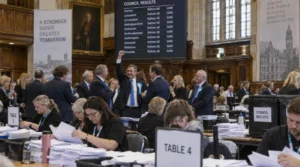
Some of Reform UK’s strongest results came in areas that had previously been associated with Labour-controlled local government.
In Wakefield, Reform won 58 of the council’s 63 seats. The result gave the party a particularly large majority and left it controlling more than nine in every ten council seats.
The pattern was similar in Sunderland, where Reform took 58 of 75 seats. Reform’s result ended Labour’s long period of control of the authority.
Thurrock produced another substantial majority, with Reform taking 45 of 49 council seats. Barnsley also changed hands. Reform secured 42 of the 63 seats, compared with 11 for Labour and eight for the Liberal Democrats.
These results gave Reform administrations enough councillors to make most ordinary council decisions without needing support from another political group.
Which Conservative Councils Did Reform Win?
Four of the councils Reform took in 2026 had previously been controlled by the Conservatives. They were Essex, Suffolk, Walsall and Newcastle-under-Lyme.
Essex was one of the most significant numerically. Reform secured 53 seats in the 78-member authority, giving it a clear overall majority.
In neighbouring Suffolk, the official county council results recorded 41 Reform councillors, compared with 13 Greens, nine Conservatives, three Labour councillors, two Liberal Democrats and two independents.
Newcastle-under-Lyme also changed hands. The council confirmed that Reform won 27 of its 44 seats, while the Conservatives took 15 and Labour two.
Did Reform Win Any London Councils in 2026?
Yes. Havering became Reform UK’s first London borough under outright party control.
Reform won 39 of Havering’s 55 council seats, comfortably exceeding the 28 seats required for a majority. The remaining seats were divided primarily between local residents‘ groups and Labour.
The result was particularly relevant to London because Reform’s strongest local-government performances before 2026 had generally been outside the capital.
Havering therefore became the clearest example of Reform converting its wider national support into direct control of a London local authority.
For residents, that means the Reform administration has substantial influence over borough-level matters including planning, housing functions, waste collection, local roads, environmental policies and council spending, within the limits set by national law and the council’s statutory responsibilities.
Did Reform Win Birmingham, Bradford or Other Councils?
Not in the same sense.
Reform made significant gains in several other councils and in some cases became the largest political group, but that does not automatically mean the party won overall control.
For example, Birmingham moved from Labour control to no overall control after the 2026 election. Reform won 23 council seats there, but no party secured a majority of the full council.
Bradford also moved away from Labour control without giving Reform an outright council majority. Kirklees similarly remained under no overall control.
This distinction helps explain why different online figures sometimes claim that Reform “won” more than 14 councils.
A party can:
- Win Individual Seats without becoming the largest group
- Become The Largest Party without holding more than half the council
- Secure Overall Control by winning a majority of all council seats
The headline figure of 14 councils refers specifically to authorities where Reform secured an overall majority in the 2026 elections.
How Many Council Seats Did Reform Win in 2026?
Reform won approximately 1,450 council seats across England.
Different final datasets show a very small difference in the total. Electionresults.uk records 1,454 seats, while Sky News’ later results page records 1,455. The difference reflects how results and delayed contests were incorporated into different datasets.
What is clear is that Reform won more council seats than any other party in the elections. The party contested all 136 councils covered by one national results dataset and recorded about 23.7% of the votes included in that analysis.
How Does Reform’s 2026 Result Compare With 2025?
The 2026 results followed Reform UK’s major breakthrough in the previous year’s local elections.
In 2025, Reform gained control of 10 councils, including Derbyshire, Kent, Lancashire, Lincolnshire, Nottinghamshire, Staffordshire, North Northamptonshire, West Northamptonshire and other authorities that changed hands during that election cycle. Parliamentary election analysis recorded Reform gaining 677 council seats that year.
The May 2026 elections therefore expanded a local-government presence that had already been established the previous year.
However, the number of councils a party currently controls can change between general local elections. Councillors can resign, switch political groups, become independent or lose seats in by-elections.
For that reason, the number of councils won during the May 2026 elections should not automatically be treated as identical to Reform’s current nationwide total at every later point in the year.
How Many Councils Does Reform Control Now?
As of 18 September 2026, PollCheck’s live council-control tracker listed Reform UK with outright majorities in 23 councils across Great Britain, while it was the largest party without a majority in another 12.
That figure includes councils gained before 2026 and takes account of later changes in council composition. It is therefore different from the answer to the question which councils have Reform won in 2026?
For the May 2026 election itself, the confirmed figure remains 14 newly won council majorities.
What Does Winning a Council Allow Reform UK to Do?
Controlling a council gives a political party substantial influence over local priorities, although the exact responsibilities depend on whether it is a county council, metropolitan borough, London borough, district or unitary authority.
Councils can have responsibilities covering areas such as:
- Adult And Children’s Social Care
- Planning And Housing
- Waste And Recycling
- Local Roads And Transport
- Public Health
- Libraries And Leisure Services
- Council Tax And Local Budgets
An overall majority generally makes it easier for an administration to approve budgets, appoint cabinet members and pursue local policies without negotiating a formal coalition. Councils must still comply with national legislation, statutory service requirements and financial rules.
What Happens Next for Reform’s Councils?
The next test for the councils won by Reform will be how their administrations manage local budgets and services over the remainder of their terms. Council composition may also continue changing through resignations, defections and by-elections.
Meanwhile, wider local government reorganisation is affecting parts of England, meaning some existing councils may eventually be replaced or merged into new unitary authorities.
The Government announced further reorganisation plans during 2026, although the programme was subsequently placed under review in September. That could eventually change the boundaries and structures within which some Reform-controlled councils operate.
For now, the clearest answer is that Reform UK won outright control of 14 councils in the 2026 English local elections: Wakefield, Sunderland, Essex, Thurrock, Barnsley, South Tyneside, Sandwell, Suffolk, Walsall, Havering, Gateshead, Calderdale, St Helens and Newcastle-under-Lyme.
The result expanded Reform’s local-government presence considerably, while other councils where the party made gains remained under no overall control rather than becoming Reform-run authorities.
About the Journalist
Olivia covers London life, culture and lifestyle for Londoner. Her work includes food, shopping, neighbourhood trends, attractions, local experiences and practical guides for residents and visitors. She focuses on engaging stories that reflect everyday life across the capital.