IPPR Think Tank Calls For UK To Rejoin EU As New Research Reveals Majority Support For Membership
 Published By
Jermaine
Published:
Updated:
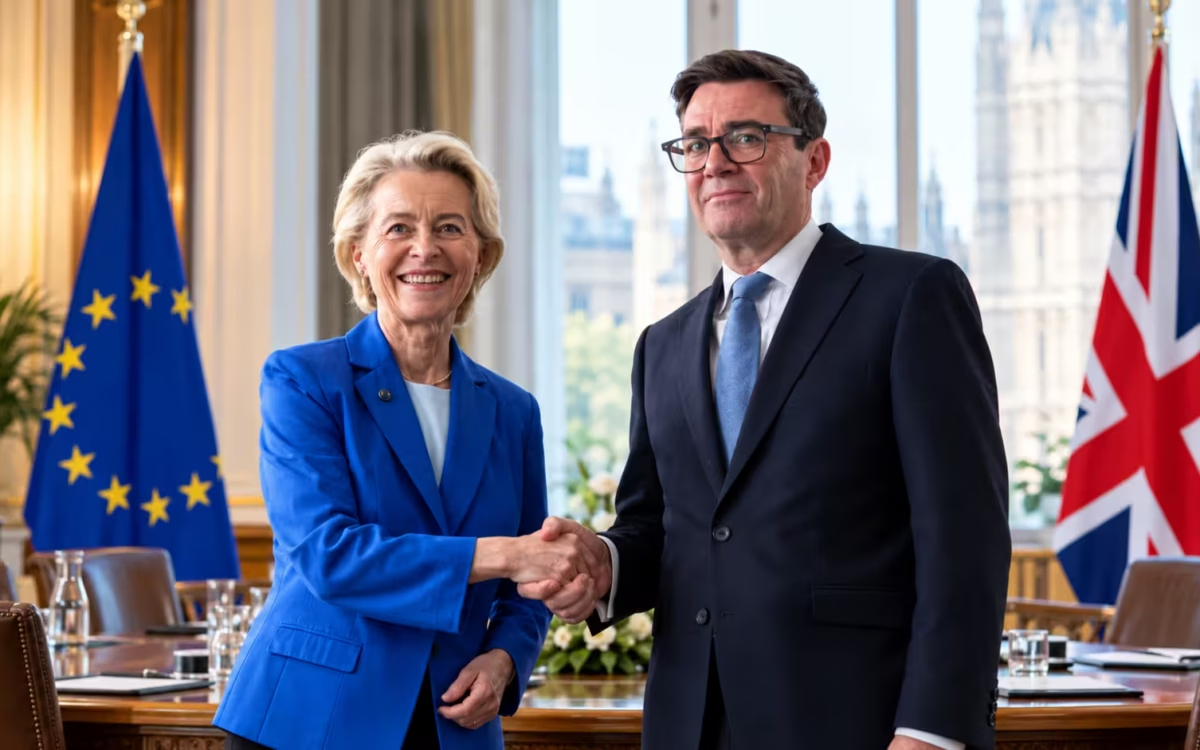
Table of Contents
20 October 2026 | UK Politics and Brexit News
Britain should make rejoining the European Union a long-term political priority to protect its economy, national security and democratic influence, according to a major new report from the Institute for Public Policy Research (IPPR).
The influential UK think tank has urged the Labour government to reconsider Britain’s relationship with Europe, warning that growing international instability, Russian aggression and uncertainty surrounding American foreign policy have fundamentally changed the country’s position in the world.
Published on 19 October 2026, the research argues that negotiating individual trade agreements with Brussels will no longer be sufficient to protect Britain’s economic and strategic interests.
The intervention comes as Prime Minister Andy Burnham considers options for the UK’s future relationship with the EU, reopening one of the most divisive questions in British politics a decade after the 2016 Brexit referendum.
New polling commissioned by IPPR and Persuasion UK indicates that 52% of respondents support the UK rejoining the EU, compared with 29% who want Britain to remain outside. Another 10% were undecided, while 9% said they would not vote.
Among respondents expressing a preference between membership and staying out, support for rejoining rises to 64%, against 36% opposed.
The findings suggest that public attitudes towards European integration have shifted substantially, although researchers warn that support could weaken when voters are confronted with difficult questions about immigration, sovereignty and the financial obligations associated with EU membership.
Harry Quilter-Pinner, executive director of IPPR, said that Britain’s traditional approach to European relations was becoming increasingly ineffective.
He warned that “a series of individual deals will not be enough”, arguing that the government should begin building political support for full EU membership rather than immediately announcing another referendum.
Laura Chappell, IPPR associate director and co-author of the research, also questioned whether Britain could exercise meaningful control over its economic future while remaining outside the bloc.
She said:
“we can’t take back control while being an outsider in Europe.”
Chappell linked the argument to household living costs, industrial development and national security, suggesting that Britain’s ability to respond to international challenges increasingly depends on cooperation with neighbouring economies.
The report, New World, New Relationship: Our Future with Europe, written by Chappell and Mihir Sharma, argues that the European Union has evolved significantly since the UK formally left in January 2020.
According to its authors, Europe is developing a more coordinated approach to defence spending, industrial investment and strategic supply chains.
They argue that Britain risks losing influence over decisions that could directly affect its manufacturing industries, businesses and economic competitiveness.
The think tank recommends creating a European Defence Alliance, expanding cooperation on industrial policy and negotiating reciprocal access to public procurement markets.
It also calls for a clear political strategy that could eventually lead to a democratic mandate for full EU membership.
These proposals arrive at a sensitive moment for the Labour government.
Burnham indicated at the Labour Party conference in September that Britain should reconsider its long-term relationship with the EU, including possible customs union arrangements, single market participation and potentially full membership.
He has acknowledged that Brexit has caused more economic harm than benefit, while also suggesting that another immediate referendum would be premature.
The renewed discussion marks a departure from the approach pursued by former Prime Minister Keir Starmer, whose government sought closer European cooperation while ruling out rejoining the single market, customs union or EU itself.
Could Britain Really Rejoin the European Union?
Despite the growing interest in EU membership, significant political and economic obstacles remain.
Separate YouGov research published in September found that 59% supported rejoining the EU, while 32% opposed it. However, support for a closer relationship without formally rejoining was even stronger, at 73%.
The polling illustrates an important distinction: many British voters favour better economic cooperation with Europe without necessarily accepting every obligation associated with full EU membership.
YouGov also found that support becomes more complicated when the potential loss of Britain’s previous EU opt-outs is considered.
yougov.com
The IPPR’s own research identifies similar vulnerabilities.
In one experiment, support for rejoining fell from 52% to 47% when participants encountered a negatively framed argument about increased immigration.
This suggests that although pro-European sentiment has strengthened, the outcome of a future referendum could depend heavily on debates over border controls, financial contributions and the practical consequences of membership.
The Guardian
Another major consideration is whether the European Union would accept Britain back under favourable conditions.
Under Article 49 of the Treaty on European Union, any application would require unanimous agreement among existing member states, approval from the European Parliament and the negotiation of accession terms.
Britain would also need to address issues including freedom of movement, regulatory obligations and the future of its previous arrangements relating to the EU budget and single currency.
Sandro Gozi, a Member of the European Parliament involved in UK-EU relations, told Euronews earlier this month that Burnham needed to clarify his intentions, while expressing openness to discussions about a new partnership.
Meanwhile, opposition remains among politicians who support Britain’s decision to leave the bloc.
Following Burnham’s September remarks, Reform UK deputy leader Richard Tice accused the government of attempting to reverse Brexit and said his party would “never let this betrayal go unchallenged”.

House of Commons Library
For British businesses, the debate raises questions extending beyond the political arguments of the previous decade.
Manufacturers trading with the EU could benefit from reduced regulatory barriers, while service providers and investors would be watching whether a closer relationship could improve market access and investment certainty.
However, any economic gains would need to be weighed against the potential costs and obligations of membership, including changes to regulatory policy and financial contributions.
A return to the EU would not automatically reverse every economic consequence of Brexit, nor would it guarantee immediate improvements in household finances.
The IPPR nevertheless argues that Britain’s broader strategic position has changed sufficiently to justify reconsidering membership as a medium-term national objective.
Its findings add to growing pressure on the prime minister to move beyond limited agreements and outline a clearer destination for UK-EU relations.
With Burnham expected to present options for Britain’s future relationship with Europe around the next UK-EU summit, the question is no longer confined to whether Brexit was the right decision in 2016.
Instead, the emerging debate is whether remaining outside the European Union will continue to serve Britain’s interests in an increasingly uncertain global economy.
For now, no decision to reapply for EU membership has been announced. But the latest IPPR intervention, combined with evidence of changing public attitudes, suggests that the question of Britain’s place in Europe is returning to the centre of national politics.
About the Journalist
Jermaines covers crime, legal affairs and money-related stories for Londoner. His reporting includes police updates, court cases, consumer rights, personal finance and cost-of-living issues. He handles sensitive subjects carefully and clearly distinguishes confirmed facts from allegations, estimates and ongoing investigations.