Reform UK Deputy Richard Tice Faces Backlash Over Climate Remarks
 Published By
Henry
Published By
Henry
Published:
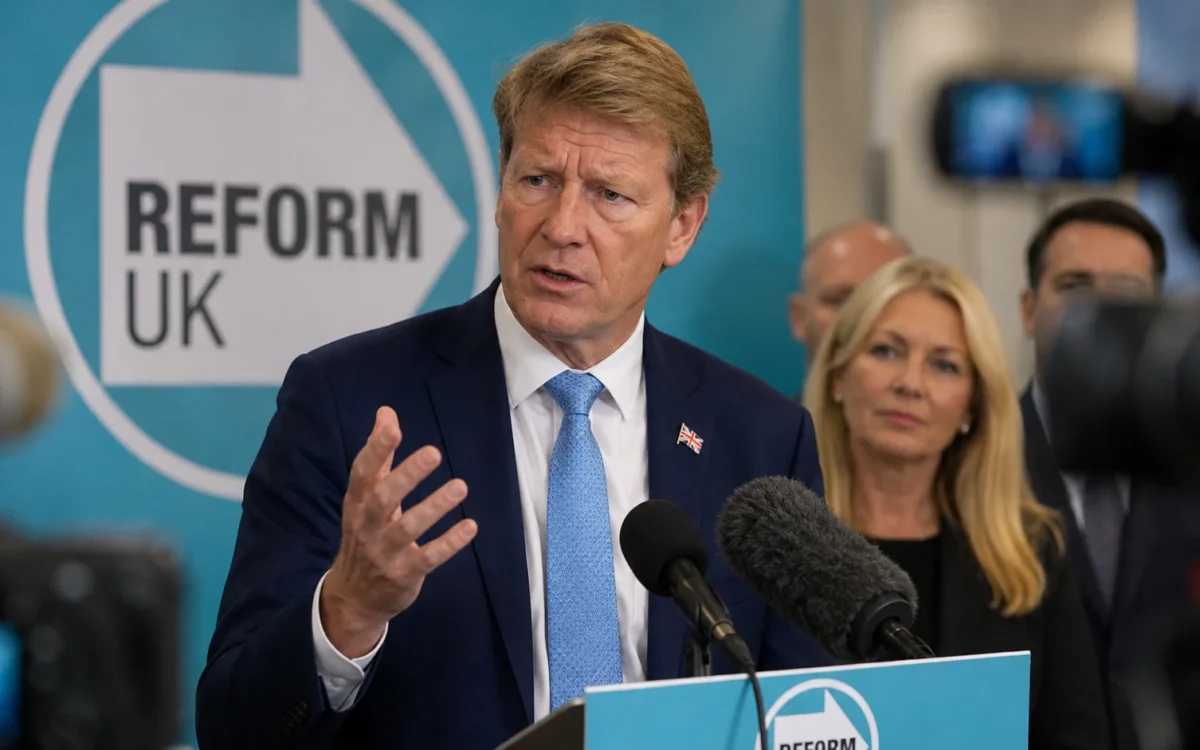
Table of Contents
Reform UK deputy Richard Tice has drawn criticism after arguing that Britain should focus more heavily on adapting to climate change and questioning whether net-zero policies can prevent further warming.
The comments, made during a Reform UK press conference on Monday, 17 August, have placed the party’s climate policy back under scrutiny at a time when England is experiencing widespread drought and an exceptionally hot summer.
Tice, who is the Reform UK MP for Boston and Skegness, acknowledged that climate change is real but challenged the case for trying to address it primarily through net-zero policies. He argued that adaptation should play a greater role and suggested Britain should examine measures such as desalination to strengthen its water supplies.
His intervention prompted criticism from environmental campaigners, health professionals and political opponents, particularly because it came after months of unusually high temperatures and worsening drought conditions.
What Did Reform UK Deputy Richard Tice Say About Climate Change?
During the press conference, Richard Tice questioned whether the UK’s pursuit of net zero would stop climate change.
He said climate change had happened throughout history and argued that adapting to changing conditions could be a more effective policy response. Tice also suggested there could be some benefits from warmer conditions, including improvements in English wine production.
His comments reflect Reform UK’s wider opposition to existing net-zero policies.
However, the scientific position is that reducing greenhouse gas emissions remains necessary to limit additional human-caused warming. The Intergovernmental Panel on Climate Change has concluded that stabilising global temperatures requires carbon dioxide emissions to reach net zero, alongside substantial reductions in other greenhouse gases.
Adaptation and emissions reduction are also not considered mutually exclusive. International climate frameworks generally call for countries to both reduce emissions and prepare infrastructure, communities and public services for climate impacts that are already occurring.
Why Have Richard Tice’s Comments Sparked Controversy?
The timing has made the comments particularly contentious.
The Environment Agency said on 10 August that 71.3% of England was in drought, following exceptionally dry conditions and continued pressure on water supplies.
Meanwhile, provisional Met Office figures covering 1 June to 10 August showed the UK’s mean summer temperature at 16.48°C, around 1.88°C above the 1991–2020 average. At that point, the Met Office said a record warm summer was becoming increasingly likely.
The public-health consequences of earlier heat episodes have also been significant.
UK Health Security Agency monitoring estimated 2,877 heat-associated deaths in England during the May and June 2026 heat events. The figure remains provisional, with final statistics expected in 2027.
Those figures have been central to criticism of Tice’s suggestion that the public should not view warmer weather solely negatively.
What Does This Mean for London?
The debate carries particular relevance for London because the capital has already experienced extreme temperatures during 2026.
The Met Office confirmed that Kew Gardens reached 35.1°C on 26 May, setting a new UK record for the highest daily maximum temperature recorded during May.
Urban areas can be particularly vulnerable during prolonged hot weather because buildings, roads and other hard surfaces retain heat. The IPCC has also warned that some effects of climate change, including extreme heat, can be magnified in cities.
That makes the debate over adaptation highly relevant to London regardless of political disagreements over net zero.
Measures such as improving building ventilation, creating shaded public spaces, planting trees, strengthening water infrastructure and preparing health services can reduce the risks created by hotter summers.
The political disagreement is primarily over whether adaptation should complement emissions reductions or replace much of the UK’s current net-zero strategy.
What Is Reform UK’s Position on Net Zero?
Reform UK has consistently positioned itself against the UK’s current net-zero programme and argues that environmental policies are placing excessive costs on households and businesses.
Tice’s latest intervention follows that established political position.
At the August press conference, he argued that the UK should consider practical responses to water shortages, including desalination technology similar to systems used in parts of the Middle East.
The party is therefore presenting adaptation, energy affordability and economic competitiveness as alternatives to what it considers an overly expensive emissions-reduction programme.
Critics dispute that framing, arguing that adaptation alone cannot prevent climate impacts from becoming progressively more severe if global greenhouse gas emissions continue.
According to the IPCC, limiting human-caused warming requires cumulative carbon emissions to be constrained and net CO2 emissions ultimately to fall to zero.
Who Is Reform UK Deputy Richard Tice?
Richard Tice is one of Reform UK’s most prominent senior politicians.
Reform UK’s official leadership information currently identifies him as the party’s deputy leader, alongside leader Nigel Farage and chairman Lee Anderson.
Tice previously led Reform UK before Farage returned to the party leadership ahead of the 2024 general election.
He was elected as the MP for Boston and Skegness on 4 July 2024, and Parliament’s official records show that he has represented the constituency continuously since then.
As deputy leader, Tice has remained a prominent spokesperson on issues including energy, immigration, government spending, taxation and environmental policy.
His political profile means his comments frequently provide an indication of how a future Reform government could approach major policy questions.
Richard Tice Also Facing Parliamentary Standards Investigation
The climate row comes as Tice is separately the subject of an investigation by the Parliamentary Commissioner for Standards.
Parliament’s official register of current investigations shows that a case involving Richard Tice was opened on 28 July 2026 under Rule 6 concerning a possible failure to declare an interest.
An investigation does not mean that the rules have been broken.
Tice has said the matter relates to whether he should have referred to an entry in his register of interests during a parliamentary debate concerning UK democracy and Israeli influence.
The standards investigation is separate from the controversy surrounding his climate comments.
Why Richard Tice Is Becoming Increasingly Important to Reform UK?
The latest controversy demonstrates the prominent role Richard Tice continues to play within Reform UK’s senior leadership.
While Nigel Farage remains party leader, Tice regularly fronts policy announcements, media appearances and press conferences and has become one of the party’s most recognisable representatives.
His climate comments also highlight one of the clearest political dividing lines emerging around Reform UK: whether the country should continue pursuing aggressive emissions-reduction targets or prioritise energy costs, economic growth and adaptation.
That question is likely to remain politically significant as hotter weather, drought conditions and pressure on Britain’s infrastructure become increasingly visible to voters.
What Happens Next?
There is little indication that Reform UK intends to soften its opposition to current net-zero policies following the criticism of Tice.
Instead, Reform UK deputy Richard Tice is continuing to make the case for a strategy focused more heavily on climate adaptation and infrastructure while questioning the economic justification for Britain’s existing approach to net zero.
Opponents are likely to keep challenging that position with evidence about the health, environmental and economic consequences of extreme temperatures.
For London and the rest of the UK, the argument is therefore becoming bigger than one politician’s comments. It forms part of a wider political battle over how Britain should respond to a changing climate — and how much voters are willing to pay for the policies designed to address it.
About the Journalist
Henry is the editorial head and lead author at Londoner. He oversees the publication’s editorial direction, article quality, source verification and corrections process. He also reviews major stories before publication to ensure they meet Londoner’s standards for accuracy, fairness and transparency.