Local Government Pay Rise 2026: New Pay Rates, Back Pay And Who Gets The Increase?
 Published By
Ben
Published By
Ben
Published:

Table of Contents
The local government pay rise 2026 has now been agreed, ending months of uncertainty for council employees and many school support workers across England, Wales and Northern Ireland.
Workers covered by the National Joint Council for Local Government Services will receive a 3.3% consolidated pay increase, effective retrospectively from 1 April 2026. Relevant nationally agreed allowances also rise by 3.3%.
The Local Government Association confirmed on 24 August that agreement had been reached for the period from 1 April 2026 to 31 March 2027.
Quick Answer: The 2026/27 local government pay award is 3.3%, backdated to 1 April 2026.
It covers NJC pay points 3 to 43 and qualifying allowances. Employees who remained on their old rate after April should receive back pay when their employer implements the new salary.
The settlement covers a huge range of workers, including council administrators, refuse workers, social care staff, housing officers, library employees and many teaching assistants. The NJC framework covers more than 1.4 million local-government-services workers nationally.
What Is The Local Government Pay Rise For 2026?
The final settlement provides a permanent 3.3% uplift to nationally negotiated NJC salaries.
The increase applies to:
- NJC Spinal Column Points 3 To 43
- Qualifying NJC Allowances
- Eligible Pay Above SCP43 Where The Job Remains Within NJC Coverage
The rise is consolidated rather than being a one-off payment. That matters because consolidated increases become part of basic salary and can therefore affect future pay awards and other calculations linked to salary.
The original employer offer was made on 24 March 2026. At the time, the National Employers described it as a full and final one-year offer running from April 2026 until March 2027.
Trade unions initially rejected it. UNISON subsequently balloted almost 200,000 council and school staff across more than 500 employers in England and Wales over possible strike action.
Although a large majority of ballots returned supported action, the required turnout threshold was not reached across enough major employers. The joint unions later accepted the 3.3% settlement.
That means the 3.3% figure is now an agreed pay award rather than simply an employer proposal.
How Much Will Council Workers Earn After The Pay Rise?
The national NJC pay spine now begins at Spinal Column Point 3, following the removal of SCP2 from 1 April 2026.
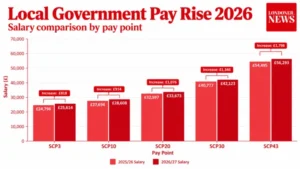
At the bottom of the national scale, SCP3 increases from approximately £24,796 to £25,614 a year. Higher points receive the same percentage increase, meaning the cash value of the rise becomes larger further up the scale.
Examples of how the award changes gross basic salary include:
| Pay Point | 2025/26 Salary | 2026/27 Salary | Annual Increase |
| SCP3 | £24,796 | £25,614 | £818 |
| SCP10 | £27,694 | £28,608 | £914 |
| SCP20 | £32,597 | £33,673 | £1,076 |
| SCP30 | £40,777 | £42,123 | £1,346 |
| SCP43 | £54,495 | £56,293 | £1,798 |
The published national scale therefore runs from roughly £25,614 at SCP3 to £56,293 at SCP43 for 2026/27.
On the standard 37-hour NJC week, the lowest national rate is around £13.28 an hour.
Councils can operate their own grading arrangements, so employees should check their authority’s salary table rather than assuming their local grade exactly matches the national spine.
The NJC framework specifically allows local modification to reflect local service requirements.
For workers in London, this is particularly important. Borough pay structures, local grades and London-related additions can mean the amount shown on an individual contract differs from the basic national NJC figures.
The figures above are also gross pay, not additional take-home income. Income Tax, National Insurance, Local Government Pension Scheme contributions, student loan deductions and other payroll deductions can reduce the amount eventually reaching an employee’s bank account.
Will Local Government Workers Get Back Pay?
Yes, where eligible.
Although agreement was only confirmed in August, the pay increase is effective from 1 April 2026. Employees who continued to receive their previous salary after that date should therefore normally receive arrears for the difference.
For example, the annual increase at SCP3 is about £818, equivalent to roughly £68 extra gross pay per month. At SCP20 the annual difference is around £1,076, or approximately £90 a month before deductions.
Someone receiving six months of arrears could therefore see roughly:
- SCP3: Around £409 Gross Back Pay
- SCP20: Around £538 Gross Back Pay
- SCP30: Around £673 Gross Back Pay
- SCP43: Around £899 Gross Back Pay
Actual arrears can differ if an employee changed hours, moved between spinal points, took unpaid leave, started or left during the period, or receives variable payments.
There is also no single national date for back pay. Councils and other participating employers need to update their own payroll systems before paying the new salary and calculating arrears.
Back pay can have another consequence for lower-paid workers. A large lump-sum payment may affect Universal Credit in the assessment period in which it is received.
UNISON highlighted this issue in August after Rochdale Borough Council agreed that workers would eventually be able to choose between receiving qualifying arrears as a lump sum or in staggered payments.
Employees receiving means-tested benefits should therefore check how an unusually large payslip could affect their individual position.
Who Gets The 2026 Local Government Pay Award?
The NJC settlement covers employees whose contracts follow the Green Book national agreement in England, Wales and Northern Ireland.
That can include workers in areas such as:
- Council Administration
- Social Care And Community Services
- Housing Services
- Waste And Recycling
- Libraries
- Planning And Environmental Services
- Catering And Cleaning
- Teaching Assistant And School Support Roles
School support staff are an important part of the settlement, although employees of academies should check whether their academy trust follows NJC pay arrangements.
Not every person working for a council receives this exact settlement.
Senior chief officers are covered by a separate Joint Negotiating Committee, although their 2026/27 national agreement also delivered a 3.3% increase from 1 April 2026.
Firefighters have another separate negotiating system. Local-authority fire and rescue employees covered by the Grey Book received a 3.8% increase in basic pay rates and Continual Professional Development payments from 1 July 2026.
Teachers also have separate national pay arrangements.
Scotland does not use this 3.3% NJC settlement either. Scottish local government employees are covered through separate Scottish Joint Council arrangements.
A two-year Scottish agreement provided a 4% rise from April 2025 followed by another 3.5% from April 2026.
Why Was the 3.3% Pay Deal Disputed?
The gap between what unions requested and what employers offered was substantial.
UNISON, GMB and Unite submitted their joint 2026/27 claim in late 2025. They sought an increase of at least £3,000 or 10%, whichever was greater, alongside a plan for a minimum NJC rate of £15 an hour.
Their claim also included a shorter working week, another day of annual leave and changes affecting school support workers.
The employers rejected those additional demands and offered 3.3%.
The Local Government Association argued that councils were already under considerable financial pressure and said the settlement would need to be paid from existing budgets.
When announcing the offer in March, it said the lowest-paid point would have increased by almost 40% since April 2021 if the offer were accepted.
Unions took a different view. UNISON argued that years of inflation had substantially reduced the real value of local government salaries and warned that low pay was contributing to recruitment and retention problems.
The dispute ultimately ended without a higher national percentage being secured.
What Happens To Local Government Pay Next?
Attention is already turning towards the structure of local government pay rather than simply the 2026 headline percentage.
One important change this year was the permanent removal of SCP2, leaving SCP3 as the bottom national point.
The unions and employers have also agreed to continue reviewing the NJC pay spine.
The National Employers and union side established terms of reference for that review during 2026, with particular attention being paid to the pressure created when increases in the statutory National Living Wage bring the lowest points increasingly close together.
That issue is likely to remain important going into the next pay round.
If lower statutory wage rates continue rising faster than the NJC structure, councils may face increasing pressure to redesign or compress the bottom of their pay scales.
For now, however, the position for 2026/27 is settled. The local government pay rise 2026 is 3.3%, effective from 1 April, with eligible workers due the revised salary and any outstanding arrears.
For council employees, the practical next step is to check their latest payslip, spinal column point and employer payroll update.
London borough workers in particular should check their own council’s grading structure, as local arrangements and supplements can make their actual salary different from the headline national NJC figures.
About the Journalist
Ben covers business, transport and global developments for Londoner. His reporting focuses on London’s economy, major companies, infrastructure, public transport and international stories that may affect people and businesses across the capital. He explains complex developments clearly using reliable sources and relevant context.