State Pension Overtaxation: HMRC To Refund 3.2 Million Pensioners After Tax Error
 Published By
Henry
Published By
Henry
Published:
Updated:

Table of Contents
Millions of State Pension recipients are set to receive money back from HM Revenue and Customs after a long-running calculation error caused some pensioners to pay too much Income Tax. The latest HMRC update puts the total repayments at around £19.3 million.
HMRC has confirmed that around 3.2 million customers will receive tax repayments after incorrect State Pension figures were used in tax calculations over several years.
The repayments are expected to total approximately £19.3 million, with HMRC planning to correct affected tax positions automatically for tax years from 2020/21 onwards. Most people covered by this exercise will not need to submit a separate refund claim.
For anyone following the state pension overtaxation HMRC refunds issue, the latest development is significant because HMRC has moved from investigating the historic problem to confirming a large-scale repayment exercise.
However, pensioners who believe they were overtaxed before April 2020 face a different process. HMRC says it cannot reliably identify all older cases automatically and those taxpayers may need to provide evidence and ask for their position to be reviewed individually.
What Is The State Pension Overtaxation Error?
The problem relates to an unusual feature of how State Pension income is calculated for tax purposes.
State Pension is taxable income, although DWP does not normally deduct Income Tax before paying it.
HMRC instead takes the State Pension into account when calculating tax through PAYE, Self Assessment or Simple Assessment.
For most pensioners, the correct annual taxable State Pension figure should have been calculated using:
- One Week at the previous year’s State Pension rate
- 51 Weeks at the new rate applying after the annual uprating
But HMRC revealed that parts of its systems had instead used 52 weeks at the higher current-year rate.
That meant taxable State Pension income could be recorded slightly too high, resulting in some pensioners paying more Income Tax than they should.
The underlying problem dates back to a PAYE system change introduced in 2010. HMRC said the full requirements for calculating taxable State Pension income were not implemented at that point.
The incorrect figures subsequently affected PAYE reconciliations from 2010/11, Self Assessment pre-population from 2015/16 and Simple Assessment calculations from 2016/17.
How Many Pensioners Are Getting HMRC Refunds?
The most important new figure is 3.2 million.
In a 3 September letter to Treasury Committee chair Dame Meg Hillier, HMRC chief executive and First Permanent Secretary John-Paul Marks said the department would proactively correct recent years.
HMRC estimates:
| Latest HMRC Refund Position | Figure |
| Customers Expected To Receive Repayments | Around 3.2 million |
| Estimated Total Repayments | Around £19.3 million |
| Automatic Review Period | From 2020/21 |
| Main Repayment Period | 2026/27 financial year |
| Separate Claim Normally Needed For 2020/21 Onwards | No |
| Earlier Cases Before 2020/21 | Case-by-case review possible |
Marks said HMRC would identify affected customers and correct their tax positions “without requiring them to make a claim”.
HMRC expects the majority of corrections and repayments to be completed during the 2026/27 financial year, meaning much of the exercise should take place by the end of March 2027.
That does not necessarily mean every affected customer will receive a conventional cash refund into their bank account.
How Will HMRC Pay The State Pension Refunds?
The method will depend on the person’s tax circumstances.
HMRC says repayments may be made through:
- PAYE Tax Code Adjustments where tax can be corrected through another pension or income source
- Self Assessment Credits added to the taxpayer’s account
- Payable Orders Or Other Methods where a direct adjustment is not suitable
This means pensioners should not assume that a physical cheque will arrive automatically.
Where a normal P800 calculation separately shows that a refund can be claimed online, HMRC says online refunds are generally paid within five working days. Cheque timings differ depending on the type of repayment.
How Much Could Individual Pensioners Receive?
Despite the large number of people involved, the individual amounts are generally small.
HMRC’s July analysis estimated that, for a basic-rate taxpayer between 2021/22 and 2024/25, the average annual overpayment was around:
- £1.76 for someone receiving the full basic State Pension
- £2.30 for someone receiving the full new State Pension
The amount can vary according to the tax year, the person’s State Pension entitlement and their marginal Income Tax rate.
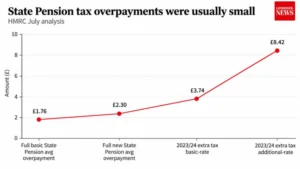
The difference became larger in years when the State Pension received a substantial annual increase.
For example, HMRC’s figures show that in 2023/24, using one extra week at the higher rate could have created £3.74 of additional tax for a basic-rate taxpayer receiving the full new State Pension, rising to £8.42 for an additional-rate taxpayer.
This helps explain why a total repayment bill of around £19.3 million can be spread across more than three million customers.
Expert Who Highlighted Error Criticises Earlier-Year Process
Tax expert Mike Warburton, a former Grant Thornton tax director whose investigation helped bring wider attention to the discrepancy, has criticised the requirement for some pensioners to find evidence relating to older years.
Speaking after HMRC’s latest refund decision, Warburton said:
“It’s disgraceful for taxpayers to be expected to go through records to make a claim.”
His concern centres on pensioners potentially affected before 2020/21, because those years are outside HMRC’s planned automatic correction exercise.
Warburton had raised the State Pension calculation issue earlier in 2026 after noticing that the State Pension amount pre-populated in Self Assessment did not match the calculation set out in HMRC’s own guidance. HMRC subsequently acknowledged the error.
Low Incomes Tax Reform Group Calls For Simple Claims
Antonia Stokes of the Low Incomes Tax Reform Group (LITRG) has also welcomed the ability to correct older cases while raising concerns about how easy the process will be for pensioners.
Stokes said it was “disappointing that HMRC data constraints prevent automated repayments further back”, while describing the ability for taxpayers to seek corrections themselves as positive.
She added that HMRC should make the process as straightforward as possible and clearly alert people that they can check whether they are entitled to repayments for earlier years.
LITRG has previously highlighted the complexity of State Pension taxation and argued that pensioners need clearer information about the taxable annual amount.
That is particularly relevant because people receiving State Pension do not simply look at the amount that landed in their bank account when determining the taxable figure. HMRC calculates taxation according to pension entitlement during the tax year.
What HMRC Has Fixed For 2025/26 And Future Years?
There has also been progress on preventing the problem from continuing.
HMRC told MPs that on 25 August 2026 it implemented a change so future annual PAYE and Simple Assessment reconciliations use the correct State Pension figures.
Self Assessment requires additional work.
HMRC said it expects to correct pre-populated State Pension figures during September for taxpayers who have not yet submitted their 2025/26 Self Assessment returns.
Those who already filed are expected to have their positions corrected subsequently.
Anyone completing a 2025/26 return should therefore still check the State Pension amount rather than automatically assuming a pre-filled figure is correct.
HMRC’s current guidance says taxpayers should use the State Pension entitlement shown by DWP, and, for most people who were already receiving the pension, the taxable annual figure reflects one week at the old rate and 51 weeks at the new rate.
Were Millions Of Pensioners Overtaxed In 2024/25?
HMRC’s earlier analysis demonstrates why the figures surrounding this issue need careful interpretation.
For 2024/25, HMRC confirmed that around 1.4 million PAYE pensioners actually paid too much tax because of the error.
It also identified:
- Up to 955,000 Self Assessment pensioners who may have had an incorrect State Pension figure used
- Around 760,000 Simple Assessment pensioners who may have had an incorrect figure used
Those latter figures were described by HMRC as upper limits, rather than confirmation that every person actually overpaid tax.
Some Self Assessment users may have manually replaced the incorrect pre-populated figure, while some Simple Assessment balances may not ultimately have been collected.
That distinction matters. An incorrect State Pension figure appearing in HMRC’s system does not automatically mean the person lost money.
What If You Think HMRC Overtaxed You Before 2020?
The latest automatic exercise goes back to 2020/21 because HMRC says that is the earliest point for which its available data allows it to identify and correct cases reliably and efficiently.
But the underlying PAYE issue potentially reaches back to 2010/11.
Anyone who believes they were affected earlier can ask HMRC to review the position, although HMRC says those requests will be handled individually and taxpayers will need appropriate evidence.
Useful records could include State Pension entitlement letters, historic tax calculations, P800 notices, Self Assessment returns and other documents showing the pension amount used for tax purposes.
Pensioners should also be cautious about unexpected calls, texts or emails claiming to offer an HMRC refund.
Genuine tax repayments should be checked through official HMRC channels rather than by giving banking or personal information to an unsolicited contact.
Why The HMRC Refund Decision Matters?
The amounts being refunded are modest for many individuals, but the case has exposed how a small technical difference can become a multimillion-pound problem when repeated across millions of tax records for years.
John-Paul Marks has apologised for the error and confirmed that HMRC is conducting an internal audit review.
He said:
“I am sorry that this error occurred and recognise the impact on affected customers.”
As of 18 September 2026, the key position is clear: around 3.2 million customers are expected to receive approximately £19.3 million in State Pension tax repayments, with HMRC handling corrections from 2020/21 onwards automatically in most cases.
For earlier years, pensioners who believe they were overcharged will need to check their records and approach HMRC for an individual review.
About the Journalist
Henry is the editorial head and lead author at Londoner. He oversees the publication’s editorial direction, article quality, source verification and corrections process. He also reviews major stories before publication to ensure they meet Londoner’s standards for accuracy, fairness and transparency.