Major UK Mortgage Lenders Raising Rates as Borrowers Face Fresh September Shock
 Published By
Ben
Published By
Ben
Published:
Table of Contents
Britain’s mortgage market has taken another turn against borrowers, with major UK mortgage lenders raising rates across hundreds of fixed deals as higher wholesale borrowing costs feed through to home loans.
Barclays, Santander, HSBC, NatWest and TSB are among the large lenders to have increased mortgage pricing in September, while Coventry Building Society, Virgin Money, Skipton Building Society and Nottingham Building Society have also been caught up in the latest repricing cycle.
The changes are already visible in market averages.
The latest Moneyfacts data available on 8 September 2026 put the average two-year fixed residential mortgage rate at 5.65%, up from 5.63% on the previous working day.
The average five-year fixed rate increased to 5.70%, from 5.68%.
That puts the average two-year rate at its highest level since early June and the average five-year rate at its highest since May.
The number of residential mortgage products available also dropped from 7,485 to 7,417 in one working day, suggesting that lenders are not only increasing rates but also withdrawing and replacing products as funding conditions change.
The increase comes after several months in which borrowers had been hoping mortgage costs would gradually ease.
Instead, September has opened with another wave of repricing.
For London homeowners, the timing is particularly difficult. Lloyds’ latest housing data showed London house prices falling 1.5% annually in August, while buyers continue to contend with borrowing costs substantially above the levels seen earlier in the mortgage cycle.
High London property values also mean relatively small changes in mortgage rates can translate into significant cash differences for households borrowing larger sums.
Which Major UK Mortgage Lenders Are Raising Rates?
Barclays has increased a range of mortgage rates by as much as 0.18 percentage points.
Its two-year fixed mortgage at 90% loan-to-value with an £899 fee increased from 4.96% to 5.14%, while the fee-free version rose from 5.11% to 5.29%.
The bank’s two-year 95% LTV deal moved from 5.35% to 5.53%.
Several five-year products were also repriced. A 90% LTV Premier mortgage increased from 4.65% to 4.83%, while some standard 90% LTV five-year deals moved from 4.85% to 5.03% and from 5.05% to 5.23%.
The changes are particularly relevant to first-time buyers because borrowers with smaller deposits tend to rely on mortgages at 90% or 95% LTV.
Santander has made similarly significant adjustments.
Among its home-mover mortgages, a 60% LTV two-year fixed deal with a £1,499 fee increased by 0.05 percentage points to 4.52%.
Its 85% LTV two-year mortgage with a £999 fee increased by 0.17 percentage points to 4.90%.
Some borrowers are seeing larger changes.
Santander increased its 90% LTV five-year mortgage with a £999 fee by 0.25 percentage points to 5.03%, while a fee-free 95% LTV two-year deal increased by 0.20 points to 5.54%.
First-time buyers have also been affected. Santander’s 90% LTV two-year and five-year fixed deals with a £999 fee increased by 0.25 percentage points to 5.10%.
Santander has separately confirmed that its new pricing became effective on Tuesday 8 September, with fixed and selected tracker rates increased across its new-business range and selected fixed rates raised for existing customers transferring products.
HSBC has increased rates across first-time buyer, homemover and remortgage mortgages, including two-year and five-year fixed products.
Its changes cover multiple LTV bands as well as fee-saver, Premier, high-value and buy-to-let products.
A market check dated 8 September put HSBC’s residential home-mover range from around 4.59% for a two-year fix and 4.58% for a five-year fix at 60% LTV, both carrying a £999 booking fee.
Its standard variable rate was listed at 6.24%.
NatWest has also increased mortgage pricing, with some changes reaching 0.25 percentage points.
The lender has repriced residential mortgages, buy-to-let products and mortgages for energy-efficient properties.
One of its largest reported changes involved a two-year fixed buy-to-let purchase mortgage at 75% LTV, which increased from 3.93% to 4.18%, although that deal carries a substantial £3,999 fee.
TSB, meanwhile, increased rates on all of its fixed house-purchase products by 0.15 percentage points from 8 September.
Its three-year fixed remortgage products were also increased by 0.15 percentage points.
Skipton, Nottingham Building Society and other lenders have also announced increases, suggesting that the move is no longer limited to one or two high-street banks.
David Hollingworth of mortgage broker L&C said:
“The flow of rate hike announcements is picking up pace as expected.”
He said the reversal was markedly different from the gentle downward movement in fixed rates borrowers had been seeing previously.
Mortgage pricing data also needs some context because different market trackers calculate their averages differently.
Rightmove’s latest tracker, based on products representing around 95% of the mortgage market and typically carrying fees of around £999, put the average two-year fixed rate at 5.13% on 8 September, up 0.08 percentage points over the week.
Its five-year average was 5.15%, up 0.07 points.
For borrowers with only a 5% deposit, however, the average two-year 95% LTV rate stood at 5.71%, while the average five-year rate was 5.69%.
For borrowers at 60% LTV, the corresponding averages were considerably lower at 4.67% and 4.71%.
That gap demonstrates why a headline “average mortgage rate” does not necessarily represent the rate an individual homeowner or buyer will receive.
Deposit size, property value, income, credit record, fees, mortgage term and whether someone is buying or remortgaging can all materially alter the available deal.
Why Are Mortgage Rates Going Up Again?
The immediate explanation is not a Bank of England rate rise.
The Bank Rate remains at 3.75%.
Instead, fixed mortgages are being pushed higher primarily by changes in wholesale financial markets.
Mortgage lenders commonly use interest-rate swaps when managing the risk attached to fixed-rate lending. When swap rates rise, offering cheap fixed mortgages becomes more expensive.
Moneyfacts data showed the two-year swap rate at around 4.26% on 3 September, compared with 4.06% a month earlier. The five-year swap had risen from around 4.16% to 4.36% over the same period.
That movement has squeezed the margin lenders have between their own funding costs and the rates offered to homeowners.
Rachel Springall, finance expert at Moneyfactscompare.co.uk, described the repricing pressure clearly:
“The pricing margins among major lenders are under pressure due to renewed volatility in the swap rate market.”
She said higher swap rates were beginning to filter through into fixed mortgage pricing, with further lender changes possible.
Hina Bhudia, partner at Knight Frank Finance, has made a similar assessment.
“Lender margins are extremely thin, which leaves them vulnerable to the kind of moves in swap rates that we’ve seen.”
Bhudia said uncertainty surrounding long-term government bond yields and the forthcoming Budget made it difficult to see mortgage rates falling sharply in the immediate term.
Global developments are playing an unusually important role.
Oil prices have again approached $100 a barrel amid renewed Middle East tensions. Higher energy costs increase the risk of another inflationary shock, making financial markets less confident that interest rates can fall rapidly.
UK government borrowing costs have risen at the same time.
On 8 September the Government sold £4 billion of 30-year debt at an interest rate of 5.82%, the highest rate on a new 30-year UK government bond since the Debt Management Office was established in 1998.
There is, however, an important distinction between what markets fear and what economists currently expect the Bank of England to do.
Financial markets have been pricing in the possibility of a 0.25 percentage-point Bank Rate increase before the end of 2026.
But that is far from a certainty.
A Reuters poll of 65 economists conducted between 4 and 8 September found that every economist surveyed expected the Monetary Policy Committee to leave Bank Rate unchanged at 3.75% at its 17 September meeting.
Fifty-seven of the 65 economists also expected rates to remain unchanged throughout the rest of 2026.

Bank of England Governor Andrew Bailey has also pushed back against the idea that higher official interest rates are already decided.
Speaking to MPs on the Treasury Committee on 8 September, Bailey said market prices contained a risk premium reflecting concerns about future energy costs.
He stressed that monetary policy would depend on how economic and geopolitical conditions actually develop rather than following a predetermined route.
That means borrowers face a slightly unusual situation.
Mortgage rates can rise even if the Bank of England does nothing, because lenders price fixed mortgages partly according to expectations about future interest rates and the cost of obtaining long-term funding.
What Should Homeowners and First-Time Buyers Do Now?
For borrowers approaching the end of an existing fixed mortgage, the latest repricing means waiting for a dramatically cheaper deal carries more risk than it did several weeks ago.
Many lenders allow existing customers or remortgage borrowers to secure a new mortgage several months before their current deal expires.
That can provide a degree of protection if rates continue rising, while some arrangements may still allow the borrower to switch again before completion should a cheaper deal subsequently become available.
The financial effect of seemingly small changes should not be underestimated.
Moneyfacts calculated that increasing a typical two-year fixed mortgage from 5.63% to 5.88% would add approximately £38 a month, or £456 a year, to repayments on a £250,000 repayment mortgage over 25 years.
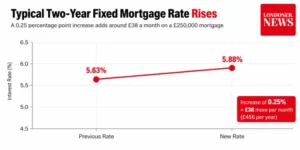
For London borrowers carrying significantly larger mortgages, the monetary effect can naturally be greater.
Borrowers should also compare the overall cost rather than automatically selecting the mortgage carrying the lowest headline interest rate.
A 4.5% mortgage accompanied by a £1,499 or £1,999 product fee may not be cheaper overall than a slightly higher-rate fee-free mortgage, particularly on a smaller balance or shorter initial deal.
The same applies when comparing two-year and five-year fixes.
A two-year mortgage gives the borrower another opportunity to refinance sooner if rates eventually fall, but it also exposes them to another round of product fees and whatever market conditions exist in 2028.
A five-year mortgage provides greater payment certainty, but the borrower could remain locked into today’s relatively elevated rates if borrowing costs fall substantially.
There is no single option that is automatically best for every household.
The clearest development this week is simply that the direction of travel has changed again.
Mortgage rates had been easing after the sharp increases seen earlier in 2026. Now wholesale borrowing costs, energy-market uncertainty and inflation concerns have forced Britain’s biggest lenders back into defensive pricing.
For anyone asking whether major UK mortgage lenders are raising rates, the answer as of 9 September 2026 is yes.
Barclays, Santander, HSBC, NatWest, TSB and several building societies have already repriced mortgages, average fixed rates are moving higher, and the number of available residential products has begun to fall.
That does not guarantee a sustained mortgage-rate surge and it does not mean a Bank of England increase is certain.
But for homeowners coming off a fixed deal and buyers preparing to enter the market, September’s repricing is a warning that the window for the cheapest available mortgage deals can close quickly when financial-market expectations change.
About the Journalist
Ben covers business, transport and global developments for Londoner. His reporting focuses on London’s economy, major companies, infrastructure, public transport and international stories that may affect people and businesses across the capital. He explains complex developments clearly using reliable sources and relevant context.