UK Banks Warn Burnham Windfall Tax Could Damage City And London Jobs
 Published By
Jermaine
Published By
Jermaine
Published:

Table of Contents
Britain’s largest banks have stepped up pressure on Prime Minister Andy Burnham’s government over the prospect of a new windfall tax, warning that another raid on the financial sector could damage the competitiveness of the City of London and push investment and jobs overseas.
The warning comes as Chancellor John Healey prepares for his first Budget in October and faces growing pressure to raise additional revenue while funding the government’s cost-of-living and economic commitments.
Banking trade body UK Finance, whose members include Barclays, HSBC, Lloyds Banking Group and NatWest Group, has written to the Chancellor opposing increases in bank-specific taxes or the introduction of a new windfall levy.
The latest intervention follows separate warnings from some of the world’s largest banking executives and comes amid a wider political debate over whether unusually strong banking profits should be used to help fund support for households and businesses.
Why Are UK Banks Warning Andy Burnham About a Windfall Tax?
Banks are concerned that the government could increase taxes on the industry as it searches for additional revenue ahead of the autumn Budget.
UK Finance chief executive David Postings told the Chancellor that the industry opposed proposals for either an increase in the bank corporation tax surcharge or a separate windfall tax.
The organisation argued that banks already make a substantial contribution to the Exchequer and that increasing the sector’s tax burden could make Britain less attractive compared with financial centres including New York, Frankfurt, Dublin and Amsterdam.
UK Finance said the banking sector paid more than £43 billion in taxes last year, equivalent to around 4.3% of total UK tax receipts. It puts the overall tax rate faced by banks at approximately 46.6%, when different taxes affecting the industry are taken into account.
The organisation’s concern is that banks deciding where to allocate investment, capital and jobs will increasingly compare Britain’s tax regime with those available elsewhere.
That argument has particular significance for London, where international financial institutions employ tens of thousands of people and continue to invest billions of pounds in offices and infrastructure.
What Bank Taxes Are Already Paid in the UK?
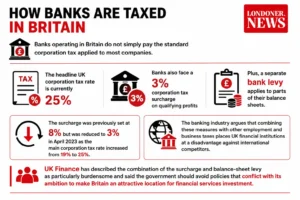
Banks operating in Britain do not simply pay the standard corporation tax applied to most companies.
The headline UK corporation tax rate is currently 25%, while banks also face a 3% corporation tax surcharge on qualifying profits as well as the separate bank levy, which applies to parts of their balance sheets.
The surcharge was previously set at 8% but was reduced to 3% in April 2023 as the main corporation tax rate increased from 19% to 25%.
The banking industry argues that combining these measures with other employment and business taxes places UK financial institutions at a disadvantage against international competitors.
UK Finance has described the combination of the surcharge and balance-sheet levy as particularly burdensome and said the government should avoid policies that conflict with its ambition to make Britain an attractive location for financial services investment.
Why Is a Bank Windfall Tax Being Considered?
The debate has intensified because Britain’s biggest banks have been reporting substantial profits.
HSBC, NatWest, Barclays and Lloyds together recorded around £29.2 billion in profits during the first half of 2026, according to figures reported earlier this month.
About £13.7 billion was earmarked for shareholders through dividends and share buybacks.
Those results have prompted trade unions and campaign groups to argue that banks have benefited disproportionately from higher interest rates while households continue to face pressure from energy bills, mortgages, rents and everyday living costs.
The Trades Union Congress has been among those pushing for higher taxation of bank profits.
Campaign group Positive Money has also called for a windfall tax, estimating that changes to the way banks are taxed could potentially raise around £19 billion. The group argues that the proceeds could help fund measures aimed at reducing household costs.
The Green Party has separately called for a 38% windfall tax on banks, proposing that revenue could be used to finance tax reductions for smaller businesses.
However, no new bank windfall tax has yet been formally confirmed by the government.
Could a Bank Tax Affect Jobs in London?
The possibility of financial jobs moving away from London is one of the banking industry’s main arguments against additional taxation.
London competes internationally with cities including New York, Paris, Frankfurt, Singapore and Dubai for financial services investment.
Banks can move certain operations between countries over time, meaning tax rates and regulation can influence decisions about where new jobs, offices and investment are located.
Earlier warnings from UK Finance suggested substantial tax increases could cause capital, investment and employment to move to other jurisdictions.
The group has previously pointed out that Britain’s banking industry supports almost 400,000 jobs, although more than half of financial sector employment represented by its members is now located outside London.
Nevertheless, London remains Britain’s dominant international financial centre, making the capital particularly exposed to decisions made by global banks.
What Has JP Morgan Said About Higher Bank Taxes?
The government has also faced pressure from JP Morgan chief executive Jamie Dimon, one of the world’s most influential banking executives.
Dimon has repeatedly criticised proposals for higher UK bank taxes and recently spoke directly with Chancellor John Healey.
He warned that excessive taxation could encourage financial institutions to move investment and jobs elsewhere, citing the movement of finance jobs away from New York as an example of what he believes can happen when the business environment becomes less competitive.
The issue is particularly important in London because JP Morgan announced plans for a new £3 billion headquarters in Canary Wharf.
The proposed development would significantly expand the bank’s long-term presence in the capital.
Dimon has previously suggested that worsening business conditions, including additional taxation, could cause the bank to reconsider major investment decisions in Britain.
How Important Are Banks to Andy Burnham’s Growth Plans?

The disagreement creates a difficult balancing act for the Burnham government.
The Prime Minister has put economic growth and reducing living costs at the centre of his programme, but both objectives could pull tax policy in different directions.
Raising money from highly profitable banks could provide additional funding for government programmes without directly increasing income tax on households.
However, the financial services industry argues that higher taxation could reduce the capital available for lending and investment, ultimately undermining growth.
UK Finance has stressed that banks provide mortgages, business loans and investment finance across the country.
Meanwhile, Barclays, NatWest and other major lenders have also argued that expanding credit to businesses will be essential if the government wants to increase economic investment.
Earlier reports suggested Burnham intended to continue the previous government’s Financial Services Growth and Competitiveness Strategy, which sought to make the UK more attractive to international financial companies and encourage investment.
A substantial bank tax rise could therefore create tension between the government’s revenue requirements and its stated desire to strengthen the City.
Why Have Bank Profits Increased?
Higher interest rates have played an important role in boosting banking profitability.
Banks typically earn money from the difference between the interest they charge borrowers and the interest paid to savers, known as the net interest margin.
Periods of higher rates can increase these margins, although individual banks are affected differently depending on their loan books, deposit levels and hedging arrangements.
HSBC reported profits of around £7.5 billion for the second quarter of 2026, with profits rising sharply compared with the same period a year earlier.
Barclays, meanwhile, reported half-year profits of around £6.1 billion, up 17% year on year, while increasing its bonus pool and announcing further shareholder distributions.
These figures have strengthened arguments from supporters of a windfall tax that the sector has sufficient capacity to make a larger contribution.
Banks counter that sustainable profits are essential for maintaining lending, attracting international capital and remaining resilient during economic downturns.
What Happens Next With the Proposed Bank Windfall Tax?
Attention will now turn to Chancellor John Healey’s first Budget, expected in October 2026.
The government has not confirmed that a bank windfall tax will be included, and discussions remain part of a wider debate about how Burnham’s administration will balance spending commitments, taxation and economic growth.
The latest warning from Britain’s biggest banks nevertheless shows that the City is already preparing for a significant lobbying battle.
For London, the stakes extend beyond bank profits. The debate touches on the capital’s position as a global financial centre, future investment in Canary Wharf and the Square Mile, and thousands of highly paid jobs connected to banking, legal services, technology and professional services.
Supporters of higher bank taxes argue that exceptional profits provide an opportunity to help households struggling with living costs without increasing taxes on workers.
The banking industry argues that continually increasing sector-specific taxes could eventually make Britain less competitive and encourage international institutions to put their next major investment somewhere else.
With the Budget approaching, Andy Burnham and John Healey will have to decide whether the potential revenue from a tougher bank tax outweighs the economic risks being raised by some of the biggest names in the City.
About the Journalist
Jermaines covers crime, legal affairs and money-related stories for Londoner. His reporting includes police updates, court cases, consumer rights, personal finance and cost-of-living issues. He handles sensitive subjects carefully and clearly distinguishes confirmed facts from allegations, estimates and ongoing investigations.

One reader comment