LCWRA First Payment After Decision: When Will You Get Paid In 2026?
 Published By
Ben
Published By
Ben
Published:

Table of Contents
Your LCWRA first payment after decision is not normally calculated simply from the date the Department for Work and Pensions (DWP) tells you that you have Limited Capability for Work and Work-Related Activity.
Under the DWP’s current Universal Credit health-condition guidance, the extra LCWRA amount will usually become payable after three monthly assessment periods following the point when you started submitting medical evidence showing that your condition limits how much work you can do. There are exceptions where the extra amount can start sooner.
That means two people who receive an LCWRA decision on the same day could have different first payment dates.
The main factors are:
- When You Reported Your Health Condition to Universal Credit
- When You First Supplied The Relevant Medical Evidence to DWP
- Your Universal Credit Assessment Period Dates
- Whether The Three-Month Relevant Period Has Ended
- Whether An Exception To The Waiting Period Applies
- Whether DWP Owes LCWRA Arrears For Earlier Assessment Periods
If the relevant period ended before your LCWRA decision was made, you could be owed money for earlier eligible assessment periods.
Recent LCWRA Update In 2026
A new Upper Tribunal decision published on 28 August 2026 has provided important clarification about the date used when calculating the LCWRA relevant period.
The decision, GEA v Secretary of State for Work and Pensions [2026] UKUT 312 (AAC), was made by Upper Tribunal Judge Butler on 7 August and published by HM Courts & Tribunals Service on 28 August.
New Tribunal Ruling On LCWRA Medical Evidence And Payment Timing
One of the issues considered was whether the three-month period under Regulation 28 could start from an earlier date written on medical evidence, rather than the date that evidence was actually supplied to DWP.
The claimant had supplied medical evidence to DWP on 3 June 2021, but the medical certificate referred to an earlier date of 15 May 2021.
The full Upper Tribunal decision states that Regulation 28(2)(b) refers to the date when the claimant first supplies evidence of limited capability for work to DWP.
Judge Butler said the wording did not allow an earlier date simply because an earlier date appeared in that evidence.
Does LCWRA Start From The Date Of The Decision?
Usually, no. An LCWRA decision confirms that DWP considers you to have limited capability for work and work-related activity, but the decision date is not automatically the date from which the extra amount becomes payable.

For most claimants, DWP has to look back at the relevant timeline.
| Stage | Why It Matters |
| Health Condition Reported | Establishes when DWP was told about the condition |
| Medical Evidence Supplied | Can determine when the relevant period begins |
| Three-Month Relevant Period | Usually has to pass before the LCWRA element is included |
| Assessment Period | Determines which monthly UC award can include LCWRA |
| LCWRA Decision | Confirms the Work Capability Assessment outcome |
| Arrears Calculation | May be needed if entitlement started before the decision |
Universal Credit works through monthly assessment periods rather than simply paying benefits according to the number of calendar days since a decision.
If DWP Benefit Closure takes longer to make the Work Capability Assessment decision, this does not necessarily mean your financial entitlement begins only when the decision arrives.
This is why someone can receive an LCWRA decision in August 2026 but potentially have an entitlement starting from an earlier assessment period.
What Is The Three-Month LCWRA Waiting Period?
The phrase three-month waiting period is commonly used, but it can be misleading if you simply count three months forward and expect money to arrive on that date.
Regulation 28 provides that the LCWRA element is normally not included until the beginning of the assessment period following the assessment period in which the relevant three-month period ends.
This interaction between calendar months and Universal Credit assessment periods explains why some people describe receiving the LCWRA element in their fourth or fifth Universal Credit payment after supplying evidence.
It is not a guaranteed fourth-payment rule for everybody.
Exceptions can also apply.
DWP guidance says the extra amount may be included without the normal wait in certain circumstances, including some claimants nearing the end of life and some people moving from Employment and Support Allowance to Universal Credit.
Is LCWRA Backdated After The Decision?
LCWRA can result in arrears when DWP makes its decision after the date from which the element should have been included in the Universal Credit award.
This is sometimes described as LCWRA backpay.
The important distinction is that backpay is not automatically calculated from the date of the LCWRA decision or from whatever earlier date happens to appear on a fit note.
DWP needs to establish the correct entitlement date using the relevant-period and assessment-period rules.
Is LCWRA Backdated To Your First Fit Note?
Not necessarily to the date written on the fit note.
The August 2026 Upper Tribunal ruling makes this distinction especially important.
The tribunal concluded that the relevant wording concerns when the claimant provides the evidence to DWP rather than an earlier date stated within the medical certificate.
So, for example, if a medical certificate says your condition affected you from 1 January but you first supply qualifying evidence to DWP later, you should not automatically assume 1 January will be used as the start of the Regulation 28 period.
Individual cases can be more complicated where different rules or exceptions apply.
How Much Is LCWRA In 2026/27?
A major Universal Credit change took effect from 6 April 2026, when the LCWRA element moved from one general rate to a higher and lower rate.
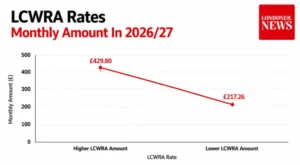
The official 2026/27 amounts are:
| LCWRA Rate | Monthly Amount In 2026/27 |
| Higher LCWRA Amount | £429.80 |
| Lower LCWRA Amount | £217.26 |
These figures are the LCWRA element itself, not necessarily the claimant’s total Universal Credit payment.
Your overall UC award can also be affected by earnings, other elements, income and deductions.
Who Can Get The Higher LCWRA Rate?
Current DWP guidance says the higher amount can apply where:
- You Told DWP About Your Health Condition Before 6 April 2026, regardless of when the LCWRA decision was eventually made
- You Meet The Severe And Lifelong Conditions Criteria
- You Are Nearing The End Of Life Under The Applicable Rules
- You Meet Certain ESA Transitional Conditions
People who reported their condition before 6 April 2026 therefore should not assume they receive the lower rate simply because their LCWRA decision was made after 6 April.
For other qualifying cases arising under the post-April 2026 system, the lower amount is generally £217.26 per monthly assessment period.
LCWRA First Payment Example
Consider a claimant whose Universal Credit assessment period runs from the 10th of each month to the 9th of the next month.
They supply qualifying medical evidence to DWP on 15 January.
A simplified timeline could look like this:
| Date | What Happens |
| 15 January | Medical evidence is supplied to DWP |
| 15 January To 14 April | Three-month relevant period runs |
| 10 April To 9 May | Assessment period in which the relevant period ends |
| 10 May | Following assessment period begins |
| 10 May To 9 June | LCWRA can potentially be included for this assessment period |
| Around Mid-June | UC payment for that assessment period would normally be due |
If the LCWRA decision were not made until August, DWP could need to revisit the earlier eligible assessment periods and calculate any LCWRA arrears that were due.
This is only an example. A claimant whose assessment period starts on another date will have a different timeline, and exceptions can change the calculation.
What To Check After Receiving An LCWRA Decision?
Once the decision appears in your Universal Credit account, do not rely solely on the date of the decision letter.
Check your next statement and look at:
- The LCWRA Amount shown in the calculation
- The Assessment Period covered by the statement
- The Rate Applied at £429.80 or £217.26 where appropriate
- The Date DWP Used for the relevant period
- Any Arrears Payment or recalculation covering earlier periods
If the numbers do not appear to match your circumstances, you can use your Universal Credit journal to ask DWP which assessment period it treated as the first period for LCWRA payment.
It can be useful to ask specifically:
- What Date Was Used As The Start Of The Relevant Period?
- Which Assessment Period First Includes LCWRA?
- Are Any LCWRA Arrears Due?
- Which 2026/27 LCWRA Rate Has Been Applied?
Keeping copies of fit notes, journal messages and decision notices can also help if the start date later needs to be checked.
What To Do If Your LCWRA First Payment Has Not Arrived?
If you have received an LCWRA decision but cannot see the extra amount, first check whether the relevant period has actually finished and which assessment period should include the element.
Then:
- Check Your Latest Universal Credit Statement
- Check Your Assessment Period Start And End Dates
- Confirm When You First Supplied Medical Evidence
- Read The LCWRA Decision Notice Carefully
- Ask DWP Which Date It Used For Regulation 28
- Ask Whether Any Arrears Calculation Is Outstanding
- Check Whether The Correct 2026/27 LCWRA Rate Was Used
If you believe DWP has used the wrong date or rate, ask for an explanation through your journal and consider independent welfare-rights advice if the issue is not resolved.
About the Journalist
Ben covers business, transport and global developments for Londoner. His reporting focuses on London’s economy, major companies, infrastructure, public transport and international stories that may affect people and businesses across the capital. He explains complex developments clearly using reliable sources and relevant context.