BR Tax Code UK: Meaning, Refunds & Underpayment Risk in 2026/27
 Published By
Ben
Published By
Ben
Published:

Table of Contents
Seeing BR on a payslip does not automatically mean something has gone wrong.
A BR tax code tells an employer or pension provider to deduct Income Tax at the basic rate from all income paid through that particular job or pension. There is no Personal Allowance allocated to that source of income.
For England and Northern Ireland, the basic Income Tax rate is 20% in the 2026/27 tax year. Wales also has a 20% basic rate in 2026/27. HMRC describes BR as a code that gives no allowances and, importantly, ignores higher rates.
That final point matters.
A BR tax code can result in too much tax being deducted, particularly when it has incorrectly been applied to someone’s main job.
But it can also result in too little tax being deducted if the person’s combined income should place some of the BR-coded income into the higher or additional-rate bands.
Anyone trying to understand other PAYE letters can compare BR with the complete list of UK tax codes and what they mean.
What Does The BR Tax Code Mean?
BR stands for Basic Rate.
Under a BR tax code, the employer or pension provider generally applies the basic rate of Income Tax to every pound paid through that particular source.
For a BR-coded employment paying £1,000 in taxable salary for a month, a simplified calculation would therefore be:
£1,000 × 20% = £200 Income Tax
For £2,000:
£2,000 × 20% = £400 Income Tax
And for £3,000:
£3,000 × 20% = £600 Income Tax
These examples concern Income Tax only. National Insurance, pension contributions, student loan repayments and other payroll deductions are calculated separately where applicable.
HMRC says BR is generally used for a second job or pension. It can also appear when someone starts a job and the information supplied to the employer causes BR to be used initially.
Does BR Give You A Personal Allowance?
No.
The standard UK Personal Allowance for 2026/27 is £12,570, although it can be reduced for people with adjusted net income above £100,000 and disappears completely at sufficiently high income.
A normal tax code such as 1257L generally allocates the standard £12,570 allowance through PAYE. Someone who wants to see how that operates can read the explanation of tax code 1257L and how the Personal Allowance is applied.
BR works differently.
There is no tax-free amount built into BR. If £10,000 is paid through a BR-coded job during the year, the basic BR calculation is:
£10,000 × 20% = £2,000
This does not necessarily mean the individual ultimately owes £2,000 on that £10,000. The person’s total annual tax liability across all income sources determines whether the BR deductions were correct.
BR Tax Code Calculator 2026/27
Estimate whether BR could be deducting too much or too little Income Tax.
Simplified 2026/27 estimate for employment and pension income in England, Wales and Northern Ireland. It does not calculate Scottish Income Tax, National Insurance, student loans, pension relief, benefits, dividends, savings income or every PAYE adjustment.
What Is The Difference Between BR, 0T, D0 And D1?
BR is often confused with 0T, D0 and D1 because all four can be used where a normal Personal Allowance is not being allocated to the income source.
They do not work in the same way.
| Tax code | Personal Allowance through that source? | How Income Tax is generally deducted |
| BR | No | All income at the basic rate, normally 20% |
| 0T | No | Income moves through the normal basic, higher and additional-rate bands |
| D0 | No | All income from that source at the higher rate, 40% in England and Northern Ireland in 2026/27 |
| D1 | No | All income from that source at the additional rate, 45% in England and Northern Ireland in 2026/27 |
The distinction between BR and 0T is particularly important.
BR applies one flat basic rate to the source. HMRC’s PAYE manual specifically says the code gives no allowances and ignores higher rates.
By comparison, 0T provides no Personal Allowance but still moves income through the applicable rate bands according to earnings.
For someone receiving a large salary, BR and 0T can therefore produce dramatically different deductions.
Is BR The Same As An Emergency Tax Code?
Not necessarily.
BR is a special PAYE code, but it should not automatically be treated as another name for an emergency tax code.
HMRC’s emergency codes for 2026/27 can include forms such as:
- 1257L W1
- 1257L M1
- 1257L X
W1 means Week 1 and M1 means Month 1. These codes calculate tax using the current pay period rather than fully taking earlier pay and tax in the tax year into account.
BR can, however, appear because of incomplete or incorrect information when somebody starts a job, which is one reason people sometimes loosely describe it as “emergency tax”.
HMRC specifically warns that a person who starts a new job without a P45 and either fails to complete the necessary starter information or completes it incorrectly may initially receive BR or 0T.
Why Have I Been Given A BR Tax Code?
There are several situations in which BR can appear legitimately.
A Second Job
This is one of the most common reasons.
Imagine an employee has a main job where their Personal Allowance is already being used.
They then take a second job.
Giving another full Personal Allowance to the second employment could mean too little tax was collected overall, so HMRC may instead allocate BR to the additional employment.
However, BR is only appropriate if taxing all of that secondary income at the basic rate produces approximately the correct result.
A higher-rate taxpayer may require a different arrangement.
A Job And A Pension
The same principle can apply when someone receives salary from employment while also receiving a taxable occupational or private pension.
Their allowance might be allocated primarily against one source while BR is used against another.
More Than One Pension
Someone receiving several taxable pensions can have a different PAYE code against each provider.
One pension may receive the allowance while another is taxed under BR, D0 or another code.
Starting A New Job Without The Right Information
A BR code can also appear when an employer does not have all the information required to operate the correct PAYE code.
This is why providing a P45 or completing HMRC’s Starter Checklist accurately is important.
An Incorrect Starter Declaration
HMRC’s PAYE rules link Starter Checklist declarations to the initial PAYE treatment.
In particular, declaring that another job or occupational/state pension exists can lead to BR being used on the new source in relevant circumstances.
How Can The Starter Checklist Help Prevent The Wrong BR Code?
The Starter Checklist replaced the old P46 process for most new starters who do not have a P45.
An employee starting a job without a P45 should normally be asked to provide starter information so that the employer can determine which initial PAYE treatment to use.
HMRC provides an official Starter Checklist for PAYE.
The employee is asked about matters including whether this is their first job since the beginning of the tax year and whether they already have another job or receive certain pensions.
That information matters because an incorrect declaration can cause the employer to use a code that does not properly reflect the employee’s circumstances.
Anyone who has already received their first pay should not normally try to solve the issue by submitting a new Starter Checklist retrospectively. HMRC instead directs employees to its online Income Tax services to check and update their information.
How Can You Avoid Being Put On BR When Starting A Job?
A new employee can reduce the risk of incorrect PAYE deductions by making sure the employer receives complete information as early as possible.
Where available, give the new employer the P45 from the previous job.
Where there is no P45, complete the Starter Checklist accurately.
Someone should not state that a previous job is still active if it has actually ended, but equally should not claim that the new employment is their only income source when another job or pension continues.
After the first payslip arrives, check:
| Check | What To Look For |
| Tax code | BR, 1257L, 0T or another code |
| Gross pay | Whether salary and other taxable payments are correct |
| Income Tax | Whether the deduction appears plausible |
| Previous pay and tax | Whether earlier employment figures have been carried over where appropriate |
| Student loan | Whether the correct plan has been recorded |
| Pension deductions | Whether the expected contribution has been taken |
A code that looks unfamiliar is not automatically incorrect. It needs to be checked against the person’s full circumstances.
What Does SBR Mean In Scotland?
SBR is the Scottish equivalent of the BR principle.
HMRC states that SBR means all income from the relevant job or pension is taxed at the Scottish basic rate.
For 2026/27, Scotland has six non-savings, non-dividend Income Tax rates above the Personal Allowance:
| Scottish band | 2026/27 rate |
| Starter | 19% |
| Basic | 20% |
| Intermediate | 21% |
| Higher | 42% |
| Advanced | 45% |
| Top | 48% |
The Scottish bands differ significantly from those applying in England, Wales and Northern Ireland.
Other Scottish codes include SD0, SD1, SD2 and SD3 for particular flat-rate treatments on secondary sources.
This makes checking SBR especially important where the person’s overall Scottish income falls into the intermediate, higher, advanced or top bands.
What Does CBR Mean In Wales?
CBR means all income from that job or pension is taxed at the Welsh basic rate.
HMRC says it is generally used for a second job or pension where the taxpayer’s main home is in Wales.
For the 2026/27 tax year, the Welsh rates applying to employment income remain:
- Basic rate: 20%
- Higher rate: 40%
- Additional rate: 45%
The associated secondary-source codes can include CBR, CD0 and CD1.
The C prefix matters because it identifies the individual as a Welsh taxpayer. It should not simply be removed because someone works for a company based in England.
Taxpayer status is determined by residence rules rather than simply the employer’s office location.
Is BR The Right Tax Code For Me?
A simplified decision path can help.
Do you have only one job and no other taxable pension?
→ If yes, BR deserves checking because a normal allowance-bearing code may be more likely, depending on the person’s circumstances.
Do you have another job or taxable pension where your Personal Allowance is already being used?
→ BR may be appropriate.
Does your combined income remain within the basic-rate band?
→ BR on the secondary source may produce the right result.
Does your total income enter the higher or additional-rate bands?
→ BR may deduct too little from the secondary income. HMRC may instead need to use another code or adjust the code on another income source.
Are you a Scottish taxpayer?
→ Check whether SBR or another Scottish code should apply rather than BR.
Are you a Welsh taxpayer?
→ A C-prefixed code such as CBR may be expected.
This is only a screening exercise. The correct PAYE code depends on the complete tax record held by HMRC.
Can A BR Tax Code Make You Pay Too Much Tax?
Yes.
The clearest example is somebody who incorrectly has BR applied to their only job.
Consider an employee earning £20,000 with no other taxable income and entitlement to the full £12,570 Personal Allowance.
If the entire £20,000 were taxed under BR:
£20,000 × 20% = £4,000
But using the Personal Allowance, only £7,430 would be taxable at 20%:
£7,430 × 20% = £1,486
The simplified difference is:
£4,000 − £1,486 = £2,514
That is why an incorrectly applied BR code can create a sizeable overpayment.
Can A BR Tax Code Make You Pay Too Little Tax?
Yes — and this is an important risk that is sometimes overlooked.
HMRC explicitly states that BR ignores higher rates.
Suppose somebody already earns enough through their main job to be a higher-rate taxpayer and then receives another £10,000 from an employment coded BR.
BR deducts:
£10,000 × 20% = £2,000
But if all £10,000 ultimately falls into a 40% Income Tax band, the tax attributable to that additional income could instead be approximately:
£10,000 × 40% = £4,000
That leaves a potential:
£2,000 underpayment
HMRC may later recover an underpayment by adjusting the person’s tax code. Where the underpayment is below £3,000 and the relevant conditions are met, HMRC says it will usually collect it through a future PAYE code over 12 months. Larger or otherwise unsuitable amounts can require another payment method.
How Much Tax Could BR Deduct At Different Salaries?
The following examples assume England, Wales or Northern Ireland rates for 2026/27 and demonstrate what could happen if BR were incorrectly applied to someone’s only employment.
They are simplified examples and exclude National Insurance, pension contributions, benefits and other tax adjustments.
| Annual income | Tax deducted under BR | Approximate normal Income Tax liability | Approximate difference |
| £20,000 | £4,000 | £1,486 | £2,514 overpaid |
| £35,000 | £7,000 | £4,486 | £2,514 overpaid |
| £55,000 | £11,000 | £9,432 | £1,568 overpaid |
| £110,000 | £22,000 | £33,432 | £11,432 underpaid |
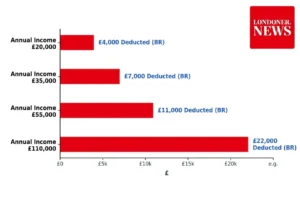
The £110,000 example illustrates why it is dangerous to assume BR always creates a refund.
At that income level, higher-rate tax applies and the Personal Allowance is also being tapered because adjusted net income exceeds £100,000.
In practice, HMRC would normally try to correct the PAYE coding rather than intentionally leave a £110,000 sole employment on BR for an entire year.
What Happens With BR When You Have Two Jobs?
A more realistic BR scenario involves a main job and a second employment.
Assume the second job pays £10,000 a year and is coded BR.
| Main job | Second job | BR tax on second job | Simplified result across both jobs |
| £20,000 | £10,000 | £2,000 | Approximately correct |
| £35,000 | £10,000 | £2,000 | Approximately correct |
| £55,000 | £10,000 | £2,000 | About £2,000 too little tax |
| £110,000 | £10,000 | £2,000 | Potentially about £4,000 too little tax |
These are deliberately simplified illustrations.
The £110,000 example is particularly important because extra income between £100,000 and £125,140 can also reduce the person’s Personal Allowance by £1 for every £2 of additional adjusted net income. That creates an effective marginal Income Tax rate that can be considerably higher than the ordinary 40% rate.
HMRC may compensate by changing the code attached to the main job or the secondary income rather than leaving the final liability to accumulate.
How Can You Calculate Tax Under BR?
The basic BR calculation is simple:
BR Income Tax = taxable pay from the BR-coded source × 20%
For example:
| BR-coded annual pay | Approximate BR Income Tax |
| £5,000 | £1,000 |
| £10,000 | £2,000 |
| £15,000 | £3,000 |
| £20,000 | £4,000 |
| £30,000 | £6,000 |
| £40,000 | £8,000 |
| £50,000 | £10,000 |
However, that only tells the reader what BR deducts.
It does not answer the more useful question:
Is that the amount of tax the person should ultimately be paying?
A useful BR tax-code calculator should therefore ask for both:
- income from the BR-coded job or pension; and
- income from other taxable employment or pensions.
It can then compare the flat BR deduction against the marginal Income Tax likely to be due once the income sources are combined.
HMRC also provides an official Income Tax estimator for the current tax year.
Does BR Affect Student Loan Repayments?
BR determines the PAYE Income Tax treatment of the income source.
It does not replace the separate student-loan calculation.
Student and postgraduate loan repayments operate under their own payroll thresholds and rates.
For 2026/27, HMRC confirms repayment thresholds including £26,900 for Plan 1, £29,385 for Plan 2, £33,795 for Plan 4 and £25,000 for Plan 5. Undergraduate plan deductions continue at 9% above the relevant threshold, while postgraduate loan deductions remain 6% above their threshold.
The Starter Checklist also asks for student-loan information.
Someone can therefore have both:
BR Income Tax + student loan deductions
on the same payslip.
Seeing 20% Income Tax under BR does not mean all other payroll deductions are included within that 20%.
Can BR Affect Universal Credit?
Potentially, but the interaction needs to be described carefully.
Universal Credit calculations for employed claimants generally take account of net take-home earnings, and DWP’s current guidance says workplace pension contributions should already be reflected because Universal Credit is based on net take-home pay.
Income Tax is one of the deductions relevant to calculating employed earnings under the Universal Credit rules. Therefore, an unusually high or low PAYE deduction can affect the net earnings reported for an assessment period.
There is an important distinction, however.
The Administrative Earnings Threshold, which affects a claimant’s work-related requirements, is measured using earnings before deductions for Income Tax, National Insurance and relievable pension contributions.
So a BR tax code should not be assumed to lower someone’s gross earnings for AET purposes simply because more Income Tax has been deducted from their payslip.
Is A 20% CIS Deduction The Same As BR Tax?
No.
This is a common source of confusion because both can involve a 20% deduction.
Under the Construction Industry Scheme, a registered and verified subcontractor will normally have CIS deductions taken at 20%, while an unregistered or unverified subcontractor can face a 30% rate.
Gross Payment Status can allow qualifying subcontractors to be paid without CIS deductions.
A CIS deduction is an advance payment towards the subcontractor’s tax liability.
It is not a BR PAYE tax code.
BR applies to income taxed through PAYE from an employment or pension. CIS applies to qualifying payments made to subcontractors under the Construction Industry Scheme.
A person could potentially encounter both systems if, for example, they undertake self-employed construction work while also having PAYE employment.
What Happens If BR Appears On A Pension?
BR is commonly used for secondary pension income.
For example, someone might receive employment income using their main allowance-bearing tax code and have another pension taxed under BR.
This does not mean every pension withdrawal will automatically be taxed at 20%.Flexible pension withdrawals have their own PAYE complications.
Where a pension provider does not have the required tax code for a flexible withdrawal, HMRC rules can require an emergency Week 1/Month 1 code, potentially producing an initial overpayment.
Specific HMRC forms such as P55, P53Z or P50Z can apply to certain pension-refund situations.
A regular secondary pension carrying BR is therefore different from an emergency-tax problem following a large one-off pension withdrawal.
What Happens To BR Tax On Redundancy Payments?
A BR code should not be used as a shortcut for deciding whether an entire redundancy package is taxable.
HMRC says the first combined £30,000 of qualifying statutory redundancy pay and certain additional termination payments can normally be tax-free.
Other amounts, including ordinary earnings, holiday pay and certain payments connected with notice periods, can be taxable through PAYE. Amounts of qualifying termination payments above the £30,000 exemption can also be taxable.
The tax treatment therefore depends on what each part of the termination package represents and when it is paid.
How Do You Check Whether A BR Tax Code Is Wrong?
Start with the payslip.
Check the tax code shown against the relevant employment or pension and then look at the other taxable income sources being received.
The key questions are:
Is this my only job or pension?
If yes, BR may deserve investigation because it provides no Personal Allowance.
Do I have another income source using my allowance?
If yes, BR may be intentional.
Does my combined income enter a higher tax band?
If yes, BR may actually be deducting too little.
Did I recently start this job?
If yes, check whether the employer received a P45 or correct Starter Checklist information.
Do I live in Scotland or Wales?
If yes, check whether an S or C prefix should appear.
HMRC’s tax-code checking service can show what the code means and allows taxpayers to review information held about their income. The service was updated for the 2026/27 tax year in April 2026.
How Do You Fix A Wrong BR Tax Code?
The first step is to establish why BR has been issued.
If the employer simply has not applied a new code already sent by HMRC, the employee may need to speak to payroll.
If HMRC’s underlying records are wrong, the taxpayer should correct the information with HMRC rather than asking the employer to invent a different tax code.
Relevant information can include:
- jobs that have ended
- jobs that are still active
- expected annual salary
- pensions
- taxable benefits and
- other income HMRC has included in the PAYE calculation.
Employers normally have to use the code HMRC gives them.
HMRC says that once a new tax code has been issued, a monthly-paid employee should normally see it used on the next or following payday, while a weekly-paid employee should generally see it by the third payday.
Will Overpaid BR Tax Be Refunded Automatically?
It can be.
If HMRC changes the tax code during the tax year and has enough information to calculate the correct position, the employer or pension provider may repay the overpaid tax automatically through payroll when the new cumulative code is operated.
If HMRC cannot reconcile the position immediately, it may review the tax after the end of the tax year.
For employees and pensioners who have paid the wrong amount, HMRC can send a P800 tax calculation or, in relevant cases, a Simple Assessment.
HMRC currently says these calculations can be issued between June and March following the end of the tax year.
Where a P800 refund can be claimed online, HMRC says payment is normally sent within five working days. A requested cheque can take up to six weeks.
How Far Back Can You Claim Overpaid BR Tax?
Tax repayment claims are subject to time limits.
HMRC’s general repayment-claim rule is normally four years from the end of the tax year concerned, although specific situations can have their own procedures or exceptions.
For example:
| Tax year | End of tax year | Normal four-year deadline |
| 2022/23 | 5 April 2023 | 5 April 2027 |
| 2023/24 | 5 April 2024 | 5 April 2028 |
| 2024/25 | 5 April 2025 | 5 April 2029 |
| 2025/26 | 5 April 2026 | 5 April 2030 |
Anyone who thinks BR caused an overpayment several years ago should therefore not assume there is unlimited time to reclaim it.
Older years should be checked first because the deadline expires sooner.
What If BR Has Caused An Underpayment?
Do not assume that no action is necessary simply because the payslip deductions look lower than expected.
HMRC says being on the wrong tax code can result in paying either too much or too little Income Tax.
Where an underpayment is identified, HMRC may:
- change the current PAYE code
- collect the shortfall through a future tax code
- issue a P800
- issue a Simple Assessment or
- require payment through Self Assessment where applicable.
HMRC generally uses a future tax-code adjustment for eligible PAYE underpayments below £3,000, collecting the amount over approximately 12 months.
For that reason, higher earners with a second job on BR should check the position before assuming the 20% deduction is sufficient.
What Should You Keep When Checking A BR Tax Problem?
Keeping basic PAYE records makes correcting a tax-code problem considerably easier.
A useful BR tax-code checklist is:
| Document or information | Why It Matters |
| Latest payslip | Shows the current code and deductions |
| Earlier payslips | Shows when BR first appeared |
| P45 | Confirms pay and tax from a previous job |
| P60 | Shows annual employment pay and tax |
| Starter Checklist details | Helps identify an incorrect new-starter declaration |
| HMRC coding notice | Explains how HMRC calculated the code |
| Pension statements | Important where multiple pensions are involved |
| Details of every active job | Needed to assess total PAYE income |
| Expected annual income | Helps determine whether BR, D0 or another code may be appropriate |
These records can also help establish how much tax has actually been overpaid or underpaid rather than relying on a single payslip.
What Is The Most Important Thing To Know About BR Tax Code?
The most important point is that BR does not mean “you are definitely owed a tax refund.”
It simply means the income from that particular PAYE source is being taxed at the basic rate without a Personal Allowance.
That can be perfectly correct for somebody with a second job whose total income remains within the basic-rate band.
It can overtax somebody who should be receiving a Personal Allowance through that source.
And because BR ignores higher rates, it can undertax somebody whose combined income belongs partly in a higher tax band.
The safest approach is therefore to compare the BR-coded income against all jobs, pensions and other taxable income, rather than looking at the BR payslip in isolation.
Final Thoughts
A BR tax code is not automatically good or bad.
For many people with a second job or pension, it is a routine PAYE code designed to prevent the same Personal Allowance being used twice.
Problems arise when BR does not match the taxpayer’s wider circumstances.
Someone with only one modestly paid job could pay substantially too much if BR is incorrectly applied because none of their Personal Allowance is being used.
At the other end of the income scale, somebody with significant earnings from another source can pay too little because BR never moves the secondary income into the higher or additional-rate bands.
That is why the right question is not simply “Am I on BR?”
It is:
Frequently Asked Questions About BR Tax Code
What does BR mean on a payslip?
BR means all income paid through that particular job or pension is taxed at the basic rate without a Personal Allowance.
Is BR tax always 20%?
For a standard BR code applying in England and Northern Ireland, the basic rate is 20% in 2026/27. CBR also uses the Welsh basic rate, currently 20%, while SBR uses the Scottish basic rate, also currently 20%.
Is BR an emergency tax code?
Not automatically. BR is commonly used for secondary jobs and pensions. Emergency tax codes normally have markers such as W1, M1 or X, although incorrect starter information can lead to BR being issued temporarily.
Why is my second job on BR?
Your Personal Allowance may already be allocated to your main employment. BR then deducts basic-rate tax from all income received through the second job.
Can BR make me pay too much tax?
Yes. This can happen if BR is incorrectly applied to income that should benefit from some or all of the person’s Personal Allowance.
Can BR make me pay too little tax?
Yes. BR only deducts at the basic rate. If a person’s combined income means some of the BR-coded earnings should effectively be taxed at a higher rate, an underpayment can arise.
What is the difference between BR and 0T?
Neither provides a Personal Allowance through the relevant source. BR charges all income at the basic rate, whereas 0T applies the normal tax bands as income increases.
What is the difference between BR and D0?
BR taxes the source at the basic rate. D0 taxes all income from that source at the higher rate.
What does SBR mean?
SBR applies the Scottish basic rate to all income from that particular job or pension. It is generally associated with secondary sources for Scottish taxpayers.
What does CBR mean?
CBR applies the Welsh basic rate to all income from that job or pension and is generally used for a second job or pension belonging to a Welsh taxpayer.
Will HMRC automatically refund BR tax?
It may do so through payroll after correcting the code where it has enough information. Otherwise, the position can be reconciled after the tax year and a P800 may be issued.
How long can I claim back overpaid tax?
The general repayment-claim limit is normally four years after the end of the relevant tax year, although particular circumstances can have different procedures.
Can my employer change BR to 1257L?
An employer normally follows the tax code supplied through the PAYE process. If HMRC’s records are wrong, the employee should update HMRC rather than simply asking payroll to choose a different code.
Does BR include National Insurance?
No. BR concerns Income Tax. National Insurance is calculated separately under its own thresholds and rates.
Does BR include student loan repayments?
No. Student and postgraduate loan repayments are separate payroll deductions and can appear alongside Income Tax deducted under BR.
About the Journalist
Ben covers business, transport and global developments for Londoner. His reporting focuses on London’s economy, major companies, infrastructure, public transport and international stories that may affect people and businesses across the capital. He explains complex developments clearly using reliable sources and relevant context.