Andy Burnham Home EV VAT Cut Deepens London’s Charging Divide
 Published By
Adam
Published By
Adam
Published:
Updated:
Table of Contents
Domestic electricity VAT will fall from 5% to zero on 1 October, reducing home charging costs. However, London drivers dependent on public chargepoints will still face 20% VAT, widening concerns about unequal access to affordable electric motoring.
Open by explaining that Andy Burnham’s domestic electricity VAT cut will make home EV charging slightly cheaper, but it will not offer the same benefit to Londoners who depend on public chargepoints.
The introduction should establish the central financial divide immediately. Drivers who charge through their household electricity supply will benefit from the removal of 5% VAT, while public charging will generally remain subject to 20% VAT. This matters particularly in London, where many residents live in flats, rent their homes or do not have off-street parking.
End the introduction by explaining that the blog will calculate the likely saving, compare home and public charging costs, and examine whether the policy risks strengthening an existing “driveway divide”.
What Does the VAT Cut Mean for EV Drivers?
The policy removes VAT from domestic electricity rather than creating a separate EV tax concession. An EV owner who charges through a household electricity account should therefore benefit automatically, while someone using public chargepoints will not receive the same reduction.
Removing 5% VAT from a VAT-inclusive electricity price reduces the final bill by approximately 4.76%. The saving on home EV charging is therefore real but relatively modest. The larger financial issue is that many public-charging users already pay a considerably higher unit price before the difference in VAT is considered.
A short comparison table can follow:
| Charging arrangement | Current VAT | Expected VAT after the change | Direct benefit |
| Home EV charging through domestic electricity | 5% | 0% | Yes |
| Public EV charging | 20% | 20%, unless policy changes | No |
| Workplace or communal charging | Depends on supply structure | Case-specific | Not guaranteed |
What Has Andy Burnham Actually Announced?
Domestic electricity VAT will fall from 5% to 0%
Explain the announcement, its start date and the expected effect on household electricity bills. Make clear that the change applies to domestic electricity generally, including electricity used for household appliances, electric heating and EV charging.
The government’s typical-household saving should be presented separately from the saving available to EV owners. A household charging one or more electric vehicles may consume more electricity than the typical household used in official illustrations, so its cash saving may be higher.
Why Is “Home EV VAT Cut” Not the Full Description?
Clarify that electricity supplied to an EV is not being given a new vehicle-specific tax status. The benefit arises because the car is charged through a domestic electricity account.
This distinction is important for accuracy. The policy does not identify which household kilowatt-hours go into a vehicle and which power lighting, heating or appliances.
What The Announcement Does Not Change?
Use a short paragraph rather than a list. Explain that the announcement does not directly reduce public-charging prices, remove standing charges or guarantee a particular electricity unit rate. It also does not necessarily apply in the same way to workplace, landlord-operated or communal charging arrangements.
The article should also note that the immediate funding period is limited, meaning the long-term tax position may still depend on later government decisions.
How Much Could a Home EV Owner Save?
Why Does Removing 5% VAT Not Cut the Final Price by a Full 5%?
Explain the calculation in plain English:
VAT-inclusive electricity price ÷ 1.05 = price without 5% VAT
For example, a VAT-inclusive rate of 26.11p per kWh would become approximately 24.87p after the tax is removed. The saving is around 1.24p per kWh, equivalent to a reduction of approximately 4.76% from the original final price.
State clearly that any electricity rate used in the article is illustrative unless the relevant October tariff has been officially confirmed.
Illustrative Annual Home-charging Savings
| Annual charging electricity | Cost with 5% VAT | Illustrative cost with 0% VAT | Estimated saving |
| 1,000kWh | £261.10 | £248.67 | £12.43 |
| 2,000kWh | £522.20 | £497.33 | £24.87 |
| 3,000kWh | £783.30 | £746.00 | £37.30 |
| 4,000kWh | £1,044.40 | £994.67 | £49.73 |
Follow the table with a short explanation that real electricity use can be higher than the energy added to the battery because charging is not perfectly efficient.
Calculate Your Own Home and Public Charging Costs
The exact saving will depend on annual mileage, vehicle efficiency, charging losses and the tariff being used. The calculator below allows readers to adjust those figures and compare home charging under 5% and 0% VAT with an estimated public-charging price.
Londoner
How much could a home EV VAT cut save you?
Compare estimated annual home-charging costs under 5% and 0% VAT with the cost of relying on public electric vehicle chargepoints.
Domestic electricity VAT used in this illustration.
Illustrative rate after removing domestic electricity VAT.
The standard VAT rate generally applied at public chargers.
Build your charging profile
Select a typical usage level or adjust the figures manually.
Your annual cost comparison
The results update automatically when you change the controls.
This calculator provides an illustrative estimate. It assumes the selected home electricity price includes 5% VAT and removes that tax by dividing the price by 1.05. Actual costs depend on tariffs, vehicle efficiency, charging networks, standing charges and energy losses.
How To Read The Calculator Results?
Explain in two or three short paragraphs that the home price is treated as VAT-inclusive and divided by 1.05 to estimate the zero-VAT rate. The optional charging-loss setting increases electricity consumption by 10%, while the public-charging figure is controlled by the reader.
Standing charges are excluded because most households would pay them even without an EV. The calculator also does not include parking charges, subscriptions, connection fees or overstay penalties.
Why Could The Policy Deepen London’s Charging Divide?
Home Charging Depends On Housing And Parking Access
Explain that access to low-cost charging is shaped by housing conditions as much as consumer choice. A homeowner with a driveway may be able to install a charger and use domestic electricity, while a renter or flat resident may have no practical way to connect a vehicle to their home supply.
This creates a situation in which two Londoners driving similar cars for similar annual mileages can face very different charging bills.
The Headline VAT Gap Becomes 0% At Home And 20% In Public
Before the policy change, qualifying home electricity is taxed at 5%, while public charging is normally taxed at 20%. After the domestic reduction, the headline difference becomes 0% versus 20%.
The article should avoid suggesting that VAT explains the entire price difference. Public chargepoint prices can also reflect equipment costs, grid connections, maintenance, land, parking, payment systems and the commercial operation of the network.
Charger Availability Is Not The Same As Price Equality
London may have a large public-charging network, but the presence of a nearby charger does not recreate the cost of a private domestic connection. This distinction provides the article’s main information-gain angle. Infrastructure can improve physical access while leaving a substantial affordability gap in place.
A London Cost Comparison: Same Car, Same Mileage, Different Bill
Use a realistic illustrative example involving two drivers.
The first driver has access to a driveway and uses 2,000kWh of battery energy each year. After an assumed 10% charging loss, the household draws 2,200kWh. At an illustrative domestic price of 26.11p per kWh, annual charging costs approximately £574.42 under the 5% VAT rate and £547.07 after VAT is removed. The yearly saving is approximately £27.35.
The second driver lives in a flat and relies on public charging at an illustrative 55p per kWh. Using the same amount of electricity, annual charging costs approximately £1,210.
Under these assumptions, the public-charging driver pays around £662.93 more each year than the home-charging driver under the zero-VAT domestic rate.
What Does The Example Show?
Explain that the VAT cut accounts for only about £27 of the difference in this scenario. Most of the gap already exists because the public unit price is substantially higher.
The policy therefore does not create the home-versus-public charging divide. It makes the home side slightly cheaper and may consequently widen an existing gap.
The calculation must be labelled as an illustration rather than a forecast, because actual tariffs, charging-network prices and vehicle consumption vary.
Why Is Public EV Charging Still Taxed At 20%?
HMRC’s Current Position
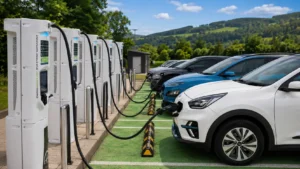
Explain that public charging has generally been treated as a standard-rated supply because the electricity is provided at a public chargepoint rather than as domestic energy supplied to a household. Present this as HMRC’s current policy position rather than as an uncontested legal conclusion.
The Charge My Street Legal Challenge
Summarise the tribunal case in a short, careful section. Explain that the First-tier Tribunal found in favour of Charge My Street in relation to certain charging supplies, but HMRC sought permission to appeal and continued to state that public charging remained standard-rated.
The legal dispute should not be presented as an automatic tax change or a basis for individual refund claims.
Why Does The Issue Matter Financially?
A lower public-charging VAT rate would reduce some of the disparity faced by drivers without home charging. However, equalising VAT would not necessarily make public charging as cheap as home charging because public operators still have additional infrastructure and operating costs.
Who Benefits Most From Zero-rated Domestic Electricity?
Higher-mileage drivers will generally save more because the benefit rises with electricity consumption. Two-EV households, taxi or private-hire drivers able to charge at home, and owners of larger or less-efficient vehicles may therefore receive a larger cash reduction.
Households using electric heating may also benefit substantially. The policy should not be framed as primarily or exclusively an EV measure.
Drivers already using very cheap overnight tariffs may save less in pounds because the VAT reduction applies to a lower starting price. Even so, their overall charging cost may remain far below typical public rates.
Who Is Most Likely to Be Left Behind?
The article should focus on renters, flat residents and households without allocated parking. These groups may be unable to install a conventional charger even when they are willing to pay for one. High-mileage urban drivers can be particularly exposed because every additional kilowatt-hour is purchased at a higher public rate.
Lower-income buyers considering used EVs may also find that a cheaper vehicle does not solve the problem of expensive charging access. This section should remain measured and avoid implying that every renter, flat resident or London driver faces the same circumstances.
Could Pavement Charging Gullies Help?
What Is A Charging Gully?
Define a charging gully as a protected channel that allows a cable to run from a home electricity supply across the pavement to a parked vehicle. Where approved by a local authority, this may allow a household without a driveway to access domestic electricity prices.
Why Are Gullies Not A Universal Solution?
Explain in prose that approval varies between boroughs, installation carries an upfront cost and the resident may not be able to park directly outside the property. Tenants and leaseholders may also require additional permission. Safety and accessibility are central considerations, so residents should not place loose charging cables across public pavements.
Does The Financial Case Add Up?
A charging gully costing around £1,000 or more is unlikely to pay for itself through the domestic VAT saving alone. The stronger financial case comes from gaining access to the wider difference between public and home electricity prices. This should be labelled as analysis based on the article’s illustrative comparison rather than as a universal payback estimate.
What Could Government Do Next?
This section should use short explanatory subsections rather than a long policy list.
Equalise VAT on Public and Domestic Charging
- Explain that reducing public-charging VAT would narrow the tax difference faced by drivers without home access.
- It would not necessarily eliminate the total retail-price gap.
Extend the Domestic VAT Policy
- Discuss the importance of whether the zero rate continues beyond its initial funding period.
- Readers should be told that a temporary reduction and a permanent tax change have different implications for EV ownership costs.
Improve Access To Domestic-rate Electricity
- Explain the role of charging gullies, communal residential chargers, landlord cooperation and affordable overnight kerbside charging.
Make Public Prices Easier to Compare
- Public-charging prices should ideally make the total cost clear, including VAT, session fees, parking charges, subscriptions and overstay penalties.
Londoner practical guide
What Should London EV Drivers Do Now?
Work through these seven checks before comparing home and public charging costs or making changes to your charging arrangements.
Conclusion
Conclude that the Andy Burnham EV VAT cut will reduce costs for drivers who can charge through a domestic electricity supply, but the saving itself is unlikely to transform EV affordability.
The more significant issue is the unequal access to cheap electricity. Londoners who rely on public infrastructure may continue paying both a higher VAT rate and a higher underlying price per kilowatt-hour.
The final paragraph should explain that the future size of the divide will depend on public-charging tax policy, local access to domestic-rate charging and whether the zero-VAT household measure continues beyond its initial period.
Frequently asked questions
Does the VAT cut apply to home EV charging?
Yes. Electricity used to charge an EV through a qualifying domestic electricity supply should benefit from the domestic VAT reduction.
Is public EV charging also becoming VAT-free?
No equivalent public-charging reduction has been announced. Public charging generally remains standard-rated under HMRC’s current position.
Will home electricity become 5% cheaper?
Not exactly. Removing 5% VAT from a VAT-inclusive price reduces the final price by approximately 4.76%.
How much could an EV owner save?
The amount depends on the tariff and electricity used. At an illustrative 26.11p per kWh, removing VAT saves approximately £12.43 for every 1,000kWh consumed.
Does the change apply to fixed tariffs?
The final article should explain the government’s stated position and advise readers to check how their supplier applies the tax change.
Why is public charging more expensive?
VAT is one factor, but public operators also face installation, maintenance, grid, land, payment and network costs.
Can Londoners run charging cables across pavements?
Loose cables may create safety and accessibility risks. Residents should use only arrangements approved by the relevant local authority.
Could a charging gully reduce costs?
It may allow some residents to use domestic electricity, but approval, parking access and installation costs vary.
Has a tribunal changed public-charging VAT?
A tribunal ruled in favour of Charge My Street in a particular case, but HMRC challenged the decision and maintained its existing policy position.
Is the domestic VAT reduction permanent?
The final article should distinguish the announced funding period from any future decision to extend the policy.
About the Journalist
Adam reports on London news, events and local developments. His coverage includes festivals, exhibitions, public announcements, community stories and important updates affecting people across the city. He aims to provide timely and accessible reporting on what is happening in London.