VG Mathers Road Haulage Collapse: Seven Jobs Lost As Scottish Firm Enters Liquidation
 Published By
Ben
Published By
Ben
Published:

A family-run Scottish haulage business with roots stretching back almost six decades has ceased trading after rising fuel, insurance, maintenance and compliance costs placed what its director described as unsustainable pressure on cash flow.
VG Mathers Limited, based at Cottown Garage in Kintore, Aberdeenshire, has entered creditors’ voluntary liquidation, with all seven remaining employees made redundant.
Michael Reid, head of insolvency services in Scotland at accountancy and advisory firm MHA, has been appointed liquidator.
The latest Companies House record, checked on 7 September 2026, lists V.G. Mathers Limited as being in “Liquidation”.
Its insolvency page records one case, categorised specifically as a creditors’ voluntary liquidation, with the winding-up commencing on 2 September 2026. An extraordinary resolution to wind up the company was filed on 3 September.
That distinction is important because several early reports described the VG Mathers road haulage collapse as an “administration”. The official Companies House position is now clear: the company is in liquidation rather than administration.
Under Insolvency Service guidance, a creditors’ voluntary liquidation is used when a company cannot pay its debts and its directors and shareholders take steps to wind the business up, with an insolvency practitioner subsequently handling the company’s affairs for creditors.
VG Mathers had become a familiar name in Scottish road transport. The haulage operation traces its origins to 1968, when it was established by Vic Mathers, father of current director Colin Mathers.
However, there is a distinction between the history of the trading business and the present legal entity: Companies House shows V.G. Mathers Limited, company number SC151520, was formally incorporated on 21 June 1994.
Over the years the company operated general haulage services across Britain and occasionally into Europe.
Industry material published before its closure described a fleet including Volvo, Scania, Iveco and Renault vehicles, with curtain-sided trailers and flatbeds.
Some vehicles were said to cover more than 100,000 miles annually. The company also carried out vehicle inspections and repair work from its Aberdeenshire base.
Why Did VG Mathers Collapse?
Director Colin Mathers said there had not been one single event behind the closure. Instead, a series of operating-cost increases and commercial pressures had gradually eroded the company’s ability to continue.
Mathers said the business had been overwhelmed by a “relentless series of challenges”, identifying fuel, insurance, compliance requirements and vehicle maintenance among the major pressures.
He said the cumulative effect had damaged liquidity, with the “compounding pressure severely choked our cash flow”.
For a haulage company, each of those costs is difficult to avoid. Diesel is an immediate operating expense whenever vehicles are moving.
Insurance is essential, vehicle maintenance cannot safely or legally be deferred indefinitely, and operators must continue meeting licensing and regulatory obligations regardless of how tight customer margins become.
Mathers said the company had attempted to absorb those higher costs rather than simply passing them on, but eventually lacked enough financial headroom to deal with payment problems or fluctuations in customer demand.
Continued trading ultimately became impossible, he said.
The problem described by Mathers is closely aligned with warnings coming from the wider road haulage industry.
Richard Smith, managing director of the Road Haulage Association, warned the Chancellor in June that “costs remain high, confidence remains fragile” across the sector.
An RHA operator survey found 84.6% of respondents were experiencing reduced profit margins because of higher fuel costs, while just 10% said they were fully able to pass those additional costs on to customers.
That last figure is particularly significant when considering the VG Mathers collapse.
A transport operator does not necessarily need to lose customers to become financially distressed.
If the price charged for moving a load fails to increase at the same pace as diesel, insurance, wages, repairs, finance and compliance expenditure, every job can become progressively less profitable.
Smith and the RHA have therefore pushed for measures including an Essential User Rebate for commercial operators, a continuing fuel-duty freeze and better payment terms to improve cash flow throughout road transport.
The structure of the British haulage market can magnify those pressures. Evidence presented to Parliament in 2026 referred to the majority of UK hauliers being micro-businesses and cited industry profit margins of less than 2% for many operators.
Even relatively modest movements in fuel or equipment costs can therefore consume a substantial proportion of operating profit.
VG Mathers was consequently operating in precisely the part of the economy where liquidity can matter as much as headline asset value.
A haulier may own vehicles, equipment and other assets but still experience acute cash-flow pressure if customers take longer to pay while fuel, insurance, wages and repairs need to be funded immediately.
The company’s most recent accounts were filed at Companies House on 29 April 2026 and covered the financial year ending 31 July 2025.
Several months later, on 27 February 2026, a further charge was created in favour of Sallyport Commercial Finance Ltd; Companies House records show the charge was registered on 3 March.
The official filing record does not, by itself, establish that this financing caused the subsequent insolvency, so it would be inappropriate to make that connection without further evidence.
What the company’s own statement does establish is that cash flow had become the critical issue by the time directors decided trading could no longer continue.
The closure has also had an immediate human impact. Seven employees lost their jobs when the business ceased trading.
Mathers thanked staff, drivers and clients who had supported the business, describing the decision as an extremely difficult outcome for the company and its team.
Michael Reid, who is overseeing the liquidation from MHA’s Aberdeen operation, said VG Mathers was “a further example of a business facing significant pressures” and confirmed that his team’s priority would be to manage the process with stakeholders as smoothly as possible.
Reid’s assessment is particularly relevant because this is not simply a business deciding voluntarily to retire its fleet after decades of trading. Companies House specifically records the proceedings as a creditors’ voluntary liquidation.
Insolvency Service guidance explains that a CVL is used when the company cannot pay its debts and its shareholders agree to place it into liquidation.
Once appointed, the liquidator takes control of the company’s affairs.
That can include realising assets, collecting outstanding invoices, dealing with contracts and claims, assessing what can be distributed to creditors and reporting on the circumstances surrounding the company’s failure.
In a CVL, the liquidator acts in the interests of creditors rather than the former directors.
MHA has advised creditors and other relevant stakeholders requiring assistance in connection with VG Mathers to contact its liquidation team.
Is the VG Mathers Collapse Part of a Bigger UK Haulage Crisis?
Mathers argued that his company’s experience should not be considered in isolation, pointing to roughly 400 road haulage and freight businesses failing during 2025.
Official figures broadly support the scale of that claim.
A Department for Business and Trade response to Parliament recorded an estimated 401 UK companies classified as freight transport by road entering insolvency during 2025.
That compares with 471 in 2024 and a recent peak of 503 in 2023. In 2019, before the pandemic, the equivalent figure was 285.
Over the four-year period from 2022 to 2025, the figures show 411, 503, 471 and 401 freight-transport insolvencies respectively. That gives a total of 1,786 companies entering insolvency in four years.
For comparison, the official figures show 1,536 failures across the four years from 2008 to 2011, although the Government cautions that changes to industrial classifications mean comparisons between the periods are only broadly comparable.
However, describing the current position simply as a continuously worsening haulage collapse would also be misleading.
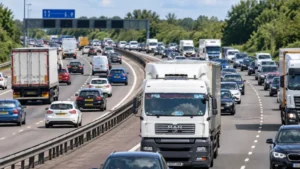
The latest detailed sector figures available for road haulage and removals in England and Wales show 184 insolvencies between January and June 2026, down from 220 during the same six months of 2025.
The rolling 12-month figure to June stood at 371, against 427 during the preceding comparable period.
In other words, the rate of failure appears to be easing from the extreme levels seen in 2023 and 2024, but the underlying number of businesses becoming insolvent remains historically elevated.
The latest overall Insolvency Service figures reinforce that more nuanced picture. Across all industries in England and Wales, 1,931 companies entered insolvency in July 2026, 5% more than in June but 5% fewer than in July 2025.
The rolling insolvency rate stood at 50.3 companies for every 10,000 businesses on the effective register, down from 52.5 a year earlier.
VG Mathers therefore failed at a point when insolvency numbers are no longer accelerating at their post-pandemic peak, but when conditions remain sufficiently difficult to eliminate established operators that have survived several previous economic cycles.
Its longevity makes the closure particularly notable.
A business that began in 1968 had traded through the oil shocks of the 1970s, multiple recessions, the financial crisis, Brexit-related changes, the pandemic and the inflation surge that followed.
Yet the eventual combination of operating expenses, regulatory costs, maintenance bills, customer demand and limited cash-flow resilience proved too much.
The closure also illustrates an important feature of the haulage industry that can be lost in national insolvency statistics. Many British operators are relatively small, independently owned firms.
Losing seven jobs may appear modest compared with a major corporate administration involving hundreds of workers, but each closure also removes vehicles, workshop capacity, local purchasing and transport capacity from regional supply chains.
For customers, creditors and former employees of VG Mathers, attention will now turn to Michael Reid and the liquidation process.
Assets will have to be assessed and realised where appropriate, outstanding amounts due to the company pursued and creditor claims established before the winding-up can eventually be completed.
For the wider industry, however, the reasons given for the VG Mathers road haulage collapse are likely to receive considerably more attention than the size of the company itself.
A nearly six-decade-old family business has disappeared not because demand for road freight has ceased, but because management says the economics of providing it became increasingly difficult to sustain.
And with the RHA reporting that more than four in five surveyed operators have seen fuel costs squeeze margins while only one in ten can pass those costs on completely, the pressures cited by VG Mathers remain very much present for other hauliers still on the road.
As of 7 September 2026, V.G. Mathers Limited remains recorded by Companies House as being in liquidation, with the creditors’ voluntary winding-up having commenced on 2 September 2026.
About the Journalist
Ben covers business, transport and global developments for Londoner. His reporting focuses on London’s economy, major companies, infrastructure, public transport and international stories that may affect people and businesses across the capital. He explains complex developments clearly using reliable sources and relevant context.