Mitigating Inheritance Tax On Pension Pots: What Savers Can Do Before the 2027 Rule Change?
 Published By
Lucy
Published By
Lucy
Published:

Table of Contents
UK pension savers with substantial retirement funds are being urged to reconsider how they pass wealth to their families as one of the biggest changes to pension inheritance taxation in years moves closer.
From 6 April 2027, most unused pension funds and pension death benefits will be brought within a deceased person’s estate for Inheritance Tax (IHT) purposes.
For years, pensions have occupied an unusual position in estate planning. While property, savings and investments can form part of an estate when somebody dies, many discretionary pension pots have generally been capable of passing to beneficiaries outside the estate for IHT purposes.
That advantage is now approaching its end.
The change is no longer simply a proposal. The reforms were legislated through the Finance Act 2026, which received Royal Assent on 18 March 2026.
HMRC then published its second detailed technical note on 27 August 2026, setting out further information on how pension schemes, beneficiaries and personal representatives will interact once the rules begin.
The timing is important because Inheritance Tax is already raising record sums.
HMRC’s latest monthly figures show that Inheritance Tax receipts reached £3.2 billion between April and July 2026, around £100 million more than during the same period a year earlier.
HMRC also confirmed that receipts in June 2026 were the highest recorded for any single month.
Separate statistics published on 30 July show that 30,400 estates paid IHT in 2023/24, representing 4.72% of UK deaths. Although that remains fewer than one in 20 estates, it is the highest proportion recorded since 2006/07.
Total liabilities for the year reached £7.03 billion.
Bringing pension wealth into the calculation could push thousands more families towards the tax.
The Government estimates that approximately 10,500 estates will become liable for IHT in 2027/28 that would otherwise have paid none, while a further 38,500 estates are expected to pay more.
Among affected estates, HMRC estimates that including pension assets could increase the average Inheritance Tax liability by around £34,000.
The Government has stressed that these are static estimates and could prove lower if people change their financial behaviour before the new rules begin.
That behavioural change appears to have already started.
Steve Webb, the former pensions minister and now a partner at pension consultants LCP, said there were signs that people with larger defined contribution pension pots were reconsidering how quickly they use their retirement savings.
Webb said:
“People with larger pots are now exploring a range of strategies to reduce any potential IHT bill for their heirs.”
The result is that mitigating inheritance tax on pension pots is rapidly becoming less about leaving the pension untouched for as long as possible and more about balancing retirement income, gifting, investment and estate planning.
What Changes to Pension Inheritance Tax From April 2027?
The key date is 6 April 2027.
For deaths occurring on or after that date, most unused defined contribution pension wealth will be included when the deceased person’s estate is assessed for IHT.
The standard IHT nil-rate band currently remains £325,000, while a qualifying estate passing a home to children or grandchildren may also benefit from the £175,000 residence nil-rate band.
That can potentially provide an individual with allowances of up to £500,000.
For married couples and civil partners, unused allowances may potentially transfer to the survivor, meaning qualifying couples can in some circumstances pass as much as £1 million before IHT becomes payable.
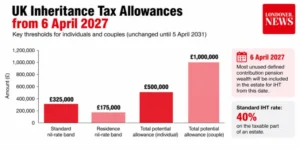
However, the £325,000 basic threshold has been frozen at its current level until 5 April 2031, increasing the likelihood that rising property, investment and pension values gradually pull more estates into the tax.
The normal headline IHT rate is 40% on the taxable part of an estate after allowances, exemptions and applicable reliefs.
Pension wealth could therefore have a significant effect.
Consider someone with a £700,000 estate outside their pension and an unused £400,000 pension pot.
Under today’s pension IHT treatment, that pension could potentially remain outside the estate for IHT purposes.
Once the 2027 rules apply, the calculation could instead begin from total wealth of around £1.1 million, subject to the precise pension benefits involved and any applicable exemptions, allowances or reliefs.
There are important exceptions.
Registered pension scheme death-in-service benefits will remain outside the new IHT rules. Certain dependant’s scheme pensions from defined benefit and collective money purchase arrangements are also excluded.
Transfers to a surviving spouse or civil partner can also continue to benefit from the normal spouse or civil partner IHT exemption where the conditions are satisfied.
HMRC’s August technical note additionally confirms that the administration process will be more involved than simply adding a pension balance to a probate form.
Personal representatives will generally be responsible for reporting and paying IHT attributable to pensions.
Pension administrators will have information-sharing obligations, while mechanisms will allow pension benefits to be withheld or pension funds to be used directly towards an IHT liability in qualifying circumstances.
HMRC has not finished publishing all of the operational material.
A third technical note is expected during autumn 2026, covering issues including international cases, the interaction between Income Tax and IHT, intestacy, charities and trusts.
Final supporting guidance is expected ahead of implementation in spring 2027.
For families planning now, that means the broad tax change is settled, although some of the detailed administration is still developing.
How Can Inheritance Tax on Pension Pots Be Mitigated?
One of the most important points for pension savers is that simply withdrawing pension money does not automatically eliminate an IHT problem.
If somebody withdraws £100,000 from a pension and simply leaves the money sitting in their bank account, it may still be part of their estate when they die.
Effective mitigation generally requires looking at what happens to the money after it leaves the pension.
Spending More During Retirement
The simplest option may also be the most overlooked: using more pension wealth to fund retirement.
Pensions were designed primarily to provide retirement income rather than operate as inheritance vehicles, which is one of the reasons given by the Government for the reforms.
People who previously planned to live from ISAs, cash or other investments while preserving their pension for children may therefore reconsider the order in which assets are used.
However, withdrawing too much too early carries an obvious risk.
James Norton, Head of Retirement and Managed Services at Vanguard Europe, recently warned that while withdrawing and gifting pension money can reduce an estate, people should avoid giving away so much that they compromise their own retirement security.
That makes cash-flow planning particularly important.
A large potential IHT saving decades in the future may not be worthwhile if achieving it leaves somebody without sufficient income for later-life living costs, care costs or unexpected expenses.
Gifting Pension Withdrawals
Lifetime gifting is likely to become one of the most closely examined options.
Everyone currently has a £3,000 annual gifting exemption. Unused annual exemption can be carried forward for one tax year.
There is also a small-gift exemption of up to £250 per person, provided another exemption has not been used for the same recipient, along with separate exemptions for qualifying wedding or civil partnership gifts.
Larger outright gifts can potentially fall outside the estate if the donor survives for seven years after making them.
That does not mean every gift becomes partially tax-free automatically after three years. Taper relief applies to tax charged on certain lifetime gifts and only becomes relevant once the necessary conditions are met.
For pensioners with dependable retirement income, an even more important provision may be the normal expenditure out of income exemption.
HMRC permits regular gifts to be exempt where they are made from normal income and the person making them can still maintain their usual standard of living.
There is no fixed monetary ceiling written into the exemption.
That could potentially allow someone receiving pension, annuity or other regular income to make systematic gifts to children or other family members without beginning a seven-year clock, provided the conditions are genuinely satisfied.
Record-keeping will be crucial.
Families should document when gifts were made, their amounts and recipients, and, where normal expenditure from income is relied upon, maintain records showing income and expenditure.
Converting Pension Wealth Into an Annuity
Annuities are also attracting renewed attention.
Rather than retaining a large investment pot throughout retirement, an individual can use some or all of a defined contribution pension to buy guaranteed retirement income.
LCP has highlighted a strategy where pension wealth is converted into annuity income and part of that regular income is subsequently gifted under the normal-expenditure-from-income rules where the necessary conditions are met.
The timing is particularly notable because annuity rates are currently at some of their strongest levels in years.
Recent market comparisons showed a healthy 65-year-old could obtain more than £8,000 a year from a £100,000 pension pot from some single-life level annuities, although actual rates vary continually by age, health, product features and provider.
An annuity should not be purchased purely for IHT reasons.
Once bought, conventional lifetime annuities generally cannot simply be reversed, and exchanging investment capital for guaranteed income can significantly change somebody’s retirement strategy.
Life Insurance Could Cover the Tax Rather Than Remove It
Another strategy being discussed by advisers is whole-of-life insurance.
The objective here is not necessarily to eliminate the IHT liability itself.
Instead, a policy can provide money to beneficiaries that may be used towards the tax bill when somebody dies.
Where an appropriate life policy is placed in trust, the proceeds may potentially sit outside the policyholder’s estate, subject to the circumstances and correct structure.
LCP says market interest has already been increasing as wealthier pension savers reconsider estate planning.
Royal London’s tax expert Clare Moffat said the best answer will not necessarily be the strategy producing the lowest possible tax bill.
She warned:
“It may be worth an inheritance tax bill if that makes family members better off.”
That distinction matters.
Avoiding £100,000 of future tax would not represent good planning if doing so required giving up substantially more than £100,000 of personal financial security or investment flexibility.
Leaving Assets to a Spouse or Civil Partner
Transfers between spouses and civil partners remain one of the most significant IHT exemptions.
Assets transferred to a qualifying spouse or civil partner can generally pass without an immediate IHT charge.
That means a pension passing to a spouse after April 2027 will not necessarily trigger the same result as a pension passing directly to adult children.
The issue may instead arise after the surviving partner subsequently dies and assets move to the next generation.
Estate planning for couples consequently needs to consider both deaths, rather than treating the first death in isolation.
Charitable Giving
Charitable legacies can also change an estate’s final tax position.
Where at least 10% of the relevant net estate is left to qualifying charities, the IHT rate applying to the relevant portion of the taxable estate can potentially fall from 40% to 36%.
This will not be appropriate for somebody whose only objective is maximising the amount received by individual beneficiaries, but for families already intending to leave money to charity, careful will planning can materially alter the final calculation.
Simply Nominating a Trust Is Unlikely to Make the New Pension IHT Disappear
Pension trusts are another area where savers need to be cautious.
Using a bypass trust or nominating a trust as the destination for pension death benefits will not simply remove the initial pension IHT charge under the new rules.
Quilter’s current technical guidance states that from April 2027 the first step remains determining whether IHT is due on the relevant pension death benefit.
A trust may still have wider estate-planning uses, particularly when considering control of money and the survivor’s estate, but it should not be treated as an automatic way around the 2027 reform.
That reflects a broader change in pension planning.
Adam Cole, retirement specialist at Quilter, said after the Finance Act received Royal Assent:
“Inheritance tax on pensions is happening.”
He said advisers would have to reconsider long-standing assumptions about the order in which clients use their assets because preserving pensions purely for inheritance purposes will become less attractive for some households.
Pension Savers Have Months Rather Than Years to Review Their Plans
There are now fewer than seven months until the new rules begin on 6 April 2027.
That does not mean pension holders should rush to empty their retirement accounts.
For many households, no change may be necessary at all.
HMRC still expects the majority of estates to remain outside IHT, and pensions continue to offer important advantages while somebody is alive, including tax relief on qualifying contributions and tax-efficient investment growth.
The people most likely to require a review are those with significant defined contribution pensions alongside valuable property, savings, investments or other assets that already bring their estate close to or above available IHT thresholds.
For those households, the questions have changed.
Rather than automatically preserving a pension until death, financial planning may increasingly involve deciding whether to spend more of the pension, make lifetime gifts, generate income through an annuity, use insurance to provide liquidity for beneficiaries, leave assets to a spouse or civil partner, make charitable gifts or combine several approaches.
There is also an Income Tax dimension.
Where somebody dies after age 75, inherited pension benefits can generally be subject to the beneficiary’s marginal rate of Income Tax when withdrawn.
The new IHT regime could therefore create situations where both taxes need to be considered, although HMRC has introduced mechanisms intended to prevent Income Tax being charged on pension money paid directly towards the relevant IHT liability.
Further clarification on the interaction between the two taxes is expected in HMRC’s next technical note during autumn 2026.
The growing importance of planning is visible in the wider tax figures.
Inheritance Tax receipts reached £3.2 billion in only the first four months of 2026/27, June produced the highest monthly receipts on record; the main £325,000 threshold remains frozen until 2031 and around 50,000 estates with inheritable pension wealth are expected either to become liable or face a larger bill once pensions are included.
The central message for pension savers is therefore not that pensions have suddenly become poor retirement vehicles.
It is that the long-standing strategy of spending other assets first while keeping a large pension untouched primarily for inheritance may no longer produce the same tax outcome after April 2027.
For larger estates, mitigating inheritance tax on pension pots will increasingly require retirement planning and estate planning to be considered together.
With the legislation now enacted and HMRC moving into the final implementation phase, families potentially affected have a relatively short window to review existing wills, pension beneficiary nominations, gifting records, retirement income plans and the overall value of their estate before the new regime begins.
Tax treatment depends heavily on individual circumstances and rules can change.
Anyone considering large pension withdrawals, substantial gifts, annuity purchases, trusts or life insurance primarily for IHT planning should consider regulated financial, tax and legal advice before making irreversible decisions.
Figures and legislation checked on 9 September 2026.
About the Journalist
Lucy reports on London’s boroughs and the capital’s sporting community. Her coverage includes council decisions, neighbourhood developments, community issues, football, tennis, cricket and major sporting events. She focuses on stories that connect local communities and highlight the people and organisations shaping London.