Fuel Prices Push UK Inflation to 3.1% as Petrol and Diesel Costs Surge
 Published By
Lucy
Published By
Lucy
Published:
Updated:

Table of Contents
UK inflation climbed to 3.1% in August 2026 as sharply higher petrol and diesel prices pushed up transport costs, putting renewed pressure on household budgets and keeping energy prices at the centre of the inflation outlook.
The Consumer Prices Index (CPI) rose by 3.1% in the 12 months to August, up from 2.9% in July, according to the latest Office for National Statistics figures released on 16 September.
The broader CPIH measure, which includes owner-occupiers’ housing costs, increased from 3.1% to 3.3%.
The clearest explanation for the latest rise was transport.
The ONS said transport, and particularly motor fuels, made the largest upward contribution to the change in both CPI and CPIH inflation between July and August.
How Are Fuel Prices Impacting UK Inflation?
The impact of fuel prices on UK inflation has become increasingly significant as petrol and diesel costs have risen rapidly.
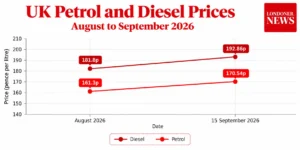
Average petrol prices increased by 9.1p per litre between July and August 2026, taking the August average to 161.3p per litre.
That was the highest monthly average petrol price recorded by the ONS since November 2022.
Diesel rose even more sharply.
Average diesel prices increased by 14.2p per litre during August, reaching 181.8p per litre.
For comparison, between July and August 2025, petrol increased by only 0.3p per litre and diesel by 0.8p.
As a result, motor fuel prices were 23% higher than a year earlier in August 2026, compared with annual growth of 15.5% in July.
| Measure | July 2026 | August 2026 |
| UK CPI inflation | 2.9% | 3.1% |
| CPIH inflation | 3.1% | 3.3% |
| Transport annual inflation | 3.6% | 4.6% |
| Average petrol price | — | 161.3p/litre |
| Average diesel price | — | 181.8p/litre |
| Annual motor fuel inflation | 15.5% | 23.0% |
Transport as a whole contributed 0.69 percentage points to the 3.1% CPI inflation rate in August, making it the largest contributing CPI division.
Petrol and Diesel Prices Have Risen Further in September
The August inflation figures do not yet capture the full increase motorists have experienced during September.
An official RAC update published on 15 September put the average UK petrol price at 170.54p per litre, while diesel had climbed to 192.86p per litre.
Petrol was therefore at its highest level since August 2022, while diesel had reached its highest level since July 2022.
RAC head of policy Simon Williams said:
“Average pump prices have jumped by yet another penny in just a day.”
The RAC calculated that filling a typical 55-litre family car had risen to around £94 for petrol and £106 for diesel by 15 September.
Those September prices are not part of the August CPI reading, but they show that the pressure facing motorists has intensified since the period covered by the latest inflation figures.
Why Do Petrol Prices Have Such an Effect on Inflation?
Fuel affects inflation in two important ways.
The first is direct.
Petrol and diesel are included in the basket of goods and services used by the ONS to calculate consumer inflation.
When pump prices rise substantially compared with the same period a year earlier, they directly increase the transport component of CPI.
The second potential effect is indirect.
Businesses involved in deliveries, haulage, construction, logistics and other fuel-intensive activities can face higher operating costs when diesel and petrol prices rise.
Some of those additional costs can eventually be passed on through higher prices for other goods and services.
There are already signs of energy pressure further up the supply chain.
Separate ONS producer-price figures showed UK manufacturers’ input prices increased by 6.1% in the year to August, with refined petroleum products among the strongest contributors. Factory-gate prices were 3.7% higher.
Is All UK Inflation Rising?
The latest figures present a more mixed picture than the headline 3.1% rate alone suggests.
Core CPI, which excludes energy, food, alcohol and tobacco, remained unchanged at 2.6% in August.
Services inflation was also unchanged at 3.4%.
Food and non-alcoholic drink inflation remained at 1.3%, while transport inflation accelerated from 3.6% to 4.6%.
That distinction is important because it indicates that the latest increase in headline inflation was heavily influenced by energy and transport rather than a simultaneous acceleration across every major spending category.
What Does Higher Inflation Mean for Interest Rates?
The latest figures arrive on the same day the Bank of England is preparing to announce its September interest-rate decision.
Bank Rate currently stands at 3.75%, while the Bank’s inflation target remains 2%. The Monetary Policy Committee’s September decision is scheduled for 17 September 2026.
The Bank had already warned in July that higher crude and refined energy prices could push inflation upwards later in 2026.
It said monetary policy cannot directly control international energy prices, but policymakers must consider whether an energy shock spreads into wages, business costs and prices elsewhere in the economy.
That relationship also matters for homeowners.
Recent volatility in inflation and energy markets has already contributed to changing expectations in wholesale financial markets, with several major UK mortgage lenders raising rates during September.
Higher inflation does not automatically mean the Bank of England will increase Bank Rate, but sustained inflation above the 2% target can affect how quickly policymakers are willing to reduce borrowing costs.
What Does the Fuel Price Rise Mean for Londoners?
The latest increases add another source of pressure for London households already dealing with comparatively high housing and everyday living costs.
Fuel prices affect more than motorists commuting by car.
Higher petrol and diesel costs can affect taxi and private-hire drivers, tradespeople, delivery companies, small businesses and households that depend on vehicles for work, caring responsibilities or journeys outside the public transport network.
London households were already facing substantial accommodation and energy costs before the latest fuel increase.
Average private rent in the capital stood at £2,302 a month in June, illustrating why changes in transport, food or energy bills can matter even when the individual increase appears relatively modest.
A wider breakdown of the cost of living in London shows how rent, household energy, transport and other essential spending combine to determine the financial pressure households actually experience.
Could Fuel Prices Keep UK Inflation Higher?
The immediate inflation outlook will depend partly on what happens to energy markets and pump prices over the coming months.
August already demonstrated how quickly fuel can change the headline inflation figure: CPI moved from 2.9% to 3.1%, with transport and motor fuels providing the largest upward contribution.
September’s pump prices have since moved significantly above August’s monthly averages.
However, inflation is determined by a much broader basket of goods and services, and fuel is only one component. Falling prices or slower increases elsewhere can partially offset higher transport costs.
Core CPI remaining at 2.6% also shows that underlying inflation did not accelerate at the same pace as the headline rate in August.
The next official UK consumer inflation figures are scheduled to be published by the ONS on 21 October 2026.
For households and businesses, however, the immediate impact is already visible at the forecourt: petrol and diesel prices are substantially higher than they were only a few weeks ago, and fuel has once again become one of the most important factors shaping the UK’s inflation picture.
About the Journalist
Lucy reports on London’s boroughs and the capital’s sporting community. Her coverage includes council decisions, neighbourhood developments, community issues, football, tennis, cricket and major sporting events. She focuses on stories that connect local communities and highlight the people and organisations shaping London.