0T Tax Code: Meaning, Tax Rates and Refunds in 2026/27
 Published By
Adam
Published By
Adam
Published:
Updated:

Table of Contents
Seeing 0T tax code on a payslip can be alarming, particularly when take-home pay suddenly falls.
The code means that no Personal Allowance is being given through that particular employment or pension. Income Tax is therefore calculated from the first pound of taxable income, using the tax bands that apply to the taxpayer.
That does not mean every pound is automatically taxed at 40% or 45%.
For the 2026/27 tax year, somebody in England or Northern Ireland on 0T can still have income taxed through the 20%, 40% and 45% bands. Scottish taxpayers may instead see S0T, while Welsh taxpayers can see C0T.
In some circumstances 0T is temporary, such as when HMRC or an employer does not yet have enough information about a new employee. In others, it can be entirely legitimate — particularly where a person’s Personal Allowance has already been used or reduced to zero.
Anyone seeing an unfamiliar PAYE code can also compare it with Londoner’s complete list of UK tax codes and what they mean.
Tax year covered: 6 April 2026 to 5 April 2027
Standard Personal Allowance: £12,570
Rates checked: September 2026
What Does the 0T Tax Code Mean?
The simplest interpretation of 0T is:
No tax-free Personal Allowance is being allocated through this PAYE source.
HMRC describes 0T as a tax code used where the Personal Allowance has been used up or where somebody has started a new job and the employer does not have enough information to give them another appropriate code.
The important distinction is that 0T is not a flat-rate tax code.
Instead, the person’s income moves through the relevant Income Tax bands.
For somebody in England or Northern Ireland during 2026/27, a simplified 0T calculation works like this:
| Taxable income under 0T | Income Tax rate |
| First £37,700 | 20% |
| £37,701 to £125,140 | 40% |
| Above £125,140 | 45% |
Because there is no Personal Allowance attached to the code, taxation starts from the first pound.
This makes 0T very different from the standard 1257L tax code, which normally allocates the £12,570 Personal Allowance.
Why Would HMRC Give Someone a 0T Tax Code?
There is no single reason.
Common situations include:
- an employee starts work without a usable P45;
- the employer cannot complete the necessary starter information;
- HMRC does not yet have enough information about the person’s income;
- the person’s Personal Allowance is being used against another income source;
- their Personal Allowance has been reduced to zero;
- a payment is made after somebody has already left employment and received a P45;
- certain pension arrangements require 0T to be operated temporarily;
- HMRC sends the employer a coding notice instructing them to use 0T.
A second job does not automatically mean 0T.
HMRC generally uses BR for many straightforward second-job or second-pension situations. If the starter checklist indicates the person already has another job or pension, BR may be appropriate. Where the necessary starter information cannot be obtained, however, 0T can arise.
That distinction is important because the BR tax code taxes all income from that source at basic rate, whereas 0T allows income to move into higher and additional-rate bands.
How Much Tax Do You Pay on 0T?
The answer depends on earnings.
The following examples compare 0T with a straightforward 1257L position for an employee in England during 2026/27.
They show Income Tax only. National Insurance, workplace pensions, student loans, salary sacrifice and other deductions are excluded.
| Annual salary | Approx. Income Tax on 1257L | Approx. Income Tax on 0T | Difference |
| £45,000 | £6,486 | £10,460 | £3,974 |
| £60,000 | £11,432 | £16,460 | £5,028 |
| £90,000 | £23,432 | £28,460 | £5,028 |
These are simplified annual comparisons.
They do not mean everyone whose payslip briefly shows 0T will ultimately owe this additional amount. If the code is temporary and later corrected, PAYE may adjust earlier deductions or HMRC may reconcile the position later.
London Example: £60,000 Salary
Consider a London employee earning £60,000 annually.
With a normal £12,570 Personal Allowance:
- Gross income: £60,000
- Personal Allowance: £12,570
- Taxable income: £47,430
- First £37,700 taxed at 20%: £7,540
- Remaining £9,730 taxed at 40%: £3,892
- Approximate Income Tax: £11,432
With 0T:
- Gross income: £60,000
- Personal Allowance allocated through the code: £0
- First £37,700 taxed at 20%: £7,540
- Remaining £22,300 taxed at 40%: £8,920
- Approximate Income Tax: £16,460
That creates a difference of approximately £5,028 over a full year.
This is one reason an unexplained 0T code can make a noticeable difference to take-home pay.
Does 0T Mean You Pay 40% Tax?
No.
This is one of the most common misunderstandings surrounding the code.
0T means zero Personal Allowance, not “40% tax”.
For someone in England or Northern Ireland, the income paid under the code normally moves through the applicable bands.
A person earning £25,000 under 0T would generally remain within the basic-rate band for that income.
Someone earning £60,000 would have part taxed at 20% and part at 40%.
Someone receiving sufficiently high taxable income could reach the 45% additional rate.
This is fundamentally different from codes such as D0 and D1, which are designed to apply a particular tax rate to all income from that PAYE source.
What Happens to 0T When Income Exceeds £100,000?
There is another reason somebody may legitimately have little or no Personal Allowance.
The standard Personal Allowance begins to taper once adjusted net income exceeds £100,000.
It falls by £1 for every £2 of adjusted net income above £100,000.
A simplified illustration is:
| Adjusted net income | Approx. Personal Allowance remaining |
| £100,000 | £12,570 |
| £105,000 | £10,070 |
| £110,000 | £7,570 |
| £120,000 | £2,570 |
| £125,140 | £0 |
At £125,140, the standard Personal Allowance has been completely removed.
This means a zero-allowance tax position can be correct for a high earner.
However, seeing 0T should not be treated as proof that HMRC has removed the allowance because of high income. The taxpayer should check the coding calculation to establish the actual reason.
Is 0T an Emergency Tax Code?
0T on its own is not necessarily an emergency tax code.
This is an area where explanations online are often confusing.
HMRC identifies emergency operation through markers such as:
- W1;
- M1;
- X;
- NONCUM.
A payslip might therefore display:
0T M1
or
0T W1
In that situation, 0T is being operated on a non-cumulative emergency basis.
But a code simply showing 0T does not automatically prove that Week 1 or Month 1 treatment is being used.
This distinction matters because the tax calculation can be very different.
What Does 0T Month 1 or Week 1 Mean?
PAYE normally works cumulatively.
A cumulative calculation considers how much somebody has earned and how much tax they have already paid during the tax year.
A Week 1 or Month 1 calculation treats the current pay period largely in isolation.
Earlier earnings and tax are not used to rebalance the calculation in the normal cumulative way.
Example: £6,000 Payment Under 0T Month 1
Assume somebody receives a monthly taxable payment of £6,000 under 0T M1.
Approximately one-twelfth of the annual basic-rate band is available for that monthly calculation:
- Monthly basic-rate slice: about £3,141.67
- First £3,141.67 at 20%: about £628.33
- Remaining £2,858.33 at 40%: about £1,143.33
- Approximate Income Tax: £1,771.66
Now imagine the same £6,000 was received later in the tax year by somebody who had earned nothing previously and whose code could be operated cumulatively.
A cumulative calculation could potentially have considerably more unused basic-rate band available at that point.
That is why a Month 1 payment can sometimes produce a deduction that appears unexpectedly severe.
It does not necessarily mean the person’s eventual annual tax bill will be that high.
0T Tax Code After Starting a New Job
A new job is one of the most familiar ways an unexpected tax code appears.
Normally, a new employer obtains PAYE information from the employee’s P45.
If there is no P45, the employer should use HMRC’s starter checklist.
The checklist helps establish:
- whether this is the person’s first job since 6 April;
- whether they have had another job;
- whether they receive certain taxable benefits;
- whether they have another job or pension;
- what temporary PAYE treatment should be used.
HMRC says that where a new starter does not provide enough information, 0T can be used.
However, employees should not assume that no P45 always equals 0T. The starter checklist can produce other codes depending on the answers given.
If a P45 becomes available later, or HMRC sends a new coding notice, payroll may subsequently update the code.
0T Tax Code on Pension Income or Pension Drawdown
Pensions deserve particular attention because emergency PAYE deductions are common when money is first accessed.
However, there is an important distinction between 0T and the standard emergency tax code.
When somebody flexibly accesses a pension for the first time and the provider does not have suitable current-year PAYE information, HMRC guidance generally requires the provider to use the emergency tax code on a Month 1 basis.
For 2026/27, the standard emergency code is 1257L operated non-cumulatively.
Therefore:
A first pension drawdown is not automatically taxed using 0T.
0T can nevertheless arise in pension situations.
For example, HMRC’s payroll guidance states that where an employee starts receiving an occupational pension from an employer while continuing to work for the same employer, the pension may initially be taxed using 0T on a Week 1 or Month 1 basis until HMRC provides another code.
HMRC may also allocate no Personal Allowance to a pension source where the allowance is already being used elsewhere.
Why Pension Withdrawals Can Still Look Heavily Taxed?
Suppose somebody takes one unusually large pension withdrawal.
Under Month 1 treatment, payroll effectively treats the payment as though that level of income could continue each month.
That can temporarily push part of the withdrawal through higher tax bands.
The result may be more Income Tax being deducted than the person ultimately owes for the year.
Depending on the circumstances, pension tax overpayments can sometimes be reclaimed during the tax year rather than waiting until the annual reconciliation.
Can You Claim Back Tax Taken From a Pension?
Potentially.
HMRC has different procedures depending on what has happened to the pension pot.
For example:
- P55 may apply where somebody has flexibly accessed part of their pension and meets the conditions for an in-year refund;
- P53Z can apply where the whole pension has been flexibly accessed;
- P50Z can apply in certain cases where the whole pension has been accessed and the person has stopped working.
The correct route depends on the individual’s circumstances.
A large tax deduction from a first pension payment should therefore not automatically be treated as the final tax liability.
What Happens With 0T After Redundancy or Leaving a Job?
This is one of the most important uses of 0T that is often missed.
There is a specific PAYE rule for payments made after an employer has already issued a P45.
HMRC says that if a former employee receives another taxable payment after leaving, the employer should normally deduct PAYE using:
- 0T Week 1/Month 1 in England and Northern Ireland;
- S0T Week 1/Month 1 in Scotland;
- C0T Week 1/Month 1 in Wales.
This can affect payments such as:
- unpaid salary discovered after leaving;
- accrued holiday pay;
- bonuses;
- commission;
- certain share-related payments;
- taxable termination payments;
- taxable elements of redundancy packages.
The employer should not issue a second P45 simply because another payment has been made.
Does 0T Apply to the First £30,000 of Redundancy Pay?
Not necessarily.
Genuine qualifying redundancy and termination payments can benefit from a tax exemption on the first combined £30,000.
However, not everything contained in a leaving package is automatically covered by that exemption.
For example, wages and certain notice-related payments can remain taxable.
Payments in lieu of notice can also fall within taxable Post-Employment Notice Pay rules.
If a taxable payment is made after the P45 has already been issued, 0T Week 1/Month 1 can then become relevant to the taxable element.
This distinction is important.
It is incorrect to simply say:
“All redundancy money received after a P45 is taxed using 0T.”
The nature of the payment must first be established.
What Is the S0T Tax Code?
S0T is the Scottish version of the zero-Personal-Allowance code.
The S prefix tells payroll to use Scottish Income Tax rates.
Scotland has a different band structure from England, Northern Ireland and Wales.
For 2026/27, the Scottish taxable-income bands are:
| Taxable income band | Scottish rate |
| First £3,967 | 19% |
| £3,968 to £16,956 | 20% |
| £16,957 to £31,092 | 21% |
| £31,093 to £62,430 | 42% |
| £62,431 to £125,140 | 45% |
| Above £125,140 | 48% |
With S0T, there is no Personal Allowance allocated through that PAYE source, so taxable earnings begin moving through the Scottish bands immediately.
What Is the C0T Tax Code?
C0T applies the zero-Personal-Allowance treatment using Welsh Income Tax rates.
The C prefix identifies a Welsh taxpayer.
For 2026/27, Welsh employment-income rates are currently aligned with those applying in England and Northern Ireland:
- 20% basic rate;
- 40% higher rate;
- 45% additional rate.
The C prefix is still significant because Wales has its own Income Tax rate-setting arrangements.
0T vs S0T vs C0T
| Code | Taxpayer | Personal Allowance through code | Tax structure |
| 0T | England/Northern Ireland | £0 | England/NI rates |
| C0T | Wales | £0 | Welsh rates |
| S0T | Scotland | £0 | Scottish rates |
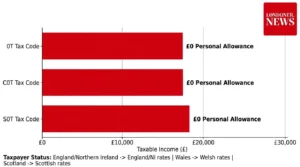
The employer’s location does not by itself decide whether S or C applies. The taxpayer’s status and main home are relevant to which national Income Tax system HMRC assigns.
0T vs BR vs D0 vs D1 vs 1257L
The following comparison helps explain why 0T should not be confused with other PAYE codes.
| Tax code | Personal Allowance on that source? | How income is generally taxed | Common situation |
| 1257L | Usually £12,570 | Normal bands after allowance | Standard job/pension |
| 0T | No | Normal tax bands from first £1 | Allowance exhausted/missing information |
| BR | No | Basic rate on all income | Second job/pension |
| D0 | No | Higher rate on all income | Additional PAYE source |
| D1 | No | Additional rate on all income | High-income additional source |
| NT | Not applicable | No tax deducted | Specific HMRC-authorised cases |
| K code | No normal allowance; extra amount added to taxable pay | Normal bands subject to K-code rules | Benefits/untaxed income exceed allowances |
The key distinction is that 0T still uses multiple tax bands.
BR does not.
For example, if a job paid £60,000 under BR in England, the employer would generally deduct 20% from the entire income from that source.
Under 0T, part could fall into the 40% band.
That means BR can sometimes create an underpayment where somebody’s overall income belongs in higher bands, whereas an incorrect 0T can cause significantly larger deductions during payroll.
Is 0T the Same as a K Tax Code?
No.
Both can result in little or no apparent tax-free income, but they work differently.
0T effectively gives that PAYE source zero Personal Allowance.
A K code is generally used when adjustments HMRC needs to collect through PAYE exceed the available tax-free allowances.
The number in a K code effectively increases the amount of income payroll treats as taxable, subject to special restrictions.
They should not be treated as interchangeable codes.
Does 0T Apply to Self-Employed People?
Not in the ordinary sense.
0T is a PAYE tax code.
Someone who is genuinely self-employed normally calculates their Income Tax through Self Assessment rather than having a PAYE tax code applied to ordinary self-employed profits.
This is particularly relevant in construction.
A self-employed subcontractor working under the Construction Industry Scheme normally deals with CIS deductions, not 0T.
Current CIS deduction rates are generally:
- 20% for registered and verified subcontractors;
- 30% for subcontractors who cannot be verified or are not registered;
- 0% deduction where gross payment status applies.
Those deductions are advance payments towards the subcontractor’s eventual tax position.
If the construction worker is actually an employee rather than self-employed, PAYE can apply and they may then have an ordinary PAYE tax code.
How Can You Check Whether 0T Is Correct?
Start with the payslip.
Look for:
1. The exact tax code
Check whether it says simply 0T or includes M1, W1, X or NONCUM.
2. Gross taxable pay
Make sure the amount being taxed is what was expected.
3. Income Tax deducted
Compare the deduction with earlier payslips.
4. Year-to-date figures
These can help identify whether the calculation appears cumulative.
Then check:
- your latest P45;
- your P60 if relevant;
- HMRC’s Personal Tax Account;
- the HMRC app;
- any PAYE coding notice sent by HMRC;
- whether HMRC has the correct employment and pension information.
A sudden unexplained switch from 1257L to 0T deserves investigation, particularly where the person’s circumstances have not changed.
How Do You Fix an Incorrect 0T Tax Code?
The solution depends on why it appeared.
If You Recently Started a Job?
Give the employer the correct P45 if one is available.
If there is no P45, make sure the starter checklist was completed accurately.
If HMRC Has Incorrect Employment Details?
Check the current-year employment information in the Personal Tax Account or HMRC app.
Old jobs may still appear active if HMRC has not received or matched the expected leaving information.
If HMRC Has Issued the Code?
Contact HMRC rather than asking payroll to simply replace the code manually.
An employer normally has to operate the authorised tax code it has been given.
If HMRC Has Already Corrected the Code?
Check subsequent payslips.
HMRC says that when it identifies certain incorrect BR or 0T codes after somebody starts a job, it can send the corrected code to the employer.
Monthly employees should generally expect the employer to use the updated code by the next payday once it has been received and processed.
If that does not happen, raise it with payroll.
Can an Employer Change 0T to 1257L?
An employer should not simply choose whichever tax code the employee prefers.
Payroll codes are governed by PAYE information supplied through:
- a P45;
- the starter process;
- HMRC coding notices;
- statutory payroll rules.
If HMRC sends a new coding notice, sometimes known as a P6, the employer should update payroll as soon as possible and normally before the employee is next paid.
For the start of a new tax year, HMRC also issues P9X instructions explaining which codes employers should carry forward or update.
This is why an employee who believes 0T is wrong may need to correct the underlying information with HMRC rather than asking payroll to “put 1257L back”.
What Are Employers Required to Do With a 0T Code?
Employers have PAYE responsibilities of their own.
They should:
- obtain the appropriate starter information;
- use P45 information where applicable;
- operate valid HMRC tax-code notices;
- update payroll when a new coding notice is received;
- make accurate Full Payment Submissions;
- retain required payroll and tax-code records;
- correctly identify payments made after an employee has left.
For a payment after a P45, HMRC requires the employer to use the appropriate 0T/S0T/C0T Week 1 or Month 1 treatment, report the payment through the FPS and retain the original leaving date.
The employer should also provide written details of the post-employment payment and deductions rather than issuing another P45.
Can Employers Be Penalised for Getting PAYE Wrong?
Potentially, but the rules should not be oversimplified.
Schedule 24 of the Finance Act 2007 contains penalties for certain inaccurate returns and documents supplied to HMRC where the relevant conditions are met.
PAYE Real Time Information returns are among the documents that can fall within those rules.
However, there is not a simple automatic Schedule 24 percentage penalty every time payroll accidentally uses the wrong tax code.
Factors including the nature of the inaccuracy, whether tax was understated and whether reasonable care was taken can matter.
Employees should therefore focus first on getting their own code corrected rather than assuming a payroll mistake automatically creates a particular employer penalty.
Will Overpaid Tax From 0T Be Refunded Automatically?
Sometimes, but not always immediately.
If HMRC corrects an incorrect tax code during the tax year and sends the employer a cumulative code with the necessary pay and tax information, payroll may effectively return an overpayment through a later wage payment.
This can appear as:
- a much smaller tax deduction;
- no Income Tax deduction for a period;
- or, in some circumstances, a PAYE tax refund within the payslip.
However, some cases cannot be completely corrected through payroll.
HMRC may instead reconcile the position after the end of the tax year.
The taxpayer may then receive a P800 tax calculation showing whether a refund is due or whether more tax is owed.
Pension overpayments can have separate in-year refund procedures.
How Long Does a 0T Tax Code Last?
There is no fixed period.
It could appear for:
- one payment;
- several weeks;
- several months;
- or longer where it correctly reflects the taxpayer’s circumstances.
A temporary new-starter problem may disappear once HMRC receives the necessary information.
A post-employment payment may use 0T only for that payment.
A person whose Personal Allowance has genuinely been exhausted could remain on an appropriate zero-allowance code for considerably longer.
Therefore, the idea that “0T always disappears after one month” is incorrect.
Does 0T Reset at the Start of a New Tax Year?
Not automatically in every situation.
Employers receive HMRC instructions about which authorised tax codes should continue into the new year and which must change.
Importantly, HMRC’s 2026/27 P9X instructions say that Week 1 and Month 1 markers should not simply be copied forward into the new year.
The underlying tax code itself may nevertheless continue where the taxpayer’s circumstances still justify it.
The safest approach is therefore to check the first payslip after 6 April rather than assuming the code must return to 1257L.
Common Myths About the 0T Tax Code
“0T means 40% tax.”
False. The normal rate bands apply from the first pound.
“0T always means HMRC made a mistake.”
False. It can be correct where the Personal Allowance is unavailable or where specific payroll rules require it.
“0T is always an emergency tax code.”
Not exactly. Emergency operation is indicated by W1, M1, X or NONCUM.
“A second job should always have 0T.”
No. BR is commonly used for straightforward second-job situations.
“A pension withdrawal always gets 0T.”
No. First flexible withdrawals commonly use the standard emergency code on a Month 1 basis instead.
“0T means you have lost the Personal Allowance forever.”
No. It means no Personal Allowance is being given through that particular code at that time.
The Bottom Line
A 0T tax code means no Personal Allowance is being applied to that particular PAYE income.
It does not automatically mean 40% tax, nor does it necessarily mean something has gone wrong.
For some employees, 0T is temporary while HMRC receives information about a new job. For others, it reflects a genuinely exhausted Personal Allowance. It also has specific uses for payments made after a P45 and in certain pension situations.
The biggest clue is often what appears after 0T.
If the payslip shows M1, W1, X or NONCUM, the code is being operated on an emergency non-cumulative basis. That can produce especially noticeable deductions from a large single payment.
Anyone whose circumstances do not appear to justify 0T should check their payslip, P45 and HMRC Personal Tax Account promptly. Correcting the underlying employment or pension information early can prevent an incorrect deduction from continuing across several pay periods.
Official HMRC References
HMRC’s current tax-code definitions confirm that 0T means the Personal Allowance has been used up or the employer does not have enough information to provide another code.
The 2026/27 Income Tax rates and Personal Allowance confirm the £12,570 standard allowance and its withdrawal above £100,000.
HMRC’s emergency tax-code guidance explains W1, M1, X and NONCUM treatment.
For payments made after leaving employment, HMRC’s employee-leaving PAYE rules confirm the use of 0T, S0T or C0T on a Week 1/Month 1 basis.
The HMRC PAYE manual on flexible pension payments explains the Month 1 treatment of first flexible pension withdrawals.
Taxpayers can use HMRC’s current-year Income Tax service to check their tax code, estimated income and employment or pension details.
FAQs About the 0T Tax Code
Is 0T a bad tax code?
Not necessarily. It can be correct, but an unexpected 0T code should be checked because it removes the Personal Allowance from that PAYE source.
What does the zero in 0T mean?
It indicates that no tax-free Personal Allowance is being allocated through the code.
Does 0T mean no tax-free allowance?
Yes, for the employment or pension using that particular code.
Is 0T taxed at 20%?
The first portion of taxable income may be taxed at 20% in England, Northern Ireland and Wales, but higher earnings can move into the 40% and 45% bands.
Is 0T the same as BR?
No. BR normally taxes all income from the source at the basic rate. 0T uses the normal progressive tax bands without a Personal Allowance.
Why did my code change from 1257L to 0T?
Possible reasons include missing employment information, multiple income sources, exhaustion of the Personal Allowance, high income or HMRC receiving new information about your tax position.
Can 0T cause an overpayment?
Yes. If the code is inappropriate or is operated temporarily on a non-cumulative basis, too much tax can sometimes be deducted.
Can 0T cause an underpayment?
It is possible depending on the person’s wider circumstances and other income. A tax code only controls PAYE deductions from the source to which it is attached.
What does 0T M1 mean?
It means 0T is being operated on a Month 1 non-cumulative basis, so each month’s calculation is treated separately rather than using the normal year-to-date cumulative calculation.
Why have I got 0T after leaving my job?
Employers normally use 0T Week 1/Month 1 for taxable payments made after a P45 has already been issued.
Why is my pension taxed using 0T?
It may be because HMRC has allocated your Personal Allowance elsewhere or because specific occupational-pension payroll rules require 0T temporarily. First flexible withdrawals, however, do not automatically use 0T.
Will HMRC refund emergency tax automatically?
Some overpayments can be corrected through PAYE once a cumulative code is issued. Other cases require an HMRC reconciliation or, for some pension withdrawals, a specific refund claim.
Who should I contact about an incorrect 0T code?
The HMRC Income Tax helpline is 0300 200 3300. Taxpayers can also check and update current-year information through their Personal Tax Account or HMRC app.
About the Journalist
Adam reports on London news, events and local developments. His coverage includes festivals, exhibitions, public announcements, community stories and important updates affecting people across the city. He aims to provide timely and accessible reporting on what is happening in London.