Tax Code 1257L: What It Means and Why It Could Change in 2026/27?
 Published By
Ben
Published By
Ben
Published:
Updated:

Table of Contents
Tax code 1257L is the standard PAYE tax code used for many employees and pensioners in the UK during the 2026/27 tax year.
The number 1257 represents the standard £12,570 Personal Allowance, while the letter L means the person is entitled to the standard tax-free allowance.
However, seeing 1257L on a payslip does not automatically prove that the right amount of tax is being deducted. Changes involving employment, pensions, company benefits, Marriage Allowance, untaxed income or earnings above £100,000 can all affect the code.
For someone whose code is wrong, the difference can potentially mean tens or even hundreds of pounds more or less in take-home pay each month.
Rates last checked: 1 September 2026
Tax year covered: 6 April 2026 to 5 April 2027
What Does Tax Code 1257L Mean?
Tax code 1257L can be broken into two parts.
| Part | Meaning |
| 1257 | Represents approximately £12,570 of tax-free income |
| L | Indicates entitlement to the standard Personal Allowance |
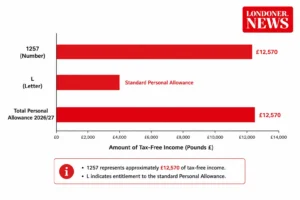
The standard Personal Allowance for the 2026/27 tax year is £12,570.
For a straightforward employee with one job, no significant taxable benefits, no untaxed income and no other PAYE complications, 1257L will commonly be the expected tax code.
HMRC determines the code and an employer or pension provider then uses it through PAYE to calculate how much Income Tax should be deducted.
People who want to understand how 1257L compares with BR, D0, D1, 0T, K codes and other payroll codes can see the full breakdown of common UK tax codes and what they mean.
How Much Can Someone Earn Tax-Free With 1257L?
Someone receiving the full standard Personal Allowance can generally have up to £12,570 of qualifying income before Income Tax becomes payable.
The figure can be viewed across different pay periods like this:
| Pay period | Approximate tax-free amount |
| Annual | £12,570 |
| Monthly mathematical equivalent | £1,047.50 |
| HMRC monthly PAYE threshold | £1,048 |
| Weekly mathematical equivalent | £241.73 |
| HMRC weekly PAYE threshold | £242 |
The small difference between the mathematical division and the PAYE figures occurs because HMRC payroll thresholds are expressed in whole pounds.
This does not mean that somebody earning £1,048 every month will necessarily have an identical tax outcome in every situation. PAYE calculations can depend on whether a code is cumulative, the employee’s earlier earnings in the tax year and other adjustments.
How Does Tax Code 1257L Work on a £30,000 Salary?
Consider an employee in England earning £30,000 a year with the standard 1257L tax code.
A simplified Income Tax calculation is:
| Calculation | Amount |
| Gross annual salary | £30,000 |
| Personal Allowance | £12,570 |
| Income remaining after allowance | £17,430 |
| Basic-rate Income Tax at 20% | £3,486 |
| Approximate average monthly Income Tax | £290.50 |
This example looks only at Income Tax.
Actual take-home pay can also be affected by National Insurance, workplace pension contributions, student loan repayments, salary sacrifice and other payroll deductions.
It also assumes the employee has a straightforward tax position and that all £17,430 falls within the basic-rate band.
Does Tax Code 1257L Mean No Tax Will Be Deducted?
No.
1257L does not mean a worker is exempt from Income Tax.
It usually means the standard £12,570 Personal Allowance is being allocated through that employment or pension.
If annual taxable income exceeds the allowance, Income Tax can still be due on the portion above it.
For someone in England, Wales or Northern Ireland with the standard allowance in 2026/27, the main bands are:
| Income | Main Income Tax rate |
| Up to £12,570 | 0% through Personal Allowance |
| £12,571 to £50,270 | 20% |
| £50,271 to £125,140 | 40% |
| Over £125,140 | 45% |
Different rules apply to Scottish taxpayers.
Why Might a Tax Code Change From 1257L?
A change away from 1257L does not automatically mean HMRC has made a mistake.
HMRC can adjust a person’s tax code when information affecting the amount of tax-free income changes.
Common reasons include:
- starting or leaving a job;
- having more than one job;
- receiving taxable company benefits;
- receiving pension income;
- receiving State Pension alongside another PAYE income;
- Marriage Allowance;
- tax owed from an earlier year;
- untaxed income;
- changes in estimated annual earnings;
- reaching an income level where the Personal Allowance begins to reduce.
For example, a code could change from 1257L to 1157L.
A simplified interpretation would be that the tax-free amount allocated through that code has fallen from approximately £12,570 to £11,570 — a reduction of £1,000.
The important question is therefore not simply whether the code has changed, but why HMRC has reduced or increased the allowance used within it.
How Much Could an Incorrect Tax Code Cost Each Month?
The financial effect depends heavily on how different the incorrect code is from the correct one and which tax rate applies to the affected income.
For illustration, assume an employee should have 1257L but receives a lower L code and all of the additional taxable income falls at either 20% or 40%.
| Example code | Reduction in allowance versus 1257L | Approx. extra tax a month at 20% | Approx. extra tax a month at 40% |
| 1157L | £1,000 | £16.67 | £33.33 |
| 957L | £3,000 | £50 | £100 |
| 657L | £6,000 | £100 | £200 |
These figures are illustrations rather than a prediction of what a particular employee will pay.
They show why a materially incorrect tax code can become expensive if it continues for several pay periods.
A lower code may also be completely legitimate if HMRC is accounting for taxable benefits, pension income, earlier underpaid tax or another adjustment.
Why Is 1257L Still Important When the Personal Allowance Is Frozen?
The £12,570 Personal Allowance has remained unchanged for several tax years and current policy keeps it at that level through 5 April 2031.
That matters because wages can increase while the tax-free threshold does not.
For example, an employee receiving annual salary increases may earn more without receiving a corresponding increase in the amount protected by the Personal Allowance.
This is commonly described as fiscal drag.
It can gradually result in more earnings becoming taxable and can also push employees towards higher tax bands even where headline Income Tax rates themselves have not increased.
For London workers, where salaries can be comparatively high, frozen thresholds can have a particularly noticeable effect.
The higher-rate threshold for England is also currently £50,270, meaning pay rises can move a larger share of someone’s salary into the 40% band.
Does Everyone Receive the Full £12,570 Personal Allowance?
No.
The standard Personal Allowance begins to reduce when a person’s adjusted net income exceeds £100,000.
The allowance falls by £1 for every £2 of adjusted net income above £100,000.
A simplified table shows the effect:
| Adjusted net income | Reduction in £12,570 allowance | Remaining Personal Allowance |
| £100,000 | £0 | £12,570 |
| £105,000 | £2,500 | £10,070 |
| £110,000 | £5,000 | £7,570 |
| £120,000 | £10,000 | £2,570 |
| £125,140 | £12,570 | £0 |
Once adjusted net income reaches £125,140, the standard Personal Allowance has been completely removed.
Someone at these income levels should therefore not assume that 1257L remains appropriate simply because it is the standard code for many other employees.
What Is the 60% Tax Trap Between £100,000 and £125,140?
The Personal Allowance taper creates an unusually high effective marginal Income Tax rate for many employees in England, Wales and Northern Ireland.
Consider £2 of additional adjusted net income above £100,000.
That £2 can be taxed at 40%, producing 80p of tax.
At the same time, the taxpayer loses £1 of Personal Allowance. That additional £1 of taxable income can produce another 40p of tax.
The combined Income Tax effect is therefore approximately £1.20 on £2 of additional income, equivalent to an effective marginal Income Tax rate of 60% over the affected range.
This calculation concerns Income Tax and does not include other deductions.
It also should not simply be applied to Scottish earnings because Scotland has different Income Tax rates and bands.
Is S1257L the Scottish Version of 1257L?
Yes.
A Scottish taxpayer receiving the standard Personal Allowance may have the code S1257L.
The S prefix tells the employer or pension provider that Scottish Income Tax rates apply.
Scotland uses more Income Tax bands than England, Wales and Northern Ireland.
For 2026/27, the Scottish rates for someone receiving the standard Personal Allowance are:
| Income band | Scottish rate |
| Up to £12,570 | 0% Personal Allowance |
| £12,571 to £16,537 | 19% |
| £16,538 to £29,526 | 20% |
| £29,527 to £43,662 | 21% |
| £43,663 to £75,000 | 42% |
| £75,001 to £125,140 | 45% |
| Over £125,140 | 48% |
Scottish Income Tax generally applies based on whether the taxpayer is a Scottish taxpayer rather than simply whether their employer happens to be located in Scotland.
What Does C1257L Mean in Wales?
Welsh taxpayers can see a C prefix on their tax code.
A straightforward Welsh taxpayer receiving the standard allowance could therefore have C1257L.
The C tells payroll that Welsh Income Tax rates apply.
For 2026/27, the main Welsh rates are currently aligned with those applying in England and Northern Ireland:
- 20% basic rate;
- 40% higher rate;
- 45% additional rate.
The prefix remains important because Wales has the power to set Welsh rates, so a C code identifies the taxpayer as being within that system.
A London employee who moves their main home to Wales or Scotland should make sure HMRC has the correct address because residence can affect which tax regime applies.
What Do 1257L W1, M1 and X Mean?
Tax code 1257L by itself is not an emergency tax code.
Emergency treatment generally becomes apparent when it appears with:
1257L W1
1257L M1
1257L X
These codes use the standard allowance but apply it on a non-cumulative basis.
1257L W1
W1 means Week 1.
The tax calculation considers the current week’s pay rather than fully taking earlier income and tax from the tax year into account.
1257L M1
M1 means Month 1.
For a monthly employee, payroll effectively treats the current month independently rather than performing the normal cumulative calculation using previous months.
1257L X
X is also used for emergency or non-cumulative tax treatment and can be relevant where pay dates vary.
Why Does Someone Get an Emergency Tax Code?
Emergency tax codes frequently appear when somebody starts a new job and the employer does not yet have sufficient information about earlier earnings and Income Tax.
This can happen where a P45 is unavailable or previous employment information has not yet been processed.
Because W1 and M1 operate period by period, somebody receiving a large payment, bonus or unusually high first wage could initially have too much or too little Income Tax deducted.
Emergency treatment is normally intended to be temporary.
Someone starting a new job should provide their P45 where available or complete the employer’s starter information accurately.
If HMRC has still not received the necessary income details after a new job starts, its current guidance says a taxpayer should generally wait 35 days before contacting it about the code.
Once HMRC updates a code after receiving corrected information, it normally tells both the taxpayer and employer within 15 working days.
A monthly employee should generally see the new code on the next or following payslip, while somebody paid weekly should normally see it by the third payslip.
What Is a K Tax Code?
A K code works differently from 1257L.
It is normally used when deductions or untaxed amounts HMRC needs to account for are greater than the person’s available tax-free allowance.
This can happen because of:
- taxable company benefits;
- State Pension or other taxable state income;
- tax owed from an earlier year;
- certain untaxed income;
- savings interest that needs to be accounted for through PAYE.
Instead of deducting an allowance from income before calculating tax, a K code effectively adds an amount to taxable pay.
K475 Worked Example
Suppose somebody has a K475 tax code and receives a salary of £27,000.
The number 475 represents £4,750.
A simplified PAYE calculation therefore treats taxable income as:
£27,000 + £4,750 = £31,750
The K code does not mean the employee physically received the additional £4,750. It is a PAYE mechanism used to collect tax relating to other taxable amounts or deductions.
There is also an important safeguard: deductions resulting from a K code cannot normally take more than 50% of the employee’s pre-tax pay or pension for that pay period.
An unexpected K code therefore deserves careful checking, but it should not automatically be treated as an HMRC error.
How Does Marriage Allowance Change a Tax Code?
Marriage Allowance can change the letter at the end of a person’s tax code.
It allows an eligible husband, wife or civil partner to transfer £1,260 of Personal Allowance to their partner.
The tax code can then end with:
| Letter | Meaning |
| M | The person is receiving transferred Marriage Allowance |
| N | The person is transferring part of their Personal Allowance |
For 2026/27, Marriage Allowance can reduce the recipient’s tax by up to £252 where the full benefit is available.
This is one reason somebody who previously had 1257L may later see a different number and an M or N suffix.
The change is not necessarily an error. It can reflect an active Marriage Allowance claim.
What Happens With 1257L on a Second Job?
Someone with two jobs only has one Personal Allowance for the tax year.
They do not automatically receive £12,570 tax-free in each employment.
A typical arrangement might therefore look like this:
| Income source | Possible tax code |
| Main job | 1257L |
| Second job | BR |
BR normally means all income from that particular employment is taxed at the basic rate without allocating another Personal Allowance to it.
Depending on the taxpayer’s total income, other codes such as D0 or D1 may instead be appropriate.
A second-job BR code is therefore not automatically emergency tax and is not automatically wrong.
Can Pensioners Have Tax Code 1257L?
Yes.
Tax codes are used by pension providers as well as employers.
A pensioner receiving a private or workplace pension through PAYE may therefore have 1257L where the standard Personal Allowance is being allocated to that pension.
The position can become more complicated for somebody receiving both the State Pension and another taxable pension.
The State Pension is taxable income, but tax is not normally deducted directly from it.
HMRC may therefore account for taxable State Pension income through the tax code attached to another pension or PAYE income.
This is one reason a pensioner’s code can be lower than 1257L or even become a K code.
A lower tax code in retirement should therefore be checked against the person’s complete pension income rather than judged by the code alone.
Does Tax Code 1257L Affect National Insurance?
No.
Income Tax codes and National Insurance categories are different parts of payroll.
1257L primarily tells payroll how Income Tax should be calculated.
National Insurance uses separate rules, thresholds and category letters.
An employee could therefore have:
Income Tax code: 1257L
National Insurance category: A
The letter A in that example has nothing to do with the L in 1257L.
Changes to an Income Tax code also do not automatically mean the person’s National Insurance category should change.
How Can Someone Check Whether 1257L Is Correct?
The first step is to compare the code with the taxpayer’s actual circumstances.
A useful sense-check is to ask:
| Question | Why it matters |
| Is this the person’s main job? | The main Personal Allowance may already be used elsewhere |
| Has the person recently changed jobs? | Old employment records can affect PAYE |
| Is there a second job? | Another code such as BR may apply |
| Are there taxable workplace benefits? | These can reduce the allowance |
| Does the person receive pension income? | Pension income can affect the code |
| Is Marriage Allowance active? | M or N may appear |
| Is income above £100,000? | The Personal Allowance may be tapered |
| Does HMRC show an old employer? | Income may be duplicated |
| Is the code W1, M1 or X? | Emergency treatment may be operating |
Taxpayers can find their tax code on a payslip, HMRC tax-code notice, online tax account or the HMRC app.
The important step is to check the income figures and deductions used to create the code, not merely the code itself.
How Can Someone Estimate Whether the Tax Looks Reasonable?
A simple 1257L sense-check for a straightforward England, Wales or Northern Ireland employee can start with four steps.
Step 1: Take expected annual taxable employment income.
Step 2: Subtract the available Personal Allowance.
Step 3: Apply the relevant Income Tax bands to the remaining taxable income.
Step 4: Compare the resulting approximate liability with the Income Tax shown across payslips.
For example:
£35,000 salary − £12,570 allowance = £22,430 taxable income
If all £22,430 falls within the 20% basic-rate band:
£22,430 × 20% = £4,486 annual Income Tax
That works out at an average of approximately £373.83 a month across a full year.
This is only a simplified tax-code check. Actual PAYE calculations can differ because of cumulative payroll calculations, benefits, bonuses, earlier employment, pensions and other adjustments.
What Should Someone Do if Tax Code 1257L Is Wrong?
An employer normally cannot simply invent a replacement tax code because an employee believes their current one is incorrect.
The underlying information held by HMRC needs to be corrected.
The taxpayer should check information such as:
- current and previous employments;
- expected annual income;
- pension income;
- taxable employment benefits;
- employment expenses;
- other items HMRC has included in the code.
Where HMRC’s information is incorrect, updating it can lead to a revised code being sent to both the taxpayer and the employer or pension provider.
The employee should then check subsequent payslips to make sure the updated code has actually been applied.
Can Someone Get a Refund After Using the Wrong Tax Code?
Yes.
If an incorrect tax code causes too much Income Tax to be deducted and HMRC has enough information to calculate the correct position, an overpayment can sometimes be returned through payroll after the tax code is corrected.
If the issue is identified after the tax year has ended, HMRC may carry out a PAYE reconciliation.
An employee or pensioner who has paid too much or too little tax may receive a P800 tax calculation or, in some circumstances, a Simple Assessment.
A P800 can show that a refund is due or that additional tax needs to be paid.
Where HMRC identifies an underpayment that can be collected through PAYE, it can sometimes alter a later tax code to recover the amount.
This also explains why a person’s future code may unexpectedly be lower than 1257L.
Is 1257L Always the Correct Tax Code?
No.
1257L is common, but it is not a universal default that every taxpayer should expect.
It is most likely to fit someone with a straightforward PAYE position, the full standard Personal Allowance and no significant adjustments.
A different code can be perfectly correct for someone who:
- has multiple jobs;
- receives taxable benefits;
- has pension income;
- receives Marriage Allowance;
- owes tax from an earlier year;
- has substantial untaxed income;
- is a Scottish or Welsh taxpayer;
- has adjusted net income above £100,000.
The purpose of checking a payslip should therefore be to establish whether the tax code reflects the person’s circumstances, rather than trying to make every code look like 1257L.
Why Should Workers Pay More Attention to 1257L in 2026?
The number itself has not changed, but its significance is increasing.
The £12,570 Personal Allowance remains frozen while earnings can continue rising.
That means an employee can receive a pay rise without receiving any corresponding increase in tax-free Personal Allowance.
Over time, more income can therefore become taxable and more workers can move towards higher-rate thresholds.
At the same time, tax codes can change because of second jobs, company benefits, pensions, Marriage Allowance and HMRC adjustments.
For employees focused only on their net salary, a code change can easily go unnoticed.
Checking the code whenever a new tax year starts, a new job begins or take-home pay changes unexpectedly can make it easier to identify a problem before several months of incorrect deductions accumulate.
Frequently Asked Questions
Is 1257L a good tax code?
For someone entitled to the full standard Personal Allowance and with a straightforward PAYE position, 1257L is normally an expected code. Whether it is correct still depends on the person’s individual circumstances.
Is 1257L an emergency tax code?
1257L on its own is not an emergency tax code. Emergency versions normally include W1, M1 or X, such as 1257L M1.
What does 1257L M1 mean?
It means the standard allowance is being applied on a Month 1 emergency basis. PAYE looks mainly at the current month’s pay rather than performing the normal cumulative calculation across the tax year.
Why has a tax code changed from 1257L to BR?
BR is often used for a second employment or pension when the Personal Allowance is already being used against another source of income. It can also appear where HMRC does not yet have complete employment information.
Why has a tax code changed from 1257L to a lower number?
HMRC may have reduced the tax-free amount to account for taxable benefits, pension income, unpaid tax, untaxed income or another adjustment. A lower number is not automatically evidence of an error.
What does S1257L mean?
S1257L indicates that the taxpayer has an allowance represented by 1257L but their relevant income is taxed using Scottish Income Tax rates.
What does C1257L mean?
C1257L identifies a Welsh taxpayer receiving the relevant standard allowance, with Welsh Income Tax rates applied through PAYE.
Can 1257L be used for a pension?
Yes. Workplace and private pension providers can use PAYE tax codes. A pensioner receiving the standard Personal Allowance through a pension could therefore have 1257L.
Does 1257L include National Insurance?
No. The code concerns Income Tax. National Insurance is calculated separately using its own thresholds and category letters.
Can a wrong tax code lead to a P800 refund?
Yes. If too much Income Tax has been paid and the issue is identified through PAYE reconciliation, HMRC may issue a P800 showing that a refund is due.
Does someone earning over £100,000 still get 1257L?
Not necessarily. The standard Personal Allowance starts reducing once adjusted net income exceeds £100,000 and disappears entirely at £125,140, so the PAYE code may need to reflect that reduction.
How quickly can HMRC correct a wrong tax code?
After the relevant information has been updated, HMRC says it normally tells the taxpayer and employer about a new code within 15 working days. Monthly workers should usually see it on the next or following payslip, while weekly workers should normally see it by the third payslip.
About the Journalist
Ben covers business, transport and global developments for Londoner. His reporting focuses on London’s economy, major companies, infrastructure, public transport and international stories that may affect people and businesses across the capital. He explains complex developments clearly using reliable sources and relevant context.



One reader comment