Rachel Reeves Urges Deeper EU Ties in Likely Final Mansion House Speech
 Published By
Adam
Published By
Adam
Published:
Updated:
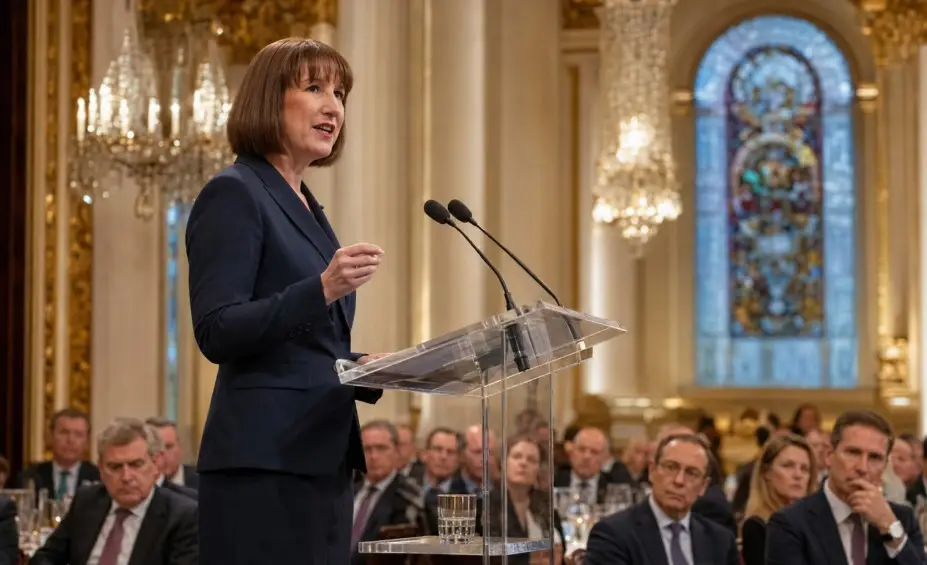
Rachel Reeves has called for a closer economic relationship with the European Union and defended her record as chancellor, using a major City of London speech to urge the next government to combine ambitious reform with financial credibility.
Rachel Reeves has called for Britain to build “much deeper ties” with the European Union as she used what is expected to be her final major speech as chancellor to set out her economic legacy and offer advice to her successor.
Speaking at the annual Financial and Professional Services Dinner at Mansion House in the City of London on Tuesday, 14 July, Reeves said the UK should confront the economic damage caused by Brexit and develop a stronger relationship with its largest trading partner.
The chancellor argued that closer co-operation could reduce costs for consumers and businesses, improve opportunities for young people and strengthen energy security, supply chains and national resilience. She told the audience that “Britain’s future is inescapably bound with that of Europe”.
Her remarks are likely to be closely watched by financial institutions and international companies based in London, many of which have called for fewer barriers to cross-border trade and investment since the UK left the EU.
Reeves Defends Economic Record
Reeves told the Mansion House audience that the British economy was “strong”, pointing to investment in infrastructure and public services, changes to fiscal rules and measures intended to ease pressure on household finances.
She said her approach, described as “securonomics”, combined stable public finances with state-backed investment and economic reform. Reeves claimed the Government had strengthened wages, reduced child poverty and placed the public finances on a more secure footing.
The chancellor said an additional £120 billion had been made available for investment through changes to the fiscal framework and the Spending Review. She also highlighted rail fare and prescription charge freezes, energy-bill measures and increased financial buffers against future economic shocks.
However, she acknowledged that renewed instability in the Middle East and volatile energy markets continued to present risks to the UK economy.
Reeves repeatedly argued that political ambition must be matched by confidence in the Government’s management of public money. She said successful administrations needed to combine “radicalism with credibility”, warning that ambitious policies could fail without public and market trust.
Sky News reported that the address was likely to be Reeves’s final major speech as chancellor, with Andy Burnham expected to become prime minister on Monday, 20 July, and appoint a new frontbench team. Sir Keir Starmer remained prime minister on Wednesday, 15 July, according to the Government’s official ministerial listing.
Bank Governor Stresses Stability
Bank of England governor Andrew Bailey also addressed the Mansion House gathering, telling financial-sector leaders that stronger economic growth depended on maintaining monetary and fiscal stability.
Bailey said the UK’s potential growth rate had fallen from an annual average of about 2.8% before the financial crisis to roughly 1.3% during the following 15 years. Growth in national income per person had also slowed sharply, affecting living standards.
He argued that effective regulation should support sustainable growth by protecting financial stability, encouraging competition and allowing businesses and households to plan with confidence. Simply demanding more or less regulation, he said, failed to address whether individual rules were achieving their intended purpose.
Bailey also warned that inflation would take longer to return to the Bank’s 2% target after renewed international disruption. Although the broader economic picture remained uncertain, he said the UK still had frameworks capable of providing stability.
The two speeches leave the incoming administration facing pressure to pursue economic change without unsettling financial markets. Decisions on the future relationship with the EU, public spending, taxation and financial regulation will now depend on the next prime minister and chancellor.
About the Journalist
Adam reports on London news, events and local developments. His coverage includes festivals, exhibitions, public announcements, community stories and important updates affecting people across the city. He aims to provide timely and accessible reporting on what is happening in London.