How Much Does It Cost To Charge An Electric Car In 2026? UK Costs Explained
 Published By
Henry
Published By
Henry
Published:
Table of Contents
For London drivers considering the switch from petrol or diesel, one question tends to come before almost everything else: how much does it cost to charge an electric car?
The answer in August 2026 depends heavily on where the car is charged. A driver with a driveway and access to domestic electricity can pay considerably less than someone relying on rapid public chargers around London or on motorway journeys.
Under Ofgem’s energy price cap for 1 July to 30 September 2026, the average electricity unit rate for a household paying by Direct Debit is 26.11p per kWh. The regulator says the overall energy price cap increased by 13% compared with the previous quarter.
Meanwhile, rapid and ultra-rapid public charging can cost substantially more. Zapmap’s latest figures, updated on 24 August 2026, show PAYG prices across leading rapid networks ranging from around 59p to 92p per kWh during July.
That means the same 60kWh battery could theoretically cost about £15.67 to charge at home, compared with around £35.40 to £55.20 at a rapid public charger, before allowing for charging losses or additional fees.
How Much Does It Cost to Charge an Electric Car at Home?
For most drivers who can do it, home charging is normally the cheapest way to charge an electric car.
The basic calculation is simple:
Battery capacity in kWh × electricity price per kWh = estimated charging cost
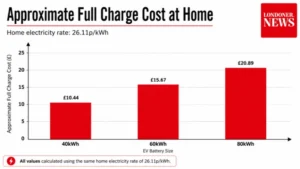
Using Ofgem’s current average capped electricity rate of 26.11p per kWh, the approximate cost of charging different battery sizes from empty to full would be:
| EV Battery Size | Home Electricity Rate | Approximate Full Charge |
| 40kWh | 26.11p/kWh | £10.44 |
| 60kWh | 26.11p/kWh | £15.67 |
| 80kWh | 26.11p/kWh | £20.89 |
These calculations use the electricity added to the battery and exclude the household standing charge. In reality, the amount taken from the grid can be slightly higher because some energy is lost during charging.
The 26.11p/kWh figure applies to the average capped standard variable tariff, not every household. Drivers on fixed deals or specialist EV electricity tariffs may pay a different rate.
How Much Does It Cost to Charge an Electric Car at a Public Charger?
This is where the answer becomes much more varied.
Public EV chargers do not all charge the same price.
Cost can depend on:
- Charging speed
- Network operator
- Location
- Time of day
- Membership or subscription
- Payment method
- Parking charges
- Connection or overstay fees
Rapid and ultra-rapid chargers are generally more expensive because they can deliver large amounts of electricity in a much shorter period.
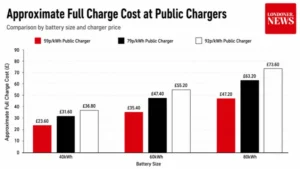
Latest Zapmap data shows PAYG pricing among major rapid and ultra-rapid charging networks ranging from approximately 59p to 92p per kWh.
Using those prices, a theoretical full charge looks very different:
| Battery Size | 59p/kWh Public Charger | 79p/kWh Public Charger | 92p/kWh Public Charger |
| 40kWh | £23.60 | £31.60 | £36.80 |
| 60kWh | £35.40 | £47.40 | £55.20 |
| 80kWh | £47.20 | £63.20 | £73.60 |
For Londoners without a driveway, this difference is particularly important. Londoners previous coverage has examined the wider public charging divide facing motorists who cannot easily access domestic electricity.
Is It Cheaper to Charge an Electric Car at Home or in Public?
Home charging is usually significantly cheaper.
Take a 60kWh electric car as a straightforward example.
Charging 60kWh at the current 26.11p domestic rate would cost approximately £15.67.
At a rapid public charger costing 79p/kWh, the same amount of electricity would cost approximately £47.40.
That is a difference of more than £31 for a single 60kWh charge.
The gap can become significant over an entire year, particularly for high-mileage motorists.
| Charging Method | Example Price per kWh | 60kWh Charge |
| Home charging | 26.11p | £15.67 |
| Public charging | 59p | £35.40 |
| Public charging | 79p | £47.40 |
| Higher-priced rapid charging | 92p | £55.20 |
However, drivers should not assume that every public charger costs 79p or more. Prices differ considerably between networks and locations, while off-peak deals and subscriptions can reduce the amount paid.
How Much Does It Cost to Charge an Electric Car for 100 Miles?
Battery size is only one way of looking at charging costs.
For motorists comparing an EV with petrol or diesel, cost per mile is often more useful.
Suppose an electric car achieves approximately 3.5 miles per kWh.
Driving 100 miles would require around 28.6kWh of electricity.
At different charging prices, the approximate electricity cost would be:
| Charging Price | Approximate Cost for 100 Miles |
| 26.11p/kWh home rate | £7.46 |
| 59p/kWh public charger | £16.86 |
| 79p/kWh public charger | £22.57 |
| 92p/kWh public charger | £26.29 |
Actual efficiency can be better or worse.
Cold weather, motorway speeds, heavy acceleration, heating, air conditioning, vehicle weight and tyre condition can all affect electricity consumption.
Drivers should therefore calculate costs using the real-world efficiency of their own vehicle where possible.
Maintaining a vehicle properly also matters for efficiency and safety. Londoner has separately explained the parts motorists must consider when keeping a car roadworthy.
How Much Does It Cost to Charge an Electric Car From 10% to 80%?
EV drivers do not normally arrive at a charger with a completely empty battery and charge it to 100%.
Rapid charging on longer journeys commonly involves topping the battery up from around 10% to 80%.
For a 60kWh battery, moving from 10% to 80% means adding approximately 42kWh.
That would cost roughly:
- £10.97 at 26.11p/kWh
- £24.78 at 59p/kWh
- £33.18 at 79p/kWh
- £38.64 at 92p/kWh
This makes it easier to understand why a motorway rapid-charging stop can feel considerably more expensive than plugging the same car in at home overnight.
Why Is Rapid EV Charging More Expensive?
A public charger is not simply reselling domestic electricity.
Chargepoint operators have to fund the infrastructure required to install and operate charging locations. Costs can include grid connections, equipment, maintenance, land, payment systems, customer support and upgrades.
Faster chargers also require substantially greater electrical capacity.
Zapmap notes that charging speed is one of the main factors influencing public charging prices, with motorists generally paying more for the convenience of rapid and ultra-rapid charging.
This is why drivers who primarily charge overnight at home can experience very different ownership costs from people who depend almost entirely on public infrastructure.
Why Can Charging Costs Be More Important for London Drivers?
London presents a particular challenge because many motorists do not have private off-street parking.
A household with a driveway may be able to install a private chargepoint, plug the car in overnight and use domestic electricity.
Someone living in a flat or terraced property may instead depend on:
- Kerbside chargers
- Council charging points
- Supermarket chargers
- Workplace charging
- Destination chargers
- Rapid charging hubs
Even where public charging infrastructure is widely available, the price per kWh can remain considerably higher than domestic electricity.
That means the economics of electric car ownership can differ between two London households even if they own exactly the same vehicle and cover exactly the same mileage.
Can Londoners Get Help With the Cost of Installing a Home Charger?
Some households can.
Changes introduced from 1 April 2026 increased several government EV chargepoint grants from £350 to a maximum of £500 per socket.
The support is available under qualifying schemes for renters and flat owners, residential landlords and households with on-street parking. The current schemes are due to remain available until 31 March 2027, subject to eligibility and government rules.
For qualifying renters and flat owners, the grant can cover 75% of eligible purchase and installation costs up to £500.
Households with only on-street parking may also qualify for assistance where an approved cross-pavement charging solution, such as a charging channel, is being installed.
For London in particular, schemes designed for properties without conventional driveways could become increasingly important.
Does an Electric Car Cost More to Charge in Winter?
It can.
Electric cars commonly use more electricity during cold weather because low temperatures can reduce battery efficiency and energy is required to heat the cabin and sometimes condition the battery.
If a vehicle that normally manages 3.5 miles per kWh falls to 3 miles per kWh during difficult winter conditions, the amount of electricity needed to cover the same journey increases.
The electricity price itself may not have changed, but the cost per mile rises because the vehicle consumes more kWh.
Pre-heating the vehicle while it is connected to a charger and using heated seats rather than relying heavily on cabin heating can help in some circumstances, although the impact varies by vehicle.
Do Bigger Electric Cars Cost More to Charge?
Usually, yes.
A larger battery takes more electricity to fill.
A small EV with a 40kWh battery charged at 26.11p/kWh needs approximately £10.44 worth of battery energy for a theoretical 0% to 100% charge.
An 80kWh vehicle needs about £20.89 at the same rate.
But battery capacity does not tell the whole story.
A larger vehicle might travel farther between charges. What ultimately matters for everyday running cost is the vehicle’s miles per kWh efficiency.
Two cars with 80kWh batteries can therefore have quite different running costs.
Does Charging Speed Change How Much You Pay?
At home, charging speed does not necessarily change the electricity unit price. A 7kW wallbox simply delivers electricity faster than a conventional domestic socket.
On the public network, however, speed and price are often connected.
A slower destination charger may cost considerably less per kWh than an ultra-rapid charger capable of delivering 150kW, 300kW or more.
Ultra-rapid charging is particularly useful on long motorway journeys, where reducing waiting time matters.
For everyday local driving, motorists who can charge slowly overnight generally have less reason to pay the premium associated with the fastest public chargers.
Are There Any Extra EV Charging Costs to Watch For?
The advertised pence-per-kWh rate should not always be treated as the final session cost.
Depending on the location, drivers could encounter:
- Parking charges: A charger may sit inside a paid car park.
- Overstay fees: Some operators charge motorists who remain connected after a permitted period.
- Connection fees: Certain tariffs include a separate session charge.
- Subscriptions: Lower electricity rates may require a monthly membership.
- Charging losses: The electricity taken from the grid can be slightly higher than the amount ultimately stored in the battery.
Drivers should check the total expected session cost before plugging in rather than comparing networks purely on charging speed.
How Can EV Drivers Reduce Their Charging Costs?
The biggest saving normally comes from using low-cost home electricity wherever practical.
Drivers can also reduce costs by charging during cheaper off-peak periods, comparing public networks before travelling and avoiding ultra-rapid chargers when speed is unnecessary.
For longer journeys, planning stops in advance can make a substantial difference. A charger costing 59p/kWh rather than 92p/kWh represents a difference of 33p for every kWh purchased.
Adding 40kWh at those rates would mean paying either £23.60 or £36.80, a £13.20 difference during one charging session.
Drivers should also keep on top of routine servicing and vehicle checks. Recent changes to the MOT process are covered in Londoner’s report on MOT photos.
Is Charging an Electric Car Cheaper Than Buying Petrol or Diesel?
It can be considerably cheaper when most charging takes place at home.
The comparison becomes less straightforward for motorists who rely heavily on high-priced rapid chargers.
An EV charged at 26.11p/kWh and returning 3.5 miles per kWh uses around 7.5p of electricity per mile.
At 79p/kWh, the electricity cost rises to roughly 22.6p per mile.
Drivers comparing an EV with a petrol or diesel car should therefore avoid using one national “EV charging cost”. The right comparison depends on where they expect to charge most frequently.
For a London flat resident with no domestic charger, public charging prices deserve particular attention before buying an EV.
How Much Does It Cost to Charge an Electric Car in the UK in 2026?
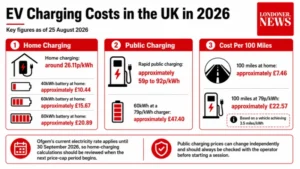
As of 25 August 2026, a useful starting point is:
- Home charging: around 26.11p/kWh on the current average Ofgem-capped Direct Debit electricity rate.
- 40kWh battery at home: approximately £10.44.
- 60kWh battery at home: approximately £15.67.
- 80kWh battery at home: approximately £20.89.
- Rapid public charging: approximately 59p to 92p/kWh among major PAYG networks in the latest available figures.
- 60kWh at a 79p/kWh charger: approximately £47.40.
- 100 miles at home: approximately £7.46 for a vehicle achieving 3.5 miles/kWh.
- 100 miles at 79p/kWh: approximately £22.57 for the same vehicle.
Ofgem’s present electricity rate applies until 30 September 2026, so home-charging calculations should be reviewed when the next price-cap period begins.
Public charging prices can change independently and should always be checked with the operator before starting a session.
Conclusion
So, how much does it cost to charge an electric car? For a typical UK driver, the answer can range from little more than £10 for a smaller battery charged at home to £50 or more for a larger rapid-charging session.
The most important factor is not simply the make of electric car it is where the electricity comes from and how much it costs per kWh.
For Londoners with off-street parking, regular home charging can keep running costs relatively low.
Those relying on public rapid chargers need to compare networks more carefully, because the difference between domestic and public electricity prices can add hundreds of pounds to annual motoring costs.
With domestic energy prices and public charging tariffs continuing to change, EV owners should calculate their costs using their own battery size, real-world efficiency, annual mileage and usual charging locations rather than relying on a single headline figure.
Frequently Asked Questions
How much does it cost to fully charge an electric car at home?
At the current average capped electricity rate of 26.11p/kWh, a theoretical full charge costs about £10.44 for a 40kWh battery, £15.67 for 60kWh and £20.89 for 80kWh, excluding charging losses.
Is it cheaper to charge an electric car at home?
Usually, yes. Domestic electricity is currently substantially cheaper per kWh than many rapid and ultra-rapid public chargers.
How much does it cost to charge an electric car at a charging station?
It varies considerably. Latest rapid-network PAYG pricing tracked by Zapmap ranges from about 59p to 92p per kWh, meaning a 60kWh charge could cost roughly £35.40 to £55.20.
How much does it cost to charge an electric car for 100 miles?
At 3.5 miles per kWh and a domestic rate of 26.11p/kWh, 100 miles requires around £7.46 of electricity. At a public rate of 79p/kWh, it is approximately £22.57.
How much does it cost to charge an electric car from 10% to 80%?
For a 60kWh battery, charging from 10% to 80% adds about 42kWh. That costs approximately £10.97 at 26.11p/kWh or £33.18 at 79p/kWh.
Are electric car chargers free in the UK?
Some locations may still offer free charging as a customer benefit, but motorists should not assume that public charging is free. Many networks charge per kWh and may also impose parking, session or overstay fees.
How much is a home EV charger grant in 2026?
Eligible renters, flat owners and some other qualifying households can receive support of up to £500 towards approved EV chargepoint installation under current government schemes.
About the Journalist
Henry is the editorial head and lead author at Londoner. He oversees the publication’s editorial direction, article quality, source verification and corrections process. He also reviews major stories before publication to ensure they meet Londoner’s standards for accuracy, fairness and transparency.