Nearly 62,000 More London Homes Could Face Mansion Tax If Threshold Falls to £1.5m
 Published By
Henry
Published By
Henry
Published:
Nearly 62,000 additional London homes could be brought into the Government’s planned high-value property tax if Chancellor John Healey lowers its starting threshold from £2 million to £1.5 million in the Autumn Budget.
The possible change is reportedly being discussed inside the Treasury ahead of the 28 October 2026 Budget, although no decision has been announced.
As of 22 September 2026, the Government’s confirmed policy remains the High Value Council Tax Surcharge, applying to residential properties in England valued at £2 million or more. It is due to take effect from April 2028.
Under the existing plan, owners of homes valued between £2 million and £2.5 million would pay an additional £2,500 a year.
The annual charge increases to £3,500 for properties between £2.5 million and £3.5 million, £5,000 between £3.5 million and £5 million and £7,500 for properties worth more than £5 million.
However, reports in recent days suggest the Treasury is considering whether the threshold could instead begin at £1.5 million, potentially bringing tens of thousands of additional London properties into the scheme.
Reuters reported on 18 September that the Government was considering the lower threshold, citing a report based on two government sources.
The Treasury has not confirmed that change. Its position is that tax decisions are announced at fiscal events rather than through responses to Budget speculation.
How Many London Homes Could Pay the Mansion Tax?
New analysis from Tax Policy Associates, the tax research organisation founded by lawyer Dan Neidle, provides one of the clearest estimates yet of what a £1.5 million threshold could mean.
Its modelling, updated on 19 September 2026, estimates that reducing the threshold could increase the number of properties within the tax from around 123,000 to approximately 245,000 under its transaction-based model.
Of the additional properties identified by that model, 61,787 are in London, meaning the capital accounts for just over half of the newly affected homes.
Tax Policy Associates estimates that approximately 144,104 London properties could ultimately fall within its illustrative £1.5 million version of the surcharge, producing an estimated annual bill of about £624 million across the capital.
The organisation stresses that these figures are estimates rather than a government forecast.
Its model uses Land Registry transactions and other datasets and may miss properties that have not changed hands since 1995. Individual property valuations could also differ substantially from modelled estimates.
Tax Policy Associates also makes clear that the entire £1.5 million scenario remains speculative.
It said:
“It’s important to add that this is all speculation.”
The organisation argues that merely creating a cheaper additional band below £2 million would generate relatively limited extra revenue after valuation and administrative costs.
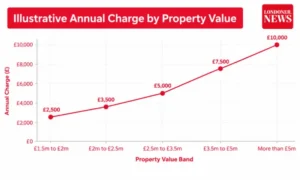
Its illustrative alternative assumes properties worth between £1.5 million and £2 million would pay £2,500 annually, while charges on more expensive homes would also increase.
Under that scenario, the bands would become:
| Property Value | Illustrative Annual Charge |
| £1.5m to £2m | £2,500 |
| £2m to £2.5m | £3,500 |
| £2.5m to £3.5m | £5,000 |
| £3.5m to £5m | £7,500 |
| More than £5m | £10,000 |
These figures have not been announced by the Government. They are Tax Policy Associates’ model of how an expanded surcharge might operate if ministers wanted to raise substantially more revenue.
The organisation estimates such a structure could produce around £800 million a year after behavioural responses and additional administration costs.
The existing Government scheme is significantly narrower. Official Budget documents estimated around 165,000 properties in England would fall within the £2 million-plus tax by 2028-29, with the policy expected to raise around £400 million after behavioural effects.
Which London Boroughs Could Be Most Affected?
The potential impact would be concentrated heavily in London’s higher-value housing markets.
Tax Policy Associates’ modelling suggests Hammersmith and Fulham could see another 7,324 properties brought into the tax if the starting point fell to £1.5 million.
That would take the estimated total affected in the borough to 19,990, with an annual combined liability of around £90.6 million under its illustrative charging structure.
In Wandsworth, another 6,526 properties could be affected, taking the estimated total to 12,526.
Kensington and Chelsea could see another 5,146 homes entering the system, producing an estimated overall total of 22,425 properties and around £131 million in annual charges.
Around 4,739 additional homes could be affected in Westminster, while approximately 4,649 more could enter the surcharge in Camden.
Other estimates for newly affected homes include:
- Richmond: 4,332
- Barnet: 3,294
- Islington: 2,906
- Haringey: 2,881
- Southwark: 2,600
- Ealing: 2,021
- Brent: 1,869
- Lambeth: 1,786
- Merton: 1,745
- Bromley: 1,729
- Hackney: 1,520
- Tower Hamlets: 1,331
The modelling also shows how geographically concentrated the possible expansion would be.
Tax Policy Associates estimates around 85% of additional properties would be in London and the wider South East under the broader regional definition used in its analysis.
That London exposure comes while parts of the capital’s property market are already experiencing falling prices.
Official ONS figures show that the average property price in Kensington and Chelsea was £1.233 million in July 2026, down 14.1% compared with a year earlier. Across London, prices fell 3.3% over the same period.
Property market analysts have also pointed to weaker conditions in the capital.
Aneisha Beveridge, head of research at Hamptons, has said that the number of homes valued above £2 million has already fallen as sellers and owners respond to weaker prime-property prices and the prospect of the forthcoming surcharge.
Reporting on the latest debate cited Hamptons data showing the stock of £2 million-plus homes had fallen by around 6.5% since the previous Budget.
Meanwhile, Colleen Babcock, property expert at Rightmove, said London’s sellers are operating in a particularly competitive market, noting that:
“The chances of selling vary significantly depending on where you live.”
Rightmove’s September data showed that fewer than half of properties coming to market in London were successfully finding buyers, compared with substantially higher selling rates in some other parts of Britain.
The planned surcharge itself was first announced in the November 2025 Budget by former Chancellor Rachel Reeves.
The Government argued that the existing council tax structure places a comparatively high burden on ordinary homes because council tax bands are still tied to 1991 property values.
The new surcharge would operate separately from those existing bands and would be based on a targeted valuation of high-value homes.
The Valuation Office is expected to determine which properties fall within the scheme, using comparable property sales and other information. Under the current proposal, properties would generally be reassessed every five years.
The Government has also consulted on potential support and payment-deferral arrangements for owners who may live in valuable properties but have limited incomes or cash available to meet the annual charge.
For London homeowners, however, the key unresolved question is now whether Chancellor John Healey will leave the £2 million threshold unchanged or extend the surcharge further down the capital’s property market.
For now, a £1.5 million threshold remains a reported Budget option rather than confirmed government policy.
The definitive position is expected to become clearer when Healey delivers the Budget on 28 October 2026.
About the Journalist
Henry is the editorial head and lead author at Londoner. He oversees the publication’s editorial direction, article quality, source verification and corrections process. He also reviews major stories before publication to ensure they meet Londoner’s standards for accuracy, fairness and transparency.