How Many People Live in London? Latest Population Figures Explained
 Published By
Henry
Published By
Henry
Published:
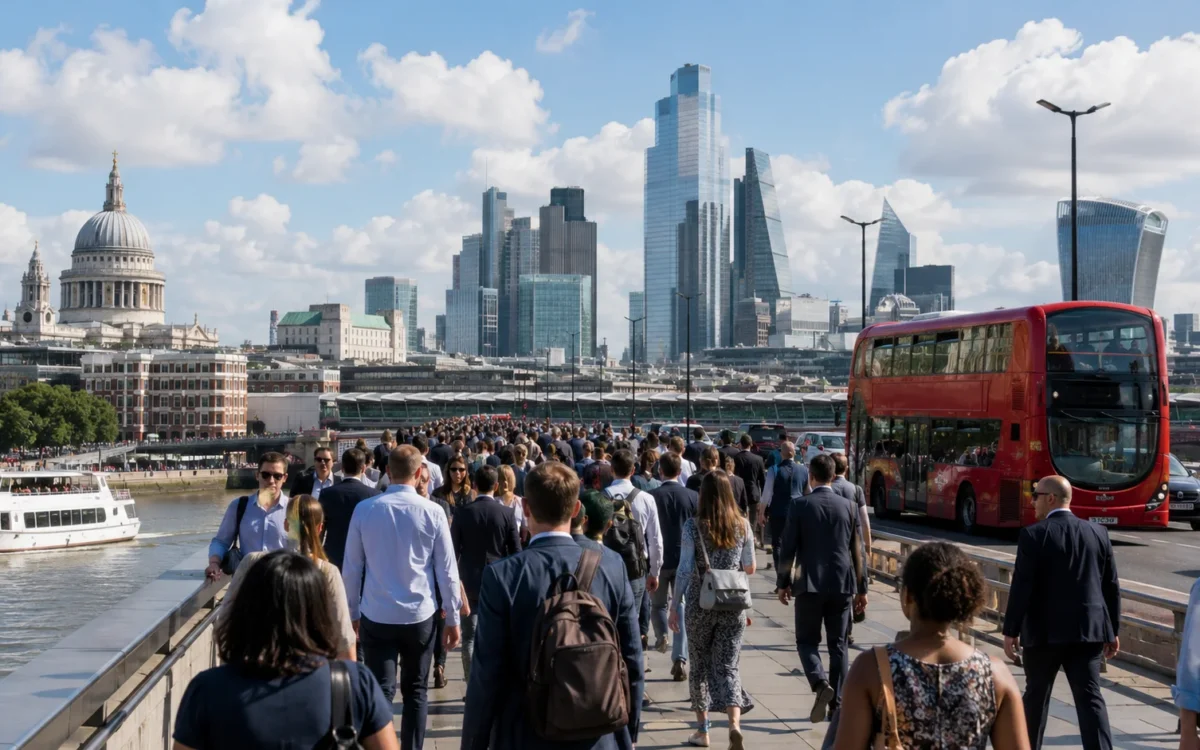
Table of Contents
Around 9.12 million people live in London. The latest official Office for National Statistics estimate puts Greater London’s population at 9,122,909 in mid-2025, making it by far the largest city in the UK. That figure is slightly lower than the revised 9,149,646 residents recorded for mid-2024.
London therefore lost about 26,737 residents, or 0.29%, in a year — an unusual development for a capital that spent much of the previous three decades expanding.
For Londoners, however, one number never tells the entire story.
The population changes dramatically depending on whether someone means Greater London, Inner London, the City of London or the wider metropolitan area.
And once commuters, tourists and short-term visitors arrive each morning, the number of people physically present in the capital can be considerably higher than its official resident population.
How Many People Live in London in 2026?
As of 2026, the latest official population estimate available for London is 9,122,909, representing the population at mid-2025.
The distinction between the year of publication and the year being measured is important. The ONS published its mid-2025 estimates on 29 July 2026.
Population statistics are not a live counter showing how many Londoners are sleeping in the capital tonight; they are statistical estimates produced after demographic data has been collected and analysed.
| London population measure | Population |
| Greater London, mid-2025 | 9,122,909 |
| Greater London, mid-2024 | 9,149,646 |
| Census 2021 | About 8.8 million |
| Croydon, 2025 | 410,085 |
| Greater London area | 1,572 km² |
| Population density | Around 5,782 people per km² |
The latest population figure therefore means roughly 9.1 million permanent residents live within the Greater London boundary.
City Hall describes London as covering around 1,572 square kilometres, while recent population-density figures put the capital at roughly 5,782 residents per square kilometre.
That helps explain why a Monday morning on the Victoria line can feel rather more crowded than the phrase “nine million people” suggests.
Is London’s Population Really Falling?
Yes — at least according to the latest official annual estimate.
London’s population fell from 9,149,646 in mid-2024 to 9,122,909 in mid-2025, a reduction of 26,737 people.
London was the only English region to record a population decline over that period. The ONS says it was the capital’s first fall since the year to mid-2021.
What is particularly interesting is that London did not shrink because people stopped coming here from abroad or because deaths suddenly overtook births.
Quite the opposite.
During the year to June 2025:
| What changed London’s population? | Approximate number |
| Births | 104,610 |
| Deaths | 50,399 |
| Arrivals from overseas | 234,612 |
| Departures overseas | 182,773 |
| People moving from elsewhere in the UK to London | 288,531 |
| People moving from London to elsewhere in the UK | 420,492 |
London therefore recorded positive natural population change because substantially more babies were born than residents died.
It also had net international migration of about 51,839.
But domestic migration went sharply in the opposite direction. Around 420,492 residents moved from London to other parts of the UK, while 288,531 people moved into London from elsewhere in the country. That left a net domestic outflow of 131,961 people.
Put simply, London is still attracting people internationally and producing more births than deaths, but large numbers of existing Londoners are moving elsewhere in Britain.
Why Are So Many Londoners Moving Away?
The statistics can tell us where people are moving, but not every household’s reason for doing so.
Housing is difficult to ignore.
For younger adults, London remains a powerful magnet for jobs, universities, culture and professional opportunities.
Later in life, however, priorities often change. A household looking for an additional bedroom, a garden or more space for children may find that the same budget stretches considerably further outside the capital.
Recent housing figures underline the pressure. In 2024-25, only around 51% of London households were owner-occupiers, compared with 67% in the rest of England. Around 28% were private renters and 21% social renters.
That does not mean every departing Londoner is being “forced out”. Some move for family, work, retirement or lifestyle reasons.
But the scale of London’s domestic population outflow makes affordability and housing supply impossible to separate from the demographic story.
It is one of the great contradictions of modern London: people from around the world continue to want to move here, while many people already here decide that their next stage of life should happen somewhere else.
Which Parts of London Are Losing People?
The population story is not uniform across the capital.
According to the latest ONS estimates, 23 of London’s 33 local-authority areas recorded population declines between mid-2024 and mid-2025.
Some of the largest percentage falls included:
| Area | Approximate annual population change |
| Camden | -1.8% |
| Westminster | -1.5% |
| Southwark | -1.5% |
Camden’s estimated population fell from 220,558 to 216,658, making its 1.8% decline one of the sharpest anywhere in England and Wales.
Domestic migration tells an equally revealing story.
Newham recorded a net loss of more than 16,000 residents to other UK areas, followed by particularly large outflows from Brent, Redbridge, Southwark, Tower Hamlets and Lambeth.
There were exceptions. Bromley and Havering, for example, recorded more people arriving from other parts of Britain than leaving during the period.
This is why talking about “London’s population” can hide considerable variation between boroughs.
Which London Borough Has the Most People?
Croydon is currently London’s most populous borough, with an estimated 410,085 residents in 2025.
Barnet follows at around 408,000 residents.
Croydon’s size makes sense when seen on the ground. It covers a substantial stretch of south London, from dense urban centres such as Croydon itself and Thornton Heath to more suburban districts towards Coulsdon, Purley and Sanderstead.
There are therefore more people living in Croydon alone than in many sizeable British towns and cities.
But population and density should not be confused. A borough can have a large total population simply because it covers a large geographical area, while smaller inner-London boroughs can feel considerably more crowded.
What Is the Difference Between London and the City of London?
This is one of the most common reasons London population figures become confusing.
London and the City of London are not the same geographical area.
When statisticians say around 9.1 million people live in London, they normally mean Greater London.
Greater London consists of:
- 32 London boroughs
- the City of London
Together they form the capital’s main administrative region.
The City of London, by contrast, is the historic Square Mile around Bank, Guildhall, St Paul’s and much of London’s financial district.
The City Corporation cites around 8,600 residents based on its commonly used resident figure, despite hundreds of thousands of workers travelling into the Square Mile for employment.
Recent ONS small-area estimates can produce higher resident estimates, and the ONS warns that uncertainty tends to be greater for small geographical areas.
So somebody saying “only a few thousand people live in the City of London” is not contradicting the claim that “nine million people live in London”.
They are talking about two different Londons.
Greater London, Inner London and Outer London Explained
London can broadly be divided into Inner London and Outer London.
The boundaries vary slightly depending on the statistical definition being used, but the fundamental pattern is straightforward: more Londoners now live in the capital’s outer districts than in its historic inner core.
Recent analysis puts approximately:
- 3.2 million people in Inner London
- 1.8 million in west London
- 1.6 million in south London
- 1.5 million in north-east London
- 1 million in north London
when London is grouped into broad sub-regions.
That suburban weight is an important part of London’s modern identity.
The postcard image of London tends to concentrate on Westminster, Soho, Camden, Shoreditch, South Bank and the City. Most Londoners, however, experience the capital through suburban high streets, estates, terraced neighbourhoods and town centres spread much further from Zone 1.
Why Do Some Websites Say London Has 9.5 Million or 9.8 Million People?
This is one of the biggest sources of confusion when searching for how many people live in London.
A number of prominent online results quote populations considerably higher than the latest official figure.
For example, some population websites use models or international urban-area projections that produce figures exceeding nine million. World Population Review currently gives a 2026 projection of about 9.19 million, while older versions and other sites have carried estimates approaching 9.8 million.
Other articles continue to quote older ONS projections. A Time Out article from 2018, for example, reported that London was projected at the time to reach 9.54 million by 2026.
But a projection is not the same as an estimate of what subsequently happened.
We now know that London’s actual population trajectory differed from those older forecasts.
The latest ONS evidence puts the population at 9.12 million in mid-2025, not 9.5 million.
That is why publication dates and geographical definitions matter whenever London population numbers are compared.
What Was London’s Population at the 2021 Census?
The 2021 Census counted approximately 8.8 million usual residents in London.
The census remains the country’s most comprehensive population count, but it only takes place periodically. Between censuses, the ONS produces annual mid-year estimates using births, deaths and migration data.
London’s population has therefore moved from roughly 8.8 million at Census 2021 to more than 9.1 million in the latest annual estimate.
The ONS also stresses that annual population estimates are subject to revision as better migration and administrative information becomes available. Figures for 2022, 2023 and 2024 have already been revised.
For readers searching an exact number, this is important: population estimates are not permanently fixed statistics.
How Has London’s Population Changed Over Time?
London’s demographic history is anything but a straight line upwards.
| Period | Approximate London population |
| 1801 | 1.0 million |
| 1891 | 5.6 million |
| 1939 | 8.6 million |
| 1981 | 6.6-6.8 million |
| 1991 | Around 6.8 million |
| 2001 | Around 7.2 million |
| 2021 | Around 8.8 million |
| 2024 | 9.15 million |
| 2025 | 9.12 million |
London expanded at extraordinary speed through the 19th and early 20th centuries as industrialisation, empire, docks, railways and employment drew people towards the capital.
By 1939, around 8.6 million people lived in London.
Then the direction reversed.
War damage, suburbanisation, new towns, changing industries and movement beyond London’s boundaries contributed to decades of population decline. By the early 1990s, the capital had roughly 6.8 million residents.
From the 1990s onwards, London entered another long period of expansion driven by jobs, international migration, natural population growth and the regeneration of formerly industrial districts.
The population eventually surpassed its pre-war high.
In 2024, London reached a modern peak of about 9.15 million on the latest revised figures before edging down in 2025.
How Diverse Is London’s Population?
Population size tells only half of London’s demographic story.
The 2021 Census showed that 40.6% of London residents were born outside the UK, the highest proportion of any English region. That represented approximately 3.58 million people at the time.
London was also the most ethnically diverse region of England and Wales.
The broad ethnic-group breakdown at Census 2021 was approximately:
| Ethnic group | Share of London’s population |
| White | 53.8% |
| Asian | 20.7% |
| Black | 13.5% |
| Mixed | 5.7% |
| Other ethnic groups | 6.3% |
Within the White population, 36.8% of all London residents identified as White British, while another 17% belonged to other White ethnic groups.
This diversity is not evenly distributed.
Newham was identified in Census 2021 data as England and Wales’s most ethnically diverse local-authority area, while different communities have distinctive concentrations across Brent, Harrow, Tower Hamlets, Southall, Croydon, Haringey and dozens of other parts of the capital.
London’s population figure therefore represents not simply a very large city, but one of Europe’s most internationally connected urban populations.
How Old Is the Average Londoner?
London is noticeably younger than the rest of the country.
The capital’s median age was around 35.7 in 2024, compared with just over 40 for England and Wales.
Around 69.5% of London’s residents were aged between 16 and 64 in 2025, again reflecting the capital’s unusually large working-age population.
There are several reasons.
Universities bring young adults into London. Graduate jobs and professional industries attract people in their twenties and thirties. International migration also disproportionately involves working-age adults.
But as Londoners reach the stage of life when they want larger homes or start families, domestic migration patterns frequently turn outwards.
That demographic conveyor belt — younger people arriving while established households leave — has shaped London for decades.
Are There More Women Than Men in London?
Yes.
The ONS-linked 2025 population data records approximately:
- 4,682,377 women
- 4,440,532 men
living in London.
Women therefore account for a little over half of the capital’s resident population.
The difference is not unusual. Women tend to have longer life expectancy than men, affecting the sex balance of populations, particularly among older age groups.
How Many People Live in London Per Square Kilometre?
London has approximately 5,782 residents per square kilometre according to recent City Hall figures using ONS population-density data. England as a whole has around 450 people per square kilometre.
In other words, London is more than 12 times as densely populated as England overall.
Even that average disguises huge local differences.
Parts of inner and east London contain dense apartment blocks, Victorian terraces and major residential developments. Towards London’s outer edge, housing becomes more suburban and considerable amounts of green space remain inside the capital’s boundary.
London is therefore dense by British standards without being uniformly built-up.
In fact, City Hall estimates that roughly half of Greater London’s area can be described as green space when different categories of greenery are included.
How Many People Are Actually in London During the Day?
There is no single reliable daily number because London’s daytime population changes continuously.
The official 9.12 million figure refers to usual residents, not everyone physically present in London on a particular day.
ONS population estimates generally use the concept of a “usually resident population”. Long-term residents are counted, while visitors and many people staying for shorter periods are not.
On any ordinary weekday, London additionally absorbs:
- commuters arriving from surrounding counties;
- domestic and international tourists;
- business visitors;
- people attending events;
- some temporary workers and short-term residents.
The difference is particularly dramatic in central London.
The City of London illustrates it perfectly. Its residential population is tiny compared with the hundreds of thousands of workers who travel into the Square Mile. The City Corporation reports around 614,500 workers associated with the district.
This is why London’s Tube stations, pavements and business districts can suggest a city substantially larger than its official residential count.
Is London Bigger Than Other UK Cities?
Yes, by a very wide margin.
Greater London is home to more than nine million people. No other individual UK city approaches that population when comparable administrative boundaries are considered.
This is also where city comparisons become dangerous.
Comparing Greater London with the municipal boundary of Manchester, Birmingham or Glasgow is rarely a like-for-like exercise. Metropolitan areas extend well beyond many official city boundaries.
The safest conclusion is straightforward: London is Britain’s largest urban centre by a considerable margin, but comparisons between international or British cities should always use equivalent geographical definitions.
Does London Have More Than 10 Million People?
Not within Greater London according to the latest official statistics.
The population is currently around 9.12 million.
Figures above 10 million usually refer to a broader London urban or metropolitan area, future population projections, or datasets using a different geographical definition.
That distinction matters.
Greater London ends at a political boundary. London’s functional economy does not.
Places such as Watford, Dartford, Epsom and towns across Essex, Hertfordshire, Kent, Surrey and Buckinghamshire are closely connected to London’s labour and transport markets while remaining outside Greater London.
A metropolitan-area statistic can therefore legitimately exceed the official London population without either number being incorrect.
They are measuring different things.
Will London’s Population Reach 10 Million?
Probably at some point — but exactly when remains uncertain.
Older forecasts expected London to reach the milestone sooner than now appears likely. The latest annual data demonstrate why demographic forecasts should never be treated as guarantees.
The GLA’s more recent population modelling nevertheless expects long-term growth to resume.
Draft 2024-based City Hall projections place London’s population at approximately 9.9 million to 10.3 million by 2046, depending on assumptions about migration and demographic change. The central projection is close to 9.95 million.
ONS projections similarly suggest long-run population growth, although the agency explicitly warns that population projections are not forecasts. They show what would happen if particular demographic assumptions continued.
London could therefore cross 10 million earlier or later depending on housing supply, migration, fertility, employment, affordability and the rate at which Londoners continue moving elsewhere in Britain.
Why London’s Population Matters
A change of 50,000 or 100,000 people can sound modest when discussing a city of nine million.
On the ground, it matters enormously.
Population determines how many homes London needs, where schools remain viable, how crowded transport becomes and where GP surgeries, hospitals and public services face pressure.
It also affects businesses. A younger working-age population helps supply London’s labour market, while changes in migration can quickly reshape recruitment in hospitality, construction, technology, health, finance and professional services.
Population decline can create its own problems.
Some London schools have already faced falling pupil numbers as the number and location of families with children changes. At the same time, areas seeing rapid housing development may face completely different pressures.
That is why London’s headline population figure should be treated less like trivia and more like an indicator of where the capital is heading.
So, How Many People Live in London?
The clearest current answer is 9,122,909 people.
That is the ONS estimate for Greater London at mid-2025 and the latest official figure available in 2026. London’s population fell by about 26,700 people during the year, largely because considerably more residents moved from London to other parts of Britain than moved in the opposite direction.
Yet the capital remains a city of extraordinary scale: more than nine million residents spread across 32 boroughs and the City of London, with millions more connected to it through work, education, tourism and commuting.
The figure to remember, then, is about 9.1 million.
But London is never just one number. Its population is constantly arriving, leaving, ageing, growing, shrinking and moving between boroughs — which is perhaps the most London thing about it.
Frequently Asked Questions
How many people live in London in 2026?
The latest official ONS data estimates 9,122,909 people lived in Greater London in mid-2025. The figures were published in July 2026.
Does London have 9 million people?
Yes. Greater London’s resident population is approximately 9.1 million.
Does London have 10 million people?
Not within the official Greater London boundary. Figures of 10 million or more normally use wider metropolitan definitions or population projections.
Is London’s population increasing?
Not in the latest annual figures. London’s population fell by 0.29% between mid-2024 and mid-2025, although long-term projections still anticipate future growth.
Which London borough has the largest population?
Croydon is currently the largest, with approximately 410,085 residents in 2025, followed by Barnet.
How many people were born outside the UK in London?
At Census 2021, 40.6% of London residents were born outside the UK, equivalent to roughly 3.58 million people at the time.
What is London’s population density?
Recent official figures put London’s population density at approximately 5,782 people per square kilometre.
Why do different websites give different London population figures?
They may be using different years, geographical boundaries or population projections. For the current Greater London resident population, the latest ONS mid-year estimate is the strongest figure to use.
About the Journalist
Henry is the editorial head and lead author at Londoner. He oversees the publication’s editorial direction, article quality, source verification and corrections process. He also reviews major stories before publication to ensure they meet Londoner’s standards for accuracy, fairness and transparency.