Kate Middleton Curtsy Queen Camilla: Why The Princess of Wales Follows Royal Tradition and What Her Recent Gesture Reveals?
 Published By
Jermaine
Published:
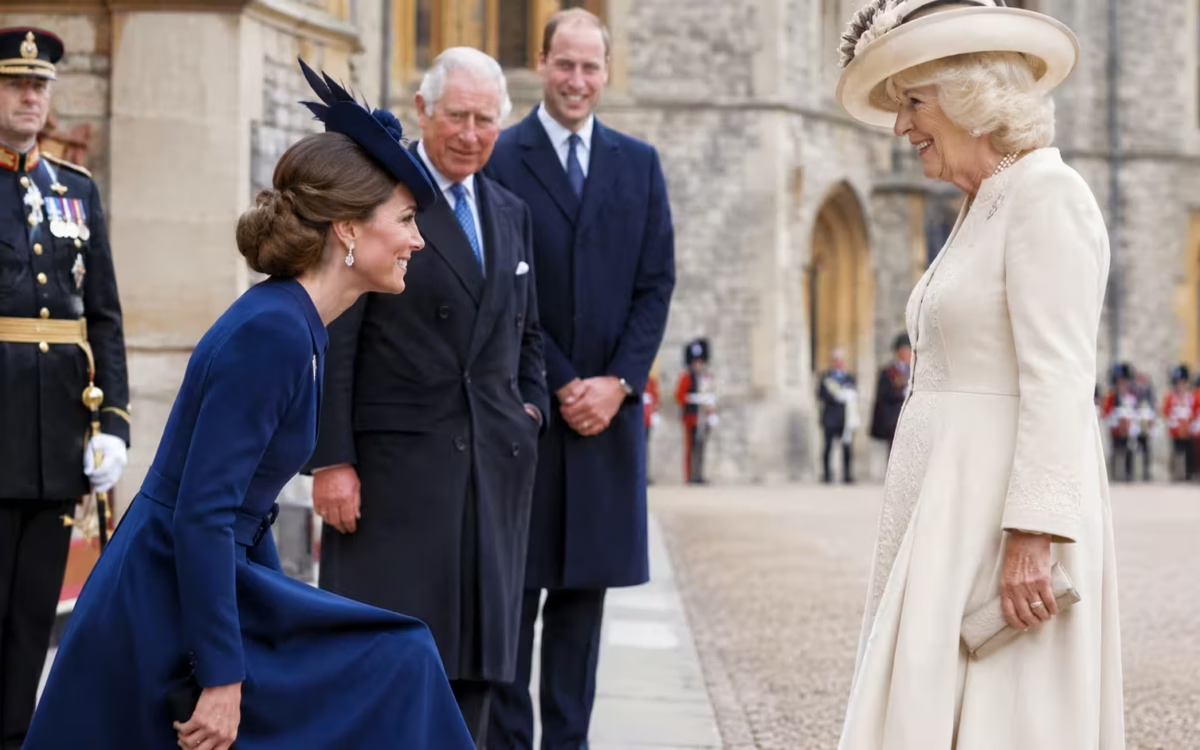
Table of Contents
Kate Middleton’s curtsy to Queen Camilla has attracted renewed attention following several royal appearances in which the Princess of Wales demonstrated traditional royal etiquette.
Despite being married to Prince William, the future king, Catherine continues to curtsy to King Charles III and Queen Camilla during formal ceremonies.
Her gestures have been particularly noticeable at Windsor Castle, where senior royals welcome international leaders during state visits.
However, an appearance on 20 October 2026 raised questions when Catherine was not seen curtsying to Camilla during the official welcome for the Sultan of Oman.
The difference stood out because Catherine had performed the gesture at previous ceremonies. Nevertheless, there is no evidence that the moment reflected tension between the two women.
Instead, it highlights how royal traditions, ceremonial arrangements and private family greetings can influence what the public sees.
Why Does Kate Middleton Curtsy To Queen Camilla During Royal Events?
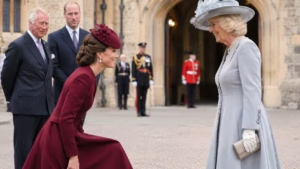
Kate Middleton curtsies to Queen Camilla as a traditional acknowledgement of her position as the reigning Queen. Although Catherine is Princess of Wales and a future Queen Consort, Camilla currently holds the more senior ceremonial position.
One memorable example occurred on 18 March 2026, when the Royal Family welcomed Nigerian President Bola Ahmed Tinubu and First Lady Oluremi Tinubu to Britain.
During the ceremonial reception at Windsor, Catherine greeted Camilla with kisses on both cheeks before performing a curtsy.
Prince William also greeted his stepmother with cheek kisses but did not perform the same gesture.
Catherine subsequently curtsied to King Charles, demonstrating her continued observance of royal customs.
Another notable moment occurred on 3 December 2025, during the state visit of German President Frank-Walter Steinmeier.
The Princess of Wales curtsied towards Camilla and then repeated the gesture when the Queen turned towards her. The exchange was widely interpreted as a warm moment between the two royals.
Catherine also demonstrated similar etiquette during Garter Day on 15 June 2026, when she performed curtsies as King Charles and Queen Camilla passed.
These occasions show that the Princess follows established ceremonial traditions while maintaining familiar interactions with senior members of the Royal Family.
Her public conduct contrasts with the continuing attention surrounding other royal relationships, including the relationship between Prince Harry and Kate Middleton, which has faced renewed scrutiny amid discussions about family reconciliation.
Why Was Kate Middleton Not Seen Curtsying To Queen Camilla In October 2026?
Kate Middleton’s appearance during the Sultan of Oman’s state visit on 20 October 2026 prompted fresh discussion about royal etiquette.
King Charles, Queen Camilla, Prince William and Catherine gathered in Windsor to welcome Sultan Haitham bin Tarik.
During the official greeting, Catherine performed a deep curtsy towards the Sultan before shaking his hand.
However, she was not seen performing a separate curtsy to King Charles or Queen Camilla during the public welcome.
The difference attracted attention because Catherine had visibly acknowledged the King and Queen during earlier state visits.
There was, however, a change in the day’s arrangements.
Prince William travelled separately to welcome the Sultan before accompanying him to the ceremonial reception.
Catherine arrived alongside King Charles and Queen Camilla rather than joining her husband for the initial greeting.
This meant she may already have greeted the royal couple privately before appearing in front of cameras.
Royal protocol does not necessarily require family members to repeat formal greetings each time they encounter one another during the same engagement.
There has been no official indication that Catherine intentionally avoided curtsying to Camilla or that the incident reflected a disagreement.
The moment also illustrates how short clips from royal appearances can generate speculation without revealing the full circumstances.
Public scrutiny of relationships within the monarchy has increased in recent years, particularly regarding Queen Camilla and Prince Harry’s relationship.
However, there is no reliable basis for connecting those wider family discussions with Catherine’s greeting during the Omani state visit.
What Does Royal Protocol Say About Kate Middleton Curtsying To Queen Camilla?
Royal etiquette traditionally reflects the hierarchy of the British monarchy, with the reigning King and Queen occupying the highest positions.
However, the Royal Family’s official guidance states that there are no obligatory codes of behaviour when greeting the monarch or another royal.
People who wish to follow tradition may perform a small curtsy or bow their heads, while others may simply shake hands.
Within the Royal Family, these customs remain particularly visible during major ceremonies, including state visits, coronations and formal services.
Catherine’s position as Princess of Wales does not place her above Queen Camilla in the present royal hierarchy.
Consequently, her curtsy is understood as an acknowledgement of Camilla’s ceremonial status rather than a reflection of their personal relationship.
The distinction matters because royal greetings often combine traditional gestures with familiar expressions of affection.
For example, Catherine has kissed Camilla on the cheeks while also performing a curtsy during the same interaction.
Similarly, Prince William often greets his stepmother warmly without observing precisely the same gestures as his wife.
Royal etiquette should therefore not be interpreted as a direct measure of emotional closeness.
Family members can maintain private relationships while following formal traditions during public engagements.
Such distinctions have existed across generations, including within the relationship between Princess Margaret and the Queen Mother, where family affection and royal expectations were closely connected.
For Catherine, observing tradition provides consistency during significant public and diplomatic occasions.
What Will Kate Middleton’s Curtsy Mean When She Becomes Queen?
Kate Middleton’s position within the Royal Family will eventually change when Prince William succeeds King Charles.
As Queen Consort, Catherine would occupy one of the monarchy’s highest ceremonial positions alongside her husband.
This would mean other royal family members might observe traditional gestures of respect towards her, just as Catherine currently acknowledges King Charles and Queen Camilla.
Until that transition occurs, she remains Princess of Wales and continues to follow the customs associated with her present position.
Her public appearances also demonstrate how she is preparing for greater responsibilities within the monarchy.
Catherine regularly accompanies Prince William at state occasions, supports charitable organisations and represents the Royal Family during important national events.
Her conduct reflects the balance between preserving longstanding traditions and maintaining an approachable public image.
The October 2026 appearance should therefore be considered alongside her wider record of ceremonial greetings rather than treated as evidence of changing relations with Camilla.
She has repeatedly demonstrated respect towards the Queen through curtsies, affectionate greetings and shared public appearances.
Ultimately, the attention surrounding Kate Middleton’s curtsy to Queen Camilla shows how even small royal gestures can become major talking points.
For Catherine, the curtsy remains a traditional expression of respect for the current Queen, while her future role represents the next stage in the monarchy’s continuing evolution.
About the Journalist
Jermaines covers crime, legal affairs and money-related stories for Londoner. His reporting includes police updates, court cases, consumer rights, personal finance and cost-of-living issues. He handles sensitive subjects carefully and clearly distinguishes confirmed facts from allegations, estimates and ongoing investigations.