Prince William And Ross Kemp Launch Emergency Initiative To Prepare UK Communities For Future Crises
 Published By
Ben
Published By
Ben
Published:
Updated:
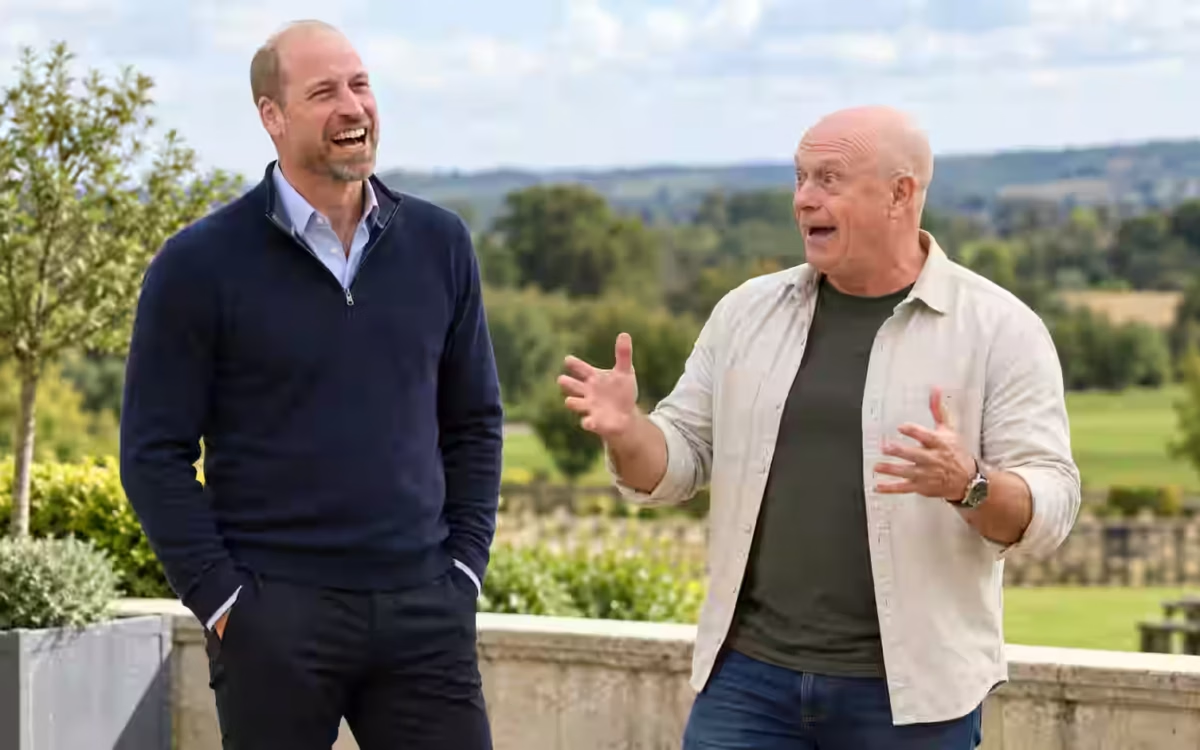
Prince William and Ross Kemp have joined forces to launch a new UK emergency preparedness initiative designed to help communities respond more effectively to flooding, wildfires and other major crises.
The Prince of Wales travelled to Ilminster, Somerset, on Tuesday, 6 October, where he formally launched Ready Together, a project created by the National Emergencies Trust.
The initiative provides practical guidance intended to help neighbourhoods and community organisations work out what resources, skills and relationships they already have before an emergency occurs.
William was joined by actor and documentary maker Ross Kemp, who became an ambassador for the National Emergencies Trust in 2025 after years reporting from conflict zones and communities affected by serious crises.
The appearance quickly attracted attention because Kemp is currently appearing in the BBC’s Celebrity Traitors, but the purpose of the visit was considerably more serious.
Kemp warned that communities should not assume emergencies will always be handled entirely by professional services.
“The more prepared we are for all eventualities, the better we’ll be able to cope with them.”
He said the world was now in a “far more dangerous situation” than it had been 30 years ago, arguing that preparedness could make communities more capable of dealing with disruption when it occurs.
The National Emergencies Trust says the central idea behind Ready Together is to convert people’s willingness to help neighbours during a crisis into something more organised.
Kensington Palace said research showed that many people would willingly help others during an emergency, while significantly fewer believed their own communities already had suitable structures or plans.
The new programme therefore aims to turn that public goodwill into “practical preparedness” before an emergency begins.
William’s involvement is not a new connection with the organisation. The Prince became Royal Patron of the National Emergencies Trust in April 2020, during its Coronavirus Appeal, and continues to support the charity’s work around UK disasters and recovery.
What Did Prince William and Ross Kemp Do During the Emergency Initiative Launch?
Rather than simply unveiling the project at a formal event, Prince William and Kemp joined local people in activities intended to demonstrate what community preparedness could look like in practice.
Young people and volunteers worked through simulated emergency scenarios, examining how residents might respond when normal services, communications or infrastructure are disrupted.
William also met members of the Ilminster Resilience Group, which has previously helped local residents during severe flooding.
The Somerset setting was particularly relevant. Flooding has repeatedly affected communities in the region, while emergency planners are also increasingly considering the risks created by wildfires and periods of extreme weather.
Kemp said the initiative was ultimately about communities recognising that individuals already possess different skills that may become valuable during a crisis.
His message was that people often prove remarkably willing to assist one another once disaster strikes, but prior preparation could make that response faster and more effective.
The pair also visited Sweet Surprise, an Ilminster café which provides opportunities for adults with learning disabilities.
Local experiences of previous flooding formed an important part of the day’s discussions.
Carole Speke, who runs Silver Street Dairy, told the BBC that flooding had previously had a major impact on her, but said the community had rallied together afterwards. She welcomed William’s decision to highlight the work being done by rural communities.
William later travelled to Ilminster Fire Station, where representatives from Devon and Somerset Fire and Rescue Service demonstrated how mapping and forecasting systems are being used to identify areas at greater risk from wildfires.
The visit therefore connected two parts of emergency preparedness: professional planning by emergency services and local preparation among the people who may initially find themselves responding to an incident.
It also reflects a wider focus from William on the consequences of extreme weather.
In recent engagements, the Prince has spoken to communities affected by flooding and examined measures that could improve resilience before future events occur.
There was still room for a lighter exchange during Tuesday’s visit.
While meeting young people, William turned attention towards Kemp’s appearance on Celebrity Traitors, joking that he was going to discover what happened in the programme and reveal the answer later.
The Prince and Princess of Wales have previously been reported as fans of the BBC series, making Kemp’s appearance alongside William an unusual meeting of royal duties and one of Britain’s most talked-about television programmes.
But Kemp’s involvement with Ready Together goes beyond his television profile.
His documentary career has taken him into conflict zones and locations dealing with violence, instability and disasters.
When the National Emergencies Trust appointed him as an ambassador, chief executive Mhairi Sharp said his experience documenting emergencies and his understanding of their effect on communities made him well suited to the organisation’s work.
Why Ready Together Could Be More Important Than It Sounds?
One of the most significant elements of the Prince William and Ross Kemp emergency initiative is the research behind it.
Ready Together was not produced solely as a public-awareness campaign.
Researchers from Nottingham Trent University carried out an extensive evidence review to help develop the framework. The work was led by Professor Rowena Hill, Professor of Resilience, Emergencies and Disaster Science.
The team examined more than 19,500 sources of evidence, eventually screening those down to 97 key sources used in developing the toolkit.
Its recommendations were then tested by experts whose combined experience covered more than 155 emergencies, alongside academic and practitioner review groups.
Professor Hill said:
“The strength of local communities can make a huge difference to how people cope before, during and after a crisis.”
She said the researchers had combined evidence from different disciplines with real-world experience to understand what helps communities become more resilient.
The research identified several areas that can strengthen preparedness, including practical skills, communication, relationships between community groups, suitable meeting places, essential supplies, financial considerations and support for people with additional needs.
That means Ready Together is not simply asking households to store emergency supplies.
Its broader objective is to encourage communities to understand who can do what.
One neighbour might have medical training. Another could own equipment or a suitable vehicle. A community centre could become a temporary meeting point.
Local businesses may have generators, storage facilities or other resources. Volunteers may know vulnerable residents who would require additional assistance.
Knowing those things before roads flood, electricity fails or communications become difficult could dramatically change how the first hours of an emergency unfold.
The concept also acknowledges a basic reality of major incidents: emergency services cannot necessarily reach every affected person immediately.
Community resilience is therefore not designed to replace firefighters, police, councils or medical services. Instead, it can provide another layer of preparedness around them.
Ready Together is intended to provide communities across all four UK nations with practical steps they can adapt to their own circumstances. Further research is also planned to assess how the programme performs once communities begin using it.
Interest in the initiative has risen quickly.
The search phrase “prince william ross kemp emergency initiative” was among Google’s active UK trends following the Somerset appearance, with more than 10,000 searches and a reported surge of over 1,000% as people looked for details of why the pair had appeared together.
For some, the immediate attraction was undoubtedly the unexpected combination of the future king and one of Celebrity Traitors’ best-known contestants.
The underlying story, however, is much broader.
Ready Together is an attempt to change emergency planning from something primarily associated with governments and professional responders into something ordinary communities also think about before a crisis occurs.
Floods, severe storms, wildfires and other emergencies may develop rapidly.
The message behind William and Kemp’s initiative is that communities cannot predict exactly when such events will happen, but they can decide how prepared they want to be when they do.
Prince William’s involvement gives the initiative national visibility, while Kemp brings both a large public profile and experience documenting people living through crises.
Behind those recognisable faces sits a comparatively straightforward idea: communities tend to come together when something goes badly wrong, so building those relationships before an emergency could make that response considerably stronger.
About the Journalist
Ben covers business, transport and global developments for Londoner. His reporting focuses on London’s economy, major companies, infrastructure, public transport and international stories that may affect people and businesses across the capital. He explains complex developments clearly using reliable sources and relevant context.