Do Husband And Wife Both Get Winter Fuel Allowance? 2026 Rules Explained
 Published By
Jermaine
Published By
Jermaine
Published:
Table of Contents
Yes, a husband and wife can both qualify for Winter Fuel Payment, but that does not necessarily mean they will each receive the full £200 or £300 payment.
For winter 2026 to 2027, what a couple receives depends mainly on their ages, whether both partners are eligible, who else lives in the household and whether they jointly receive certain means-tested benefits.
In some couples, each spouse receives an individual share. In others, one payment covering the couple is made to one partner.
There is another important change to understand. The £35,000 income threshold is applied individually rather than to a couple’s combined household income.
This means one spouse could keep their Winter Fuel Payment while the other’s payment is later recovered by HMRC if that person’s income exceeds the threshold.
Do Husband And Wife Both Get Winter Fuel Allowance?
A married couple can both receive Winter Fuel Payment where both partners meet the eligibility rules.
For winter 2026 to 2027, a person can generally qualify if they were born on or before 27 June 1960 and normally live in England, Wales or Northern Ireland. The relevant qualifying week is 21 to 27 September 2026.
However, living together changes how the payment is calculated.
If both spouses qualify and they do not jointly receive one of the relevant means-tested benefits, the household payment is normally divided between them.
For example:
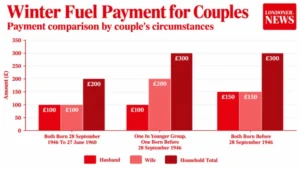
| Couple’s Circumstances | Husband | Wife | Household Total |
| Both Born 28 September 1946 To 27 June 1960 | £100 | £100 | £200 |
| One In Younger Group, One Born Before 28 September 1946 | £100 | £200 | £300 |
| Both Born Before 28 September 1946 | £150 | £150 | £300 |
The important point is that two eligible spouses do not automatically receive £200 each.
A younger qualifying couple would normally receive £100 each, giving the household £200 altogether. Where both partners are in the older age group, they can normally receive £150 each, giving a combined £300.
Marriage itself is not what creates the split. Government rules look at eligible people living in the same household, meaning similar payment arrangements can apply to other eligible adults sharing a home.
What Happens If Only One Spouse Qualifies?
A couple does not need both partners to have reached the qualifying age.
If only one spouse is eligible, that person may receive the higher amount that applies when they live with nobody else who qualifies.
For winter 2026/27, this generally means:
- £200 if the eligible spouse was born between 28 September 1946 and 27 June 1960
- £300 if the eligible spouse was born before 28 September 1946
For example, imagine a husband aged 70 lives with his 63-year-old wife. If the husband meets the other conditions but his wife is too young to qualify, he would normally be treated as the only eligible person in the household and could receive £200.
That can produce a result that initially looks unusual. A 70-year-old living with a younger, non-eligible spouse can receive £200, while two qualifying spouses in the younger age group normally receive £100 each.
The household still receives £200 overall. The difference is simply how that amount is allocated.
What If A Couple Gets Pension Credit Or Universal Credit?
The rules are different where a couple jointly claims certain means-tested benefits.
These include Pension Credit, Universal Credit and income-related Employment and Support Allowance.
Where husband and wife make a joint qualifying claim, one partner normally receives the Winter Fuel Payment on behalf of the couple, rather than the payment being divided into two separate amounts.
A joint-claim couple can receive:
- £200 if both partners fall within the younger qualifying age group
- £300 if one or both partners were born before 28 September 1946
The money is generally paid into the bank account where the relevant benefit is normally received.
This is why two neighbouring married couples of identical ages could see their payments arrive differently.
One couple may see £100 paid to each partner, while another could see a single £200 payment entering one account because they have a joint qualifying benefit claim.
The total support may be the same even though the payment method is different.
When Will Married Couples Get Their Winter Fuel Payment?
Most eligible people should receive their 2026 Winter Fuel Payment during November or December 2026.
Before the money is paid, the DWP normally sends a letter during October or November explaining how much the person will receive and which bank account will be used.
For couples receiving separate payments, the two amounts should not necessarily be expected to appear in the bank on exactly the same day.
The main 2026/27 timeline is:
| Stage | Date |
| Qualifying Week | 21 To 27 September 2026 |
| Claims Open | 21 September 2026 |
| Payment Letters | October Or November 2026 |
| Most Payments | November Or December 2026 |
| Contact DWP If Payment Still Missing | After 27 January 2027 |
Most eligible pensioners will not need to submit a separate claim.
Automatic payments normally apply where the DWP already has the necessary information through benefits including the State Pension, Pension Credit, Attendance Allowance, PIP or Carer’s Allowance.
Some people do need to claim, particularly if they have never received Winter Fuel Payment before and do not receive one of the payments that allows the DWP to process it automatically.
For winter 2026 to 2027, new claims open on 21 September 2026.
What Should Married Couples Check Before Winter?
The simplest way for husband and wife to work out what they are likely to receive is to check each partner separately before considering the household payment.
Confirm:
- Both Dates of Birth – Each person must satisfy the relevant age rule
- Who Was Living In The Household – Circumstances during 21 to 27 September 2026 can affect the amount
- Whether Both Partners Qualify – One eligible spouse can receive a different amount from two eligible spouses
- Whether Benefits Are Claimed Jointly – This can determine whether there are two payments or one household payment
- Each Person’s Income – The £35,000 recovery threshold is individual, not household-based
- Bank And Address Details – Outdated information can cause problems with correspondence or payment
There are also exclusions in certain circumstances, including some people who spend the entire qualifying week in prison, people whose immigration status prevents access to public funds and particular long-term care-home residents.
People living in Scotland should also note that Winter Fuel Payment does not apply there. Scotland operates the separate Pension Age Winter Heating Payment.
The Key Point For Husband And Wife
So, do husband and wife both get Winter Fuel Allowance? They can, but couples should not assume this means two full Winter Fuel Payments.
Where both spouses qualify and are not covered by the joint-benefit payment rules, the household amount can be divided between them.
Two qualifying spouses in the younger age group can normally receive £100 each, while a couple where both are in the older group can receive £150 each.
If just one partner qualifies, that person may instead receive £200 or £300 depending on age.
For couples on certain jointly claimed means-tested benefits, one person may receive the entire £200 or £300 household payment.
Perhaps the most important detail for 2026 is that the £35,000 income threshold is assessed separately for each spouse. One person’s higher income does not automatically remove the other partner’s entitlement.
With the qualifying week running from 21 to 27 September 2026 and most payments expected in November or December, couples should check both partners’ ages, income and benefit circumstances rather than assuming that being married means they will receive identical payments.
About the Journalist
Jermaines covers crime, legal affairs and money-related stories for Londoner. His reporting includes police updates, court cases, consumer rights, personal finance and cost-of-living issues. He handles sensitive subjects carefully and clearly distinguishes confirmed facts from allegations, estimates and ongoing investigations.