Industrial Accelerator Act: UK Moves Closer To Joining EU’s ‘Made in Europe’ Scheme
 Published By
Lucy
Published:
Updated:
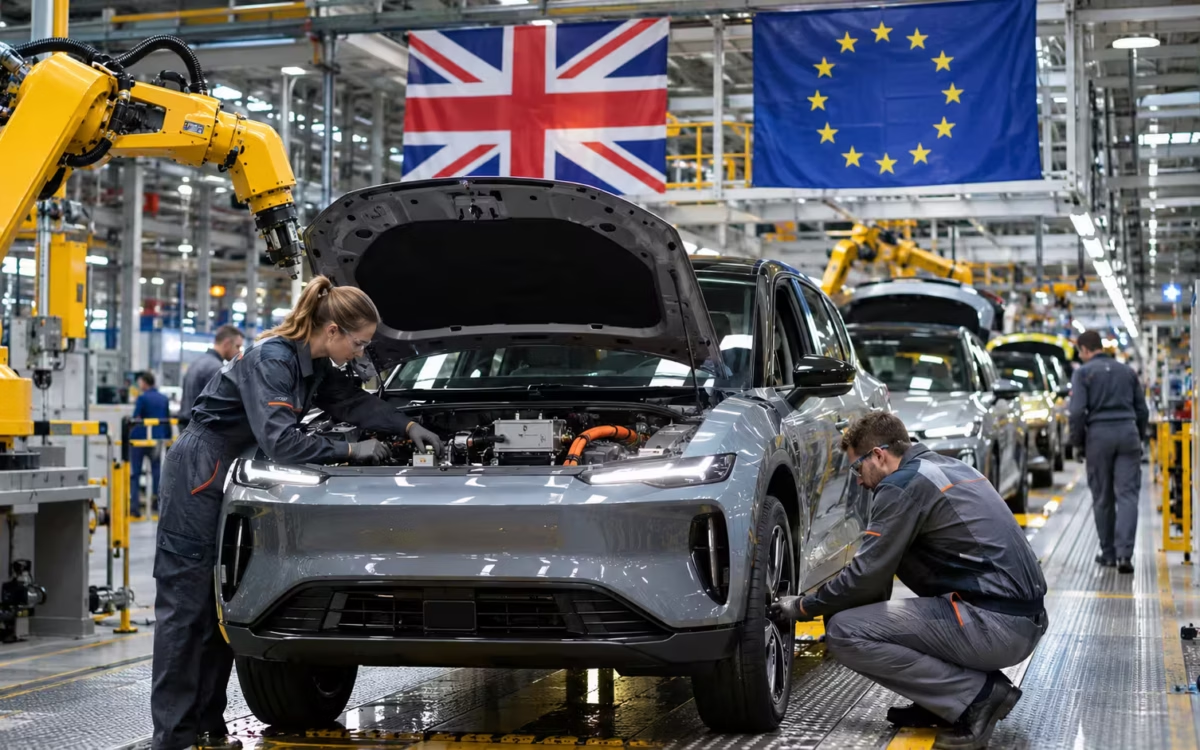
Table of Contents
Britain is moving closer to securing involvement in the European Union’s proposed Industrial Accelerator Act after Ireland put forward a compromise that could protect British manufacturers from being excluded from the bloc’s new industrial policy.
The latest proposals, reported on 24 and 25 November, could allow UK-manufactured vehicles to qualify under the EU’s ‘Made in Europe’ framework without Britain having to introduce identical tariffs on Chinese electric vehicle imports.
The development represents a potentially significant breakthrough for Prime Minister Andy Burnham’s efforts to strengthen economic relations with Brussels following Brexit, while protecting thousands of manufacturing businesses and jobs across Britain.
Ireland, which currently holds the rotating presidency of the Council of the European Union, submitted its fourth compromise proposal on 23 November. Further discussions are expected on 27 November, ahead of a meeting of EU competitiveness ministers on 3 December.
However, Britain’s inclusion has not yet been formally agreed, and the proposed legislation remains subject to negotiations between EU institutions and member states.
What Is the Industrial Accelerator Act and Why Does UK Involvement Matter?
Originally proposed by the European Commission on 4 March 2026, the Industrial Accelerator Act (IAA) is intended to strengthen European manufacturing, reduce dependence on overseas suppliers and improve the continent’s industrial competitiveness.
The legislation forms part of the EU’s wider Clean Industrial Deal, with Brussels aiming to increase manufacturing’s contribution to EU gross domestic product to at least 20% by 2035.
The proposals introduce European-origin and low-carbon manufacturing requirements for certain government contracts, subsidies and public support programmes.
Industries covered by the proposed legislation include automotive manufacturing, steel, aluminium, cement, renewable energy technologies and battery production.
The European Commission also wants to encourage investment in domestic industrial capacity while reducing strategic vulnerabilities arising from dependence on overseas manufacturing.
For Britain, however, the central concern is whether products manufactured outside the European Union but within closely integrated European supply chains will receive equivalent treatment.
Although the UK left the EU in 2020, British factories continue to rely heavily on European components, manufacturing partnerships and export markets.
Exclusion from key provisions of the Industrial Accelerator Act could leave British manufacturers competing against European businesses that have access to government-backed incentives unavailable to their UK counterparts.
Ireland Offers Potential Breakthrough for British Manufacturers
The latest Irish compromise could help resolve one of the most difficult issues affecting Britain’s post-Brexit trading relationship with Europe.
Under the reported proposals, Britain, Switzerland and European Economic Area countries could receive recognised partner status for automotive manufacturing.
The arrangement could enable vehicles manufactured at British facilities, including BMW’s Mini factory in Oxford and Nissan’s manufacturing plant in Sunderland, to qualify under European production requirements, subject to the final conditions.
A particularly important development is the reported removal of a requirement for Britain to replicate EU tariffs on Chinese electric vehicles automatically.
France and Germany had previously supported closer alignment between British and European trade protection measures as a condition of UK participation.
Such requirements presented difficulties for the British government, which is attempting to maintain independent trade policies while attracting international investment into domestic manufacturing.
The Irish compromise instead places greater emphasis on reciprocal arrangements, potentially allowing European manufacturers access to equivalent British public support and procurement opportunities.
Nevertheless, the precise conditions attached to UK participation remain unresolved.
The issue was also raised during parliamentary questioning on 24 November, when ministers acknowledged that European negotiations were continuing.
Responding to questions about the Industrial Accelerator Act, Foreign Office minister Hamish Falconer told MPs:
“The Industrial Accelerator Act debate is certainly not concluded yet and may take some time before it is.”
He also revealed that approximately 5,000 amendments had been proposed to the legislation, illustrating the complexity of reaching a final European agreement.
Automotive Industry Warns Over €80 Billion Trading Relationship
Britain’s automotive industry is among the sectors with the greatest commercial interest in the outcome of the negotiations.
According to the Society of Motor Manufacturers and Traders (SMMT), automotive trade between the UK and EU is worth approximately €80 billion annually.
Research undertaken by Oxford Economics and commissioned by the SMMT also estimates that British automotive production supports around €24 billion in European economic activity and approximately 250,000 jobs across EU member states.
The findings underline the extent to which British and European manufacturing operations remain interconnected despite Brexit.
| Automotive economic indicator | Estimated value |
| Annual UK–EU automotive trade | €80 billion |
| EU economic activity supported by UK automotive production | €24 billion |
| EU jobs supported by UK automotive production | 250,000 |
| EU spending supported by UK automotive exports to the bloc | €5.6 billion |
| EU jobs supported by UK automotive exports to the bloc | 58,000 |
Source: SMMT and Oxford Economics analysis, published 22 September 2026.
These figures measure existing economic activity and employment supported by the automotive relationship rather than predicted losses resulting from the proposed legislation.
Speaking in a joint industry statement on 17 November, Mike Hawes, Chief Executive of the SMMT, warned:
“Europe cannot build a stronger automotive industry by cutting the UK out of the markets that make it competitive.”
The SMMT has urged policymakers to recognise British-built vehicles, batteries and components as integral parts of European manufacturing.
Manufacturers fear that exclusion could influence future investment decisions, particularly when international automotive companies are choosing locations for new electric vehicle factories and battery production facilities.
For smaller British component suppliers, the consequences could be equally significant. European customers may have a financial incentive to source qualifying materials and components from suppliers elsewhere if British products are disadvantaged under the final rules.
The concerns extend beyond Britain. European manufacturers that supply British assembly plants could also experience reduced demand if vehicle production in the UK becomes less competitive.
UK–EU Negotiations Face Further Challenges Over Chinese Electric Vehicles
Despite progress towards a compromise, Britain’s relationship with China remains an important consideration in the negotiations.
The EU introduced additional tariffs on Chinese battery electric vehicles in 2024 amid concerns about state subsidies and unfair competition affecting European manufacturers.
Britain has not introduced equivalent additional tariffs, maintaining greater flexibility in its approach to Chinese automotive imports and investment.
The British government faces a difficult economic balancing act.
While closer industrial cooperation with Europe could protect established manufacturers, restrictive trade measures could affect consumer choice, electric vehicle affordability and Britain’s ability to attract overseas investment.
In an expert analysis published by Chatham House on 29 October, Sam Lowe, Associate Fellow in the UK in the World Programme and Global Economy and Finance Programme, wrote:
“The focus on investment is arguably more consequential, given the UK’s desire to attract Chinese automotive manufacturing facilities to Britain.”
Lowe’s assessment highlighted that the negotiations are not simply about import tariffs.
Future restrictions on foreign investment, manufacturing ownership and access to industrial subsidies could also have long-term consequences for Britain’s economic strategy.
The latest Irish proposals may offer greater flexibility, although cooperation on economic security is likely to remain an important part of any eventual arrangement.
What the Industrial Accelerator Act Could Mean for British Jobs and Investment?
Securing favourable treatment under the Industrial Accelerator Act could provide greater certainty for British manufacturers as they develop investment plans for 2027 and beyond.
The automotive sector is particularly exposed because of the significant capital investment required to transition from traditional combustion engines to electric vehicle manufacturing.
A successful agreement could help British companies remain eligible for selected European procurement and industrial support programmes, while reducing the incentive for international manufacturers to relocate production to EU member states.
Potential benefits include:
- Improved confidence in long-term British manufacturing investment.
- Continued integration with European automotive supply chains.
- Greater commercial opportunities for British component manufacturers.
- Reduced risk of exclusion from qualifying European public contracts.
- Stronger cooperation on battery production and low-carbon technologies.
- Greater stability for manufacturing employment.
However, the Industrial Accelerator Act is not the only immediate challenge facing Britain’s automotive industry.
Separate changes to electric vehicle rules of origin under the UK–EU Trade and Cooperation Agreement are scheduled to take effect on 1 January 2027.
The SMMT and European Automobile Manufacturers’ Association estimate that these changes could expose vehicle manufacturers to approximately €1.8 billion in additional tariffs during 2027 if alternative arrangements are not agreed.
Vehicles failing to meet the relevant origin requirements could face a 10% tariff when traded between Britain and the EU.
These rules are separate from the Industrial Accelerator Act, meaning British participation in the ‘Made in Europe’ scheme would not automatically resolve the forthcoming tariff problem.

Will the UK Secure an Industrial Accelerator Act Agreement in December?
The latest developments follow the UK–EU summit held in Brussels on 20 November, where British and European leaders agreed to strengthen cooperation on industrial resilience and economic security.
The official UK–EU summit joint statement confirmed plans for a new economic security dialogue, closer cooperation on electric vehicle and steel supply chains, and regular progress reviews every four months.
Although the summit established a stronger foundation for industrial cooperation, it did not guarantee Britain’s inclusion in the Industrial Accelerator Act.
Attention is now turning towards the EU Competitiveness Council meeting on 3 December, where ministers are scheduled to discuss the legislation.
The outcome could provide further clarity on whether British manufacturers will receive equivalent treatment under the European industrial framework and what reciprocal commitments Britain may need to make.
Even if EU ministers reach a common position, further legislative negotiations involving the European Parliament will be required before the Act can become law.
For British businesses, the emerging compromise offers renewed optimism after months of uncertainty surrounding access to European industrial support.
The coming weeks could prove decisive in determining whether Britain remains a recognised partner in Europe’s next generation of industrial manufacturing or faces additional competitive barriers in its largest automotive export market.
“Britain’s inclusion in the EU’s Industrial Accelerator Act could protect manufacturing jobs, strengthen investment confidence and safeguard the £UK–EU automotive trading relationship worth €80 billion annually.”
— Lucy, Londoner Editorial
About the Journalist
Lucy reports on London’s boroughs and the capital’s sporting community. Her coverage includes council decisions, neighbourhood developments, community issues, football, tennis, cricket and major sporting events. She focuses on stories that connect local communities and highlight the people and organisations shaping London.