Global Airlines Liquidation: UK Flight Cancellation Fears Grow as A380 Airline Collapses
 Published By
Jermaine
Published:
Updated:
Published: 16 November 2026
British aviation start-up Global Airlines has entered compulsory liquidation following a High Court ruling, bringing its ambitious plans for luxury transatlantic flights to a dramatic halt.
The collapse has prompted questions about UK flight cancellations, passenger bookings and the future of the company’s Airbus A380 aircraft.
The London-based business, founded by entrepreneur and travel influencer James Asquith, had promised to transform long-haul travel between Britain and the United States.
However, despite years of publicity, substantial investment ambitions and plans for a premium flying experience, the airline completed only four commercial flights before its aircraft was grounded.
According to an official notice published in The Gazette, the High Court of Justice issued a winding-up order against Global Airlines Ltd on 4 November 2026, with the decision becoming public on 12 November.
The order follows a creditor’s petition filed on 29 May 2026. V Prime, an Official Receiver, was appointed as liquidator and will oversee the formal winding-up process.
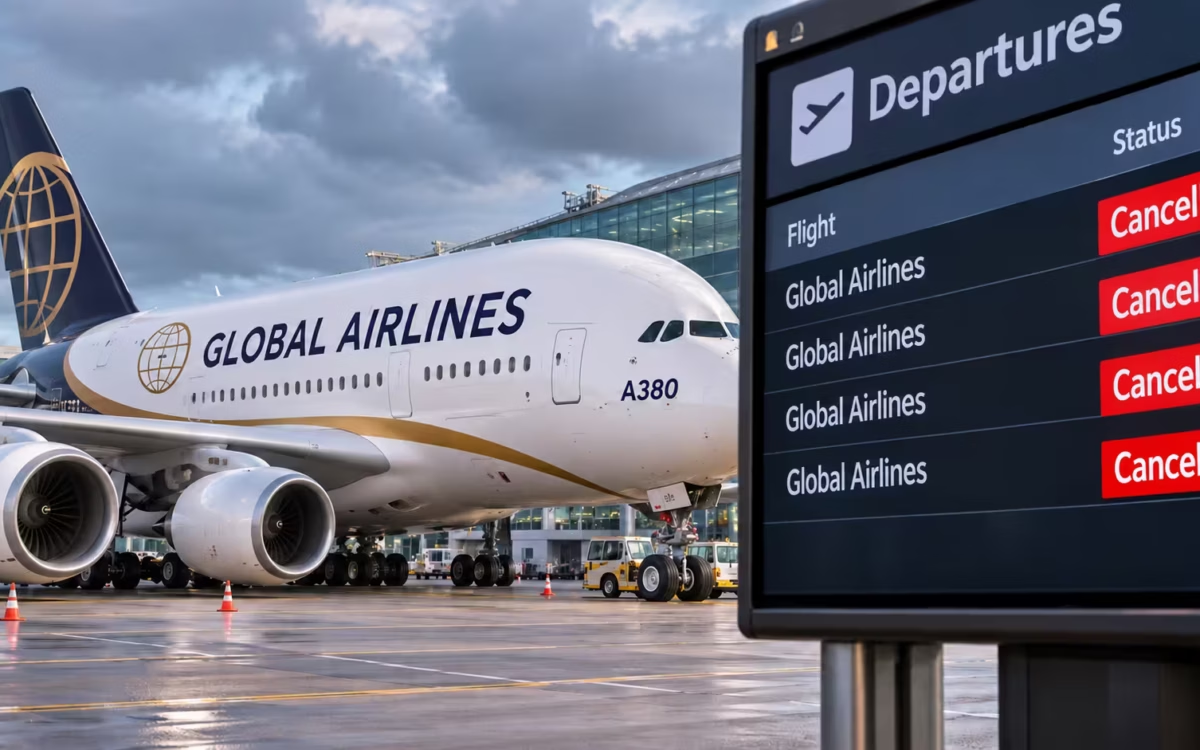
Although some reports have linked the collapse to cancelled UK flights, the situation requires clarification. Global Airlines had not established a regular scheduled flight network, and there is no verified evidence of widespread new passenger flight cancellations resulting from the November liquidation.
Nevertheless, the company’s failure represents another setback for the competitive British aviation sector and raises questions about whether ambitious airline start-ups can survive the substantial financial and operational demands of modern commercial aviation.
Global Airlines was launched in 2021 with the intention of restoring what its founder described as the golden age of air travel. Its proposed business model focused on operating Airbus A380 superjumbo aircraft, offering passengers more space, premium hospitality and an alternative to established airlines.
The company originally discussed building a fleet of multiple A380 aircraft, a strategy that attracted significant attention because the double-deck aircraft had already been discontinued by manufacturer Airbus.
Global Airlines eventually secured a former China Southern Airlines A380, registered 9H-GLOBL, which became the centrepiece of its planned transatlantic operation.
The aircraft finally carried paying passengers on 15 May 2025, departing Glasgow Airport for New York’s John F Kennedy International Airport.
It subsequently completed a return flight to Glasgow and another round trip between Manchester and New York. Those four flights ultimately became the company’s entire commercial flying history.
Because Global Airlines had not obtained its own Air Operator Certificate, the services were operated by Hi Fly Malta, an established aviation company providing aircraft and operating services.
The initial flights generated considerable publicity, but they did not develop into a reliable scheduled airline network.
By July 2025, the company’s A380 had been placed into long-term storage at Tarbes in southern France, where it has remained. The aircraft required an extensive maintenance inspection before it could return to commercial operations.
That prolonged grounding became a major obstacle to the airline’s expansion plans.
Aviation specialist Marina Efthymiou, professor of aviation management at Dublin City University, had already expressed scepticism about the business in an interview with Metro in May 2026.
“I’m surprised we’re still talking about Global,” she said.
“I thought they’d be dissolved as soon as their A380 was parked.”
Her comments reflected longstanding concerns about the commercial viability of building a start-up airline around an ageing, four-engine aircraft with demanding maintenance requirements.
Although used A380 aircraft can sometimes be acquired for significantly less than new long-haul jets, their acquisition price is only one part of the cost.
Airlines must also finance heavy maintenance, insurance, flight crews, ground handling, airport charges, fuel and regulatory compliance. These expenses can become particularly difficult to manage when the business operates only one aircraft and has no consistent scheduled revenue.
For Global Airlines, the inability to establish regular commercial operations meant that its highly publicised business model was never demonstrated at scale.
Aviation writer Ben Schlappig, founder of the travel publication One Mile at a Time, described the liquidation in his November 2026 analysis as:
“It’s the end of the road (or runway) for Global Airlines.”
Schlappig had questioned the sustainability of the venture for several years, particularly its dependence on one expensive aircraft and the gap between its promotional plans and actual operations.
His assessment followed earlier concerns from industry observers about the financial risks facing an airline attempting to compete in the transatlantic market without an established network, operating certificate or substantial fleet.
Even before the company entered liquidation, airline industry commentator Rob Burgess, founder of Head for Points, had raised concerns about the project while acknowledging the achievement of getting an aircraft into commercial service.
Speaking to The Independent around the inaugural flight in May 2025, Burgess observed:
“There are many logical reasons why they are doomed to failure.”
The remark captured the competing views surrounding Global Airlines: admiration for an entrepreneur attempting to launch a new airline, alongside serious doubts about whether the proposed operation could become profitable.
What Does Global Airlines’ Liquidation Mean for UK Flight Cancellations?
The most immediate concern for travellers is whether the liquidation has resulted in cancelled flights from British airports.
Global Airlines previously operated services connecting Glasgow and Manchester with New York, but these were limited charter operations in May 2025 rather than part of an established year-round schedule.
No regular Global Airlines flights were operating when the November 2026 liquidation order was issued.
Consequently, the collapse should not be interpreted as evidence that hundreds of active flights across the UK have suddenly been cancelled.
There is also no verified indication that normal services operated by British Airways, Virgin Atlantic, easyJet or other established carriers have been cancelled because of Global Airlines’ financial difficulties.
Passengers who previously booked through Global Airlines or its ticketing partners should distinguish between completed flights, cancelled charter arrangements and any outstanding bookings or payments.
Anyone with an unresolved booking should contact the company or travel agent through which the reservation was originally purchased and retain payment receipts, booking confirmations and correspondence.
The UK Civil Aviation Authority’s guidance on airline failures explains that passenger protection varies according to the type of booking and the method of payment.
Travellers who booked an ATOL-protected package may have different financial protections from those who purchased standalone flight tickets. Credit card customers may also qualify for protection under Section 75 of the Consumer Credit Act 1974, while some debit card payments may be eligible for chargeback claims.
However, these protections depend on the circumstances of the booking and should not be assumed to apply automatically to every Global Airlines transaction.
The liquidation also raises questions about the fate of the company’s only A380 aircraft.
The jet, previously operated by China Southern Airlines, has remained at the Tarmac Aerosave storage facility in France since July 2025.
A significant maintenance inspection would be required before it could return to commercial service, adding further complexity to any potential sale or attempt to restore operations.
The appointed liquidator will need to establish the company’s assets, liabilities and creditor claims before determining how recoverable value can be distributed under insolvency rules.
The liquidation order itself does not establish exactly how much money creditors will recover or what will ultimately happen to the aircraft.
Global Airlines’ financial and operational difficulties also highlight a wider challenge for start-up carriers attempting to enter established international aviation markets.
Transatlantic flying is dominated by airlines with substantial fleets, longstanding airport relationships, sophisticated booking systems and the financial resources to withstand unexpected disruptions.
An airline operating a single aircraft faces a particularly difficult commercial position. A maintenance problem can prevent the company from operating its entire planned service, while larger competitors generally have more flexibility to substitute aircraft and accommodate disrupted passengers.
This makes reliability and financial resilience just as important as the quality of the onboard passenger experience.
Global Airlines had sought to differentiate itself through luxury, distinctive cabin designs and an emphasis on customer service. Yet the commercial challenge was not simply attracting attention or persuading travellers to try the product.
It was establishing a repeatable operation capable of generating sufficient revenue to cover the substantial cost of long-haul flying.
The November court decision also provides a clearer legal picture of the company’s position.
Although the Companies House public profile has continued to display Global Airlines Ltd as active, the official Gazette notice confirms that the company is subject to compulsory liquidation.
These records are not necessarily contradictory. A company can remain on the register while its winding-up process continues, before its eventual dissolution.
Under the court order, the Official Receiver is responsible for administering the liquidation, examining the company’s affairs and handling the interests of creditors.
It remains unclear how much value can be recovered from the company’s assets, whether the A380 will attract a buyer or whether any connected business activities might continue separately.
Founder James Asquith had previously discussed plans to revive flights and pursue further routes, including possible services to the Maldives. However, no regular service was established before the liquidation order.
For UK passengers, the practical impact remains limited by the airline’s small operational history. Its collapse does not represent the shutdown of a major scheduled carrier with an extensive active route network.
For the aviation industry, however, the liquidation marks the apparent end of one of Britain’s most publicised recent airline ventures.
The project succeeded in returning an A380 to passenger service for a handful of transatlantic flights, but it never established the network, operational independence or commercial scale needed to fulfil its original ambitions.
As the liquidation process moves forward, attention will turn to creditors, the future of the stored aircraft and whether further information emerges about the financial circumstances behind the failed venture.
The central development is now confirmed: Global Airlines has been ordered into liquidation, its only aircraft remains grounded, and its plans for regular transatlantic passenger flights have not materialised.
About the Journalist
Jermaines covers crime, legal affairs and money-related stories for Londoner. His reporting includes police updates, court cases, consumer rights, personal finance and cost-of-living issues. He handles sensitive subjects carefully and clearly distinguishes confirmed facts from allegations, estimates and ongoing investigations.