HMRC AI Chatbot Tax Rules: UK Taxpayers Warned Their ChatGPT Conversations Could Be Examined Under New Powers
 Published By
Ben
Published:
Updated:
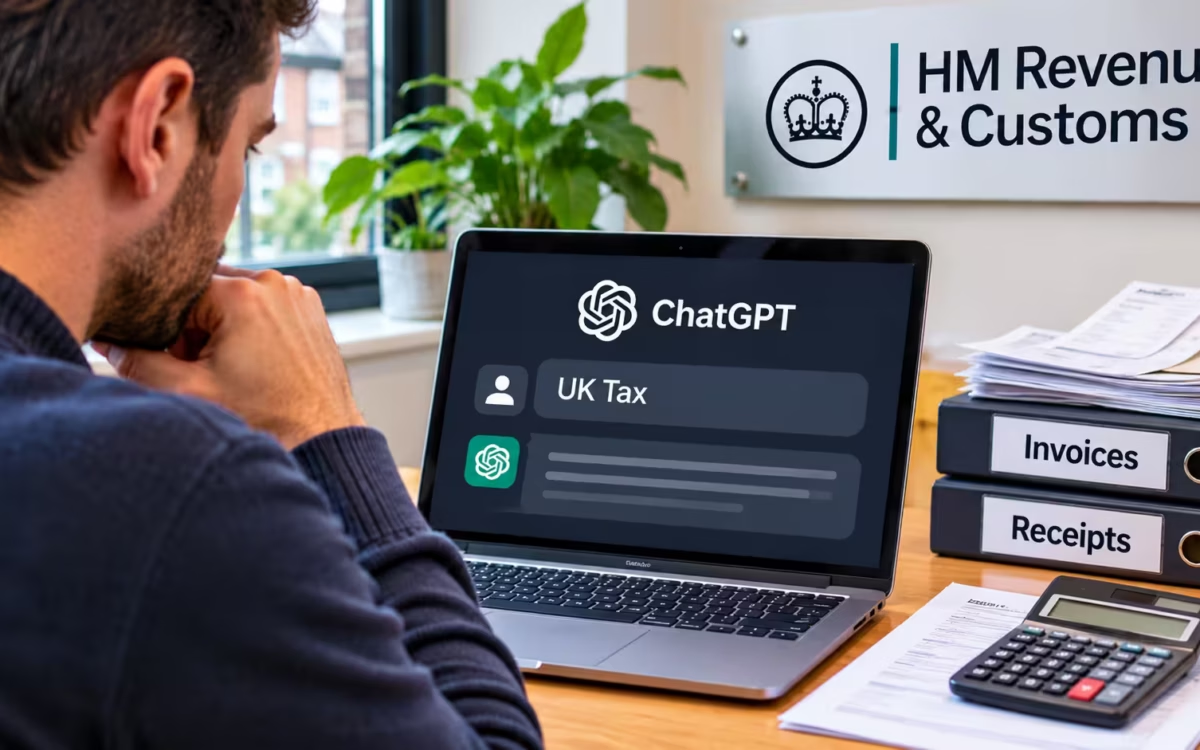
Millions of UK taxpayers who use artificial intelligence to manage their finances could face greater scrutiny as HM Revenue and Customs (HMRC) prepares to expand its powers to inspect digital tax records, potentially including conversations with AI chatbots such as ChatGPT, Claude and Microsoft Copilot.
The proposals have raised concerns among tax professionals, privacy campaigners and businesses that increasingly rely on automated software to calculate tax liabilities, prepare Self Assessment returns and identify allowable expenses.
Under the planned changes, HMRC would be able to obtain a wider range of digital information where it already has the legal authority to investigate a taxpayer’s affairs. This could potentially include records showing how an AI system produced a particular tax calculation.
However, the proposals do not give HMRC unrestricted access to personal chatbot conversations, and there is no confirmed policy allowing the tax authority to routinely monitor everyone’s AI usage.
The controversy follows fresh reporting on 11 November 2026, when concerns emerged about the implications of proposed amendments to the Finance Act 2008. The legislation is expected to be updated through Finance Bill 2026–27.
The government’s official policy paper, Reforming Information Powers and Modernising Computer Records Law, was most recently updated on 3 November 2026.
The changes aim to modernise tax investigations as financial information increasingly moves away from traditional documents and towards cloud-based accounting systems, automated financial tools and AI-generated calculations.
Could HMRC Access ChatGPT Conversations Under the New Tax Rules?
Currently, HMRC can issue information notices under Schedule 36 of the Finance Act 2008 when documents or records are reasonably required to check a taxpayer’s position.
The proposed legislation would broaden the terminology governing digital information under Section 114, replacing older references to computer equipment with wording that reflects modern methods of creating, processing and storing information.
The draft introduces the concept of a relevant thing, which could potentially cover digital systems containing information that HMRC is legally entitled to request.
Importantly, the draft legislation does not explicitly mention ChatGPT, Claude, Copilot or other generative AI chatbots. Their potential inclusion is an interpretation of the broader proposed wording, rather than a specifically announced chatbot surveillance power.
For example, an individual who asks an AI chatbot to calculate Capital Gains Tax on a property sale might generate a series of prompts, calculations and explanations before entering the final figure on a tax return.
If the resulting tax calculation became the subject of an HMRC investigation, questions could arise about whether the underlying AI-generated working records were relevant to checking its accuracy.
Similar concerns could affect self-employed workers using AI to categorise business expenses, landlords calculating rental profits and companies relying on automated systems for Corporation Tax or VAT reporting.
The distinction is that an ordinary conversation asking about tax law does not automatically become something HMRC is entitled to inspect. The information requested must still satisfy the relevant statutory requirements.
Matthew Holman, a partner at law firm Cripps, explained the potential legal implications in comments reported by City A.M. on 11 November.
He said the legislation was:
“expanding its operative definitions in such a way that AI could be within its new (wider) scope.”
Holman also raised concerns that chatbot conversations could contain statements which, when taken out of context, might be interpreted as evidence of an intention to evade tax.
This creates a potential problem for taxpayers who use AI to explore different financial scenarios.
Someone asking whether a particular business expense is deductible may simply be testing the rules before making a legitimate decision. However, a conversation recorded by an AI service may not clearly distinguish hypothetical questions from actions a taxpayer has actually taken.
Tax barrister Andy Wood raised a similar concern in comments reported by the Daily Express on 11 November.
“Asking how a transaction would be taxed is not the same as admitting that the transaction occurred.”
His comments highlight why context could become crucial if digital conversations are ever requested during a tax investigation.
A taxpayer might investigate several legal ways of structuring a transaction before deciding not to proceed with any of them. Treating preliminary questions as evidence of completed financial activity could lead to unnecessary disputes.
The proposed rules also have implications for third-party software providers. HMRC’s policy documentation confirms that intermediaries, including businesses holding or managing relevant tax information through digital systems, may be affected.
In certain circumstances, HMRC could seek relevant records from a third party. The official policy paper states that a third party would normally be approached only after an approach to the taxpayer had failed.
Whether a particular AI conversation would be disclosable would depend on the legal powers being used, the information sought and the circumstances of the investigation.
Seb Maley, chief executive of tax insurance provider Qdos, warned that increasing dependence on AI does not remove the need for taxpayers to check their financial records.
Speaking about the proposals, in comments reported by Business Matters, Maley said:
“Simply trusting a system to get things right won’t be enough if HMRC comes knocking.”
His warning reflects a wider challenge for small businesses adopting AI-powered bookkeeping and tax preparation systems.
Although automation can reduce administrative work, inaccurate calculations, incorrectly classified expenses or outdated tax guidance can still lead to errors in submitted returns.
HMRC has also made clear that taxpayers remain responsible for the accuracy of information they submit, even when they have relied on external advice or automated tools.
The proposals have nevertheless attracted criticism over the potential privacy implications.
Anne Strickland, a researcher at the TaxPayers’ Alliance, warned in comments reported by the national press that compelling people to disclose private AI conversations could represent an intrusive expansion of the tax authority’s existing powers.
Her concerns reflect the possibility that a chatbot conversation may contain considerably more personal information than the financial records HMRC actually needs.
An individual could discuss family circumstances, employment problems or hypothetical future plans while asking questions about tax. Disclosing an entire conversation could therefore reveal sensitive information unrelated to the investigation.
Legal specialists have emphasised that information requests must remain necessary and proportionate.
HMRC has responded by rejecting suggestions that the proposed reforms are intended to permit widespread examination of AI chat histories.
An HMRC spokesperson said, in comments reported on 11 November:
“We can only request information where we already have a lawful basis to do so.”
The department said its objective was to update existing information powers to reflect how tax information is stored and processed digitally, rather than to inspect everyone’s use of large language models.
This distinction matters because the changes are designed to operate through existing legal powers, not establish an independent system for monitoring individual AI activity.
The reforms are scheduled to take effect when Finance Bill 2026–27 receives Royal Assent. As of 12 November 2026, they are not yet in force, and an exact commencement date has not been confirmed.
Reports have also highlighted financial penalties associated with failing to provide information requested by HMRC.
Under the existing rules, failing to comply with a valid information notice without a reasonable excuse can result in an initial £300 penalty, with further penalties possible if non-compliance continues.
Separate rules allow penalties of up to £3,000 for certain inaccuracies in information or documents supplied in response to a notice.
Those amounts should not be interpreted as automatic fines for using ChatGPT or declining an informal request to share AI conversations. The type of notice, statutory conditions and individual circumstances determine whether a penalty can apply.
What Should UK Taxpayers Do Before the HMRC AI Rules Take Effect?

For individuals and businesses using AI to prepare tax returns, the immediate priority is ensuring that submitted calculations can be independently verified.
A taxpayer using an automated accounting platform should retain original invoices, receipts, financial statements and records supporting the figures eventually reported to HMRC.
Where a chatbot has helped calculate taxable profits or identify expenses, the underlying calculations should be checked against current legislation and official guidance rather than accepted solely because the AI response appears confident.
Businesses should also understand how their software providers store financial information and whether customer data or AI-generated working records are retained within third-party systems.
This issue has become increasingly significant as HMRC separately steps up efforts to combat inaccurate AI-generated tax advice.
In October 2026, a government communications case study revealed that HMRC had intervened after online search systems and AI tools circulated misleading information about VAT deadlines.
Some AI-generated answers had incorrectly suggested that VAT payment deadlines could move to the following working day when they fell on a weekend or bank holiday.
HMRC worked to correct the misinformation through official guidance updates and verified online alerts, demonstrating the financial risks of treating chatbot responses as authoritative.
The department is also exploring wider measures to identify and respond to misleading tax information online.
That development comes alongside growing adoption of government-supported digital tax services. Budget 2026 reported that HMRC’s Ask HMRC digital assistant handled 6.3 million customer interactions during 2025–26.
The increasing use of technology presents an important challenge for tax administration: digital tools can make tax obligations easier to understand, but they also create records and automated calculations that may need to be examined when something goes wrong.
For London-based freelancers, company directors, landlords and self-employed professionals, the proposed reforms could make transparent record-keeping more important as the tax system becomes increasingly digital.
People who receive a formal HMRC information notice should examine what information is being requested, the legal basis for the notice and any applicable rights to challenge it. Professional advice may be appropriate where a request involves confidential, privileged or potentially irrelevant material.
There is no general requirement under the proposed changes for every taxpayer to submit their chatbot conversation history with a Self Assessment return.
The central issue remains whether AI-generated information has played a relevant role in producing tax figures that HMRC is lawfully entitled to investigate.
As Finance Bill 2026–27 progresses, attention will turn to how the wider definitions of digital information are applied in practice, how third-party data requests are handled and whether existing safeguards are sufficient to protect personal privacy.
Until those questions are resolved, the position is clear: AI chatbot use is not prohibited, tax calculations remain the taxpayer’s responsibility, and HMRC’s proposed digital information powers do not amount to automatic access to private conversations.
“HMRC’s proposed powers could bring AI-generated tax records under greater scrutiny, but they do not grant unrestricted access to private ChatGPT conversations. Taxpayers remain responsible for ensuring their AI-assisted calculations are accurate.”
— Ben, Londoner Editorial
About the Journalist
Ben covers business, transport and global developments for Londoner. His reporting focuses on London’s economy, major companies, infrastructure, public transport and international stories that may affect people and businesses across the capital. He explains complex developments clearly using reliable sources and relevant context.