UK Budget Income Tax Freeze: Millions Face Higher Tax Bills as Thresholds Stay Frozen Until 2031
 Published By
Ben
Published:
Updated:
Published: 29 October 2026
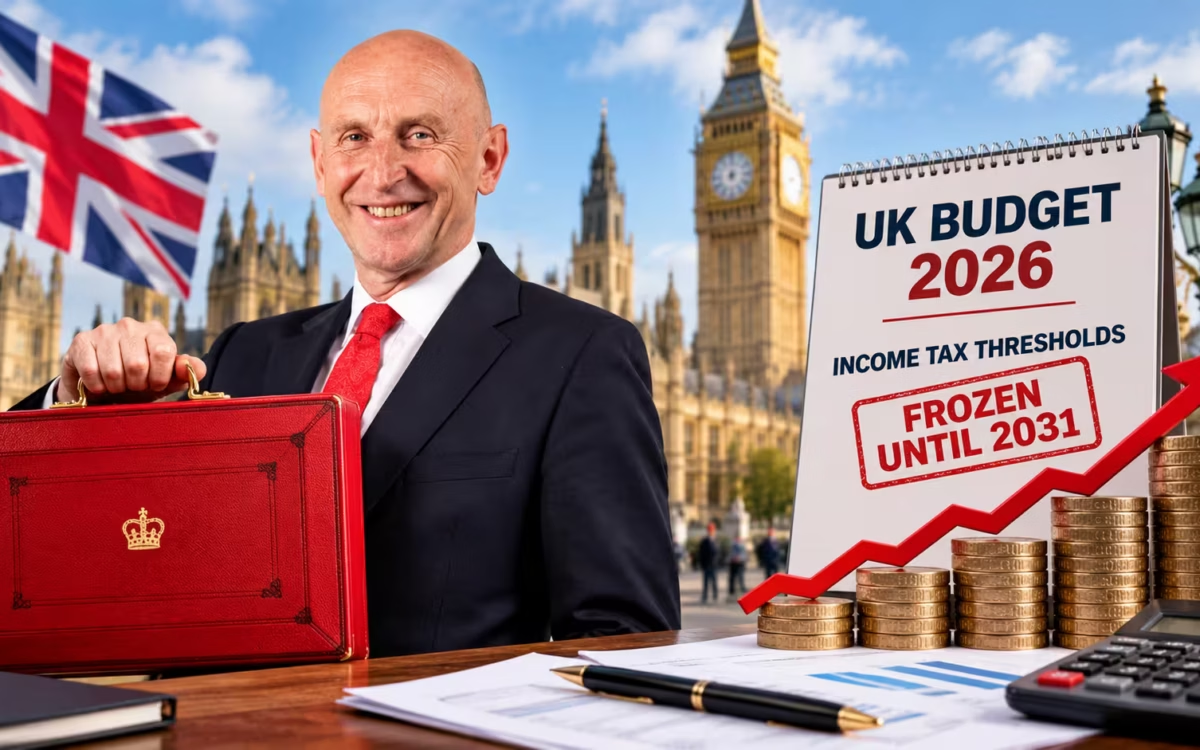
Millions of British workers face a growing income tax burden after Chancellor John Healey’s Autumn Budget 2026 left the UK’s income tax thresholds frozen until April 2031, despite increasing pressure on household finances from inflation, rising living costs and subdued real wage growth.
The Chancellor delivered his first Budget on 28 October 2026, promising financial breathing space for families and businesses while maintaining the government’s commitment not to increase the headline rates of income tax, National Insurance or VAT.
However, one of the most significant long-term pressures on taxpayers remains unchanged.
The personal allowance, which determines how much individuals can earn before paying income tax, will stay at £12,570, while the higher-rate threshold in England, Wales and Northern Ireland remains at £50,270.
Although the government has avoided directly increasing income tax rates on employment earnings, freezing these thresholds allows the Treasury to collect additional revenue as wages increase.
The policy, known as fiscal drag, means employees can face higher tax bills even when their pay rises do little more than compensate for inflation.
The freeze was originally introduced under former Chancellor Rishi Sunak and extended by successive governments. Rachel Reeves extended the thresholds until April 2031 in the November 2025 Budget.
Healey’s latest Budget does not introduce a further extension. Instead, it leaves that existing timetable in place, maintaining a substantial source of revenue for the Treasury.
According to the Office for Budget Responsibility’s October 2026 economic forecast, frozen thresholds will continue to amplify the effect of nominal wage growth on income tax receipts throughout the remainder of the decade.
The independent fiscal watchdog forecasts that the overall UK tax burden will reach 38.6% of GDP by 2031-32, a historically high level.
For millions of households, the announcement raises an important question: how much of their future pay increases will actually reach their bank accounts?
Why the UK Budget Income Tax Freeze Could Cost Workers More?
The income tax freeze affects workers differently depending on their annual earnings, tax residency and other sources of income.
For employees in England, Wales and Northern Ireland, the main income tax thresholds remain:
| Income tax threshold | Frozen amount |
| Personal allowance | £12,570 |
| Higher-rate threshold | £50,270 |
| Additional-rate threshold | £125,140 |
| Basic income tax rate | 20% |
| Higher income tax rate | 40% |
| Additional income tax rate | 45% |
Scotland operates different income tax bands and rates for earnings, although the UK-wide personal allowance remains relevant.
Under normal circumstances, increasing tax thresholds with inflation would help prevent workers from paying progressively more tax simply because their wages have risen alongside prices.
But with the thresholds unchanged, a worker who receives an annual pay increase may gradually move closer to the higher-rate income tax band.
Someone earning £49,000, for example, is currently below the £50,270 higher-rate threshold.
If their salary increases to £51,000, the portion above £50,270 becomes subject to 40% income tax rather than the 20% basic rate in England, Wales and Northern Ireland.
An employee already paying higher-rate income tax generally loses 40p in income tax and another 2p in employee National Insurance from each additional pound of ordinary employment earnings, leaving approximately 58p before pension contributions, student loan repayments and other deductions.
For people earning above £100,000, the situation can become more complicated because the personal allowance is reduced by £1 for every £2 of adjusted net income above that level.
This creates an effective 60% marginal income tax rate on income within the personal allowance withdrawal range, before National Insurance is considered.
London employees working in sectors such as financial services, technology, professional services and management may encounter these thresholds as their careers progress.
The impact can be particularly noticeable in the capital, where higher housing and commuting costs can mean that relatively strong salaries do not necessarily translate into greater financial security.
Money-saving expert Martin Lewis highlighted the continuing impact of fiscal drag following the Budget.
In a video posted on X on 28 October, Lewis described it as “the biggest single tax rise we’ve had for years and it’s carrying on.”
His comments underline the distinction between the government’s decision to keep headline tax rates unchanged and the increasing amount of tax collected as earnings rise.
The OBR’s latest analysis provides further evidence of the financial significance of the policy.
It estimates that a simultaneous one-percentage-point increase in nominal earnings and consumer price inflation would raise annual income tax and National Insurance receipts by approximately £7 billion on average under the current frozen thresholds.
That is around £2.5 billion more annually than under a scenario in which thresholds were uprated with inflation.
These figures represent an economic sensitivity estimate, rather than a forecast that the freeze will raise an additional £7 billion every year.
Nevertheless, they demonstrate how the Treasury’s revenues can increase without requiring an explicit rise in income tax rates.
The OBR also estimates that the combined income tax and National Insurance threshold freezes between 2022-23 and 2030-31 could reduce labour supply by the equivalent of 215,000 workers at average hours by the end of that period.
This is a modelled reduction in total hours worked, not a prediction of 215,000 redundancies.
The concern is that higher effective marginal tax rates can weaken financial incentives for additional work, promotions and longer working hours.
Economists Warn That Fiscal Drag Will Add to Household Pressure
The decision to maintain the existing income tax freeze comes at a difficult time for the UK economy.
Healey’s Budget was presented against a backdrop of international uncertainty, rising energy costs and continuing pressure on government borrowing.
The Chancellor announced temporary measures intended to help households, including a £100 energy payment for eligible households in England living in council tax bands A to D, alongside extended electricity VAT relief and fuel duty support.
However, economists have questioned whether these measures will be sufficient to offset the wider pressures on household living standards.
Helen Miller, director of the Institute for Fiscal Studies (IFS), said in the organisation’s initial assessment of the Autumn Budget that the government had accepted higher borrowing over the next several years while relying on stronger revenues and tighter spending plans later in the forecast.
She warned: “The Chancellor’s commitment to fiscal consolidation is welcome. But it is delivery that really matters.”
Miller also raised concerns about the limited growth impact of the Budget’s policy measures and the difficulty of delivering future public spending restraint.
The IFS assessment suggested that the Chancellor had preserved some flexibility in the public finances, but difficult decisions on departmental budgets and government spending remain unresolved.
For taxpayers, this matters because slower economic growth and increasing tax receipts can create an uncomfortable combination: households may contribute more to public finances without experiencing meaningful improvements in purchasing power.
The Resolution Foundation also warned that Britain faces another prolonged period of weak living standards.
Its 28 October Budget assessment estimated that household disposable income per person would not recover its recent losses until around April 2029.
The think tank forecast average annual income growth of just 0.6% over the current Parliament.
Ruth Curtice, chief executive of the Resolution Foundation, said the Budget contained some sensible tax measures but argued that “the opportunity to fix our broken tax system has been missed again.”
Her assessment reflects a wider concern among economists that successive governments have relied heavily on adjustments to existing taxes and frozen allowances rather than comprehensive tax reform.
For households experiencing rising costs, a pay increase may therefore provide less financial relief than its headline value suggests.
The pressure is not limited to people approaching the higher-rate tax threshold.
Lower earners may find themselves paying income tax for the first time as wages rise above the £12,570 personal allowance.
Middle-income employees can see a growing proportion of their earnings taxed at 20%, while those approaching £50,270 face the possibility of part of their income becoming subject to the 40% rate.
For families balancing mortgages, childcare, rent, utilities and everyday spending, these incremental changes can accumulate over several years.
The situation is particularly relevant because the October 2026 OBR forecast expects real household incomes to remain under pressure in the near term.
Although nominal salaries may rise, inflation can erode the purchasing power of those increases.
The result is that some households could experience higher income tax payments without a corresponding improvement in their standard of living.
The freeze also raises questions about longer-term fairness.
Critics argue that workers should not automatically face higher effective tax burdens simply because their wages increase with inflation.
Supporters of maintaining the thresholds point to the government’s need to generate reliable tax revenue, protect public services and manage borrowing without announcing higher headline rates of income tax.
Both arguments remain central to the debate over how Britain should fund public spending while encouraging employment and economic growth.
Alongside the continuing freeze, the Budget included further tax changes affecting income from savings and property.
The government announced an additional two-percentage-point increase in tax rates on these forms of income from April 2027, on top of the two-percentage-point increases previously announced in the 2025 Budget.
This means the additional tax burden will not fall exclusively on employment earnings, although the precise effects depend on the type and amount of income received.
Pensioners have also received a specific measure intended to address the consequences of the frozen personal allowance.
From 6 April 2027, the government plans to introduce a Pension Tax Allowance, providing an income tax reduction for eligible people above State Pension age.
It is designed to prevent those whose total income does not exceed the full new State Pension from having to pay small amounts of income tax simply because pension increases have overtaken the frozen personal allowance.
The relief will taper for individuals with higher incomes and is scheduled for the tax years 2027-28 to 2029-30.
It does not represent a general increase in the personal allowance for all taxpayers, and the broader income tax threshold freeze remains in place.
For working households, the central issue therefore remains unchanged.
The government’s decision not to increase headline income tax rates provides some certainty over the tax system, but the combination of frozen allowances, wage growth and inflation means that tax liabilities can continue rising throughout the decade.
The next major question is whether future economic conditions and government budgets will provide sufficient scope to begin increasing thresholds again after April 2031.
For now, the UK Budget income tax freeze remains one of the most consequential long-term features of the country’s tax system, even though it received relatively little attention in the Chancellor’s Budget speech.
As Britain approaches another year of uncertain inflation, household spending pressure and modest expected real income growth, the difference between a larger salary and genuinely higher take-home pay is likely to become increasingly important for millions of workers.
About the Journalist
Ben covers business, transport and global developments for Londoner. His reporting focuses on London’s economy, major companies, infrastructure, public transport and international stories that may affect people and businesses across the capital. He explains complex developments clearly using reliable sources and relevant context.