UK Supermarket Merger Speculation Grows As Sainsbury’s, Morrisons And Asda Face Major Shake-Up
 Published By
Ben
Published By
Ben
Published:
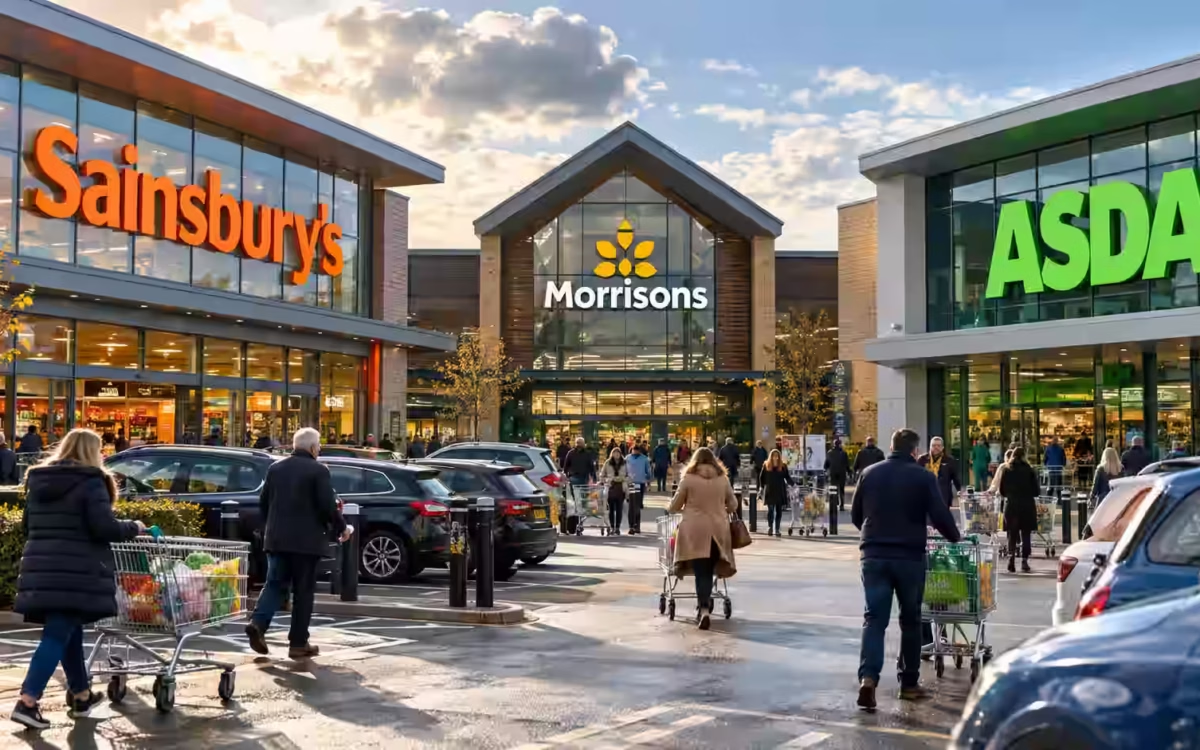
Speculation over a major UK supermarket merger has intensified after reports revealed that Sainsbury’s held talks with Morrisons over a multibillion-pound deal, raising questions about whether Britain’s grocery industry could be heading towards its biggest restructuring in years.
The discussions, which reportedly began in November 2025 and ended in February 2026, have brought renewed attention to the future of Morrisons and Asda, two established supermarket chains facing mounting pressure from discount rivals Aldi and Lidl.
Although no merger has been announced and the Sainsbury’s-Morrisons discussions are no longer active, retail analysts believe the changing competitive landscape could create opportunities for further consolidation.
The possibility of a takeover has also raised questions about supermarket prices, store closures, employment and how Britain’s biggest retailers might compete in the coming years.
According to Sky News, Sainsbury’s and Morrisons explored a potential merger earlier this year but failed to reach an agreement. Sainsbury’s reportedly withdrew from the discussions, with disagreements over valuation understood to have contributed to the breakdown.
Neither supermarket has publicly confirmed plans to restart negotiations, and both declined to comment when the earlier discussions emerged.
However, the disclosure has encouraged analysts to reconsider the long-term structure of the supermarket industry, particularly as Morrisons and Asda struggle to recover market share.
A merger between Sainsbury’s and Morrisons would potentially create a business controlling approximately 23.6% of the British grocery market, compared with Tesco’s estimated 27.8% share.
Such a combination would bring together hundreds of supermarkets, convenience stores, distribution operations and established supplier relationships, potentially allowing the combined retailer to compete more aggressively on pricing.
The development follows a difficult period for Morrisons, which has faced substantial borrowing costs since its acquisition by US private equity firm Clayton, Dubilier & Rice.
The Bradford-based supermarket previously occupied a position among Britain’s four largest grocery retailers but has since been overtaken by Aldi and, more recently, Lidl.
Recent market figures place Lidl at approximately 8.7% of grocery sales, ahead of Morrisons at around 8.4%.
Lidl has continued expanding its British operations and announced plans in October to open more than 50 stores during its financial year, supported by a £600 million investment programme.
That expansion demonstrates the growing competitive pressure on traditional supermarket chains, which must balance price reductions against rising operating costs and the need to protect profitability.
Retail analyst Clive Black of Shore Capital suggested that changes in the competitive environment could encourage another wave of supermarket deals.
Commenting on the Competition and Markets Authority’s changing approach, Black told The Guardian that “the change encourages another chapter of consolidation”.
The comments reflect a wider belief among market observers that mergers previously regarded as difficult or commercially unattractive could become more realistic as discount retailers strengthen their positions.
Independent retail analyst Richard Hyman has also highlighted differences between the supermarket businesses that could influence future dealmaking.
Speaking to City AM, Hyman suggested Morrisons could be a more natural fit for Sainsbury’s because of its emphasis on fresh food and established supply chains, while Asda has traditionally focused more heavily on competitive pricing.
Discussing Asda’s positioning, he said: “Asda doesn’t have a strong food culture in my view.”
The distinction could become important if Sainsbury’s eventually chooses to revisit a supermarket acquisition under chief executive Simon Roberts.
Morrisons operates significant food manufacturing and processing facilities, giving it a different business model from many competitors.
Combining those capabilities with Sainsbury’s grocery operations could create opportunities for purchasing efficiencies, improved distribution and stronger supply-chain integration.
Nevertheless, operating a larger retail organisation would introduce substantial integration costs and management challenges.
Could Asda and Morrisons Become Part of a Bigger Supermarket Group?
Asda has also emerged in speculation surrounding potential supermarket consolidation.
The retailer has faced financial and operational pressures following its private equity-backed takeover, while its competitors have continued investing in lower prices, convenience stores and customer loyalty programmes.
Some industry observers believe a combination involving Asda and Morrisons Supermarket or Sainsbury’s could eventually become attractive to shareholders seeking stronger businesses capable of competing against Tesco.
However, there is no confirmed merger agreement involving Asda, Morrisons or Sainsbury’s as of 9 October 2026.
Industry speculation about possible future deals should therefore be distinguished from the previously reported Sainsbury’s-Morrisons negotiations.
Retail analyst Catherine Shuttleworth explained how significantly the competitive landscape has changed since regulators blocked Sainsbury’s previous attempt to acquire Asda in 2019.
Speaking to City AM, she said: “The big four no longer exist as they did in 2019.”
She pointed to the growth of discount supermarkets and changes in the ownership of Asda and Morrisons as factors that have fundamentally altered the industry.
The regulatory environment is another important consideration.
In April 2019, the Competition and Markets Authority blocked Sainsbury’s proposed £7 billion-plus merger with Asda after concluding that the combination could lead to higher prices, reduced choice and poorer service for shoppers.
However, Aldi and Lidl now command a considerably larger share of UK grocery spending than they did during that investigation.
In August 2026, the CMA provisionally decided that Aldi and Lidl should be designated as large grocery retailers under rules governing restrictive land agreements.
A final decision on that designation is expected during October.
Although the process is separate from merger approval, it illustrates how the regulator’s assessment of competition in grocery retail is evolving.
A future supermarket merger would still require its own competition assessment, including consideration of local store overlaps, national pricing pressure, consumer choice and possible remedies.
A proposed combination could potentially involve selling stores in locations where the merged business would otherwise control too much of the market.
Meanwhile, Tesco chief executive Ken Murphy has avoided becoming drawn into speculation surrounding potential mergers between competing supermarkets.
Speaking as Tesco published its half-year financial results on 8 October, Murphy said he did not “overthink possible permutations and combinations” when questioned about potential consolidation.
Tesco reported adjusted operating profit of approximately £1.78 billion for the first half of its financial year, representing growth of around 6.5%.
The company also raised the lower end of its annual adjusted operating profit forecast, with expectations now ranging between £3.15 billion and £3.3 billion.
The results highlight the financial strength of the market leader at a time when some traditional competitors are facing greater pressure to improve efficiency and protect their positions.
For shoppers across London and the wider UK, a major supermarket merger could bring both opportunities and concerns.
Supporters of consolidation argue that larger grocery groups could negotiate more competitive supplier agreements, reduce duplicated costs and potentially pass some savings to customers through lower prices.
However, fewer independently competing supermarket businesses could also reduce customer choice, particularly in areas where several nearby stores would come under the same ownership.
Local suppliers and smaller food producers might also face changes in purchasing arrangements if supermarket groups combined their procurement operations.
For employees, any merger could create uncertainty around overlapping head-office functions, distribution networks and store locations. No job losses or store closures have been announced in connection with the reported Sainsbury’s-Morrisons talks.
Despite the speculation, Morrisons has continued pursuing its own turnaround programme.
In September, the retailer reported a 3.2% increase in like-for-like sales for the 13 weeks to 26 July 2026, suggesting some improvement in underlying trading performance.
Its efforts to reduce costs, improve its pricing position and strengthen customer loyalty could influence whether its owners consider renewed merger discussions or favour an independent recovery.
The immediate question is whether the renewed interest in supermarket consolidation will lead to another formal approach or remain speculation.
For now, Sainsbury’s Supermarket and Morrisons are operating separately, while Asda continues its own recovery strategy and Aldi and Lidl expand.
What has changed is the growing expectation that the UK’s supermarket industry may not retain its present structure indefinitely.
With competitive pressures increasing and ownership strategies evolving, investors, suppliers and shoppers will be watching closely for signs of another potential multibillion-pound deal.
About the Journalist
Ben covers business, transport and global developments for Londoner. His reporting focuses on London’s economy, major companies, infrastructure, public transport and international stories that may affect people and businesses across the capital. He explains complex developments clearly using reliable sources and relevant context.