Piers Morgan to Sue Earl Spencer Despite Apology Over Diana Book Error
 Published By
Ben
Published By
Ben
Published:
Updated:
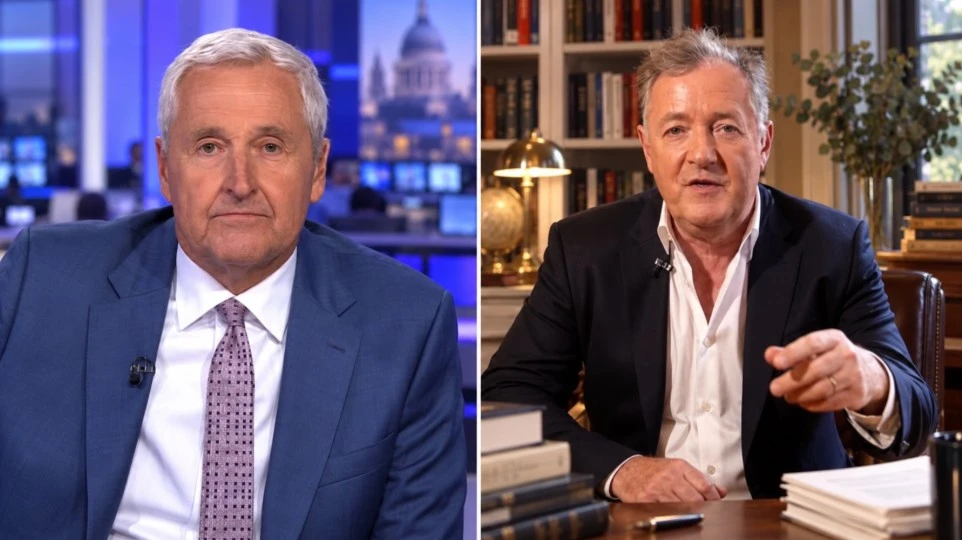
Table of Contents
Piers Morgan says he is pressing ahead with legal action against Earl Spencer and his publisher despite receiving an apology over an inaccurate claim in the Princess Diana memoir Swan Song: Diana, My Sister.
The row intensified after Charles Spencer acknowledged that he had wrongly linked Morgan to the publication of secretly taken photographs of Diana exercising at a gym in 1993.
The latest development is that future editions of the memoir are expected to be corrected, while Morgan has instructed lawyers and continues to demand action over copies already in circulation.
The Bookseller reported that future editions will be updated, while The Times reported on Wednesday, 23 September, that an edited version is to be printed. For people searching for the latest on Piers Morgan sue Earl Spencer, the dispute therefore has not ended with Spencer’s apology.
Morgan told ITV News he had instructed law firm Shillings to send a legal letter to Spencer and Penguin, saying he wanted the admitted error withdrawn from the book. He has also called for damages to be paid to the King’s Trust.
No court judgment has been made against Spencer or his publisher, and reporting that Morgan intends to sue should not be confused with a ruling that defamation has occurred.
What Did Earl Spencer Get Wrong About Piers Morgan?
The dispute comes from a passage in Spencer’s newly published memoir about Diana, Princess of Wales. Spencer recalls personally contacting newspaper editors before Diana’s funeral in September 1997 to tell them they were no longer welcome to attend.
In the book, he describes Morgan as reacting badly to the telephone call. Spencer then connected that reaction with intrusive photographs of Diana exercising in a gym that had appeared in the Mirror group years earlier.
The problem was the timeline.
The photographs were published by the Sunday Mirror on 7 November 1993. Morgan did not join the Daily Mirror until October 1995, nearly two years later. At the time the gym photographs appeared, he was working for rival newspaper The Sun.
That discrepancy became the centre of Morgan’s challenge to the book. Speaking on Piers Morgan Uncensored, he argued that the dates made it straightforward to demonstrate that he could not have had the role attributed to him in connection with the photographs.
Spencer subsequently issued an apology.
A statement on his behalf said that his description of the telephone conversation with Morgan remained his version of events, but acknowledged that the subsequent assumption connecting Morgan with the 1993 photographs was incorrect.
“As an historian, accuracy is important to Earl Spencer,” the statement said, before confirming that Spencer apologised for the error.
Spencer has therefore not withdrawn his account of Morgan’s behaviour during their alleged 1997 telephone conversation. What he has withdrawn is the assumption linking Morgan personally to the publication of the gym photographs.
That distinction is important because the two men continue to disagree about the phone call itself. Morgan says he was respectful rather than “surly”, while Spencer has maintained his account of the conversation.
Why Is Piers Morgan Still Taking Legal Action?
Morgan has made clear that he does not regard an apology alone as sufficient because physical copies containing the disputed passage have already gone on sale.
Speaking to ITV News Royal Editor Chris Ship, Morgan said he was “spitting blood” over what had been written about him and confirmed that a legal letter was being sent.
He has demanded that the disputed material be removed and has argued that books containing the acknowledged error should not continue being sold.
Morgan has gone further in interviews with other broadcasters. Speaking to the BBC, he said his lawyers would seek removal of the offending pages and added that, if correcting the problem required the first edition to be pulped, “so be it”. The BBC reported that Penguin was expected to amend the point in later editions.
The publishing industry has since provided further confirmation. The Bookseller reported that it understood future editions of Swan Song would be updated in relation to the error, meaning readers purchasing later printings may receive a version different from copies released on 22 September.
That still leaves the question of what happens to first-edition copies already distributed to bookshops and customers. Morgan wants substantially stronger action than simply changing later editions. As of 23 September, however, there has been no reported court ruling ordering the memoir to be withdrawn or pulped.
Royal Experts and Reviewers Question the Fallout
The row has become part of a much wider debate around Spencer’s memoir, which contains several disputed accounts concerning Diana, King Charles and the events surrounding her death and funeral.
Royal commentator Richard Fitzwilliams said Morgan was “absolutely right to consider legal action“, arguing that an established factual error could lead readers to question other recollections in the memoir.
Former Buckingham Palace press secretary Dickie Arbiter, who worked closely with the Royal Family during the period surrounding Diana’s death, has been particularly critical of some of Spencer’s wider claims.
Discussing Spencer’s portrayal of King Charles’s reaction to Diana’s death, Arbiter told the BBC that Spencer was talking “hogwash” and maintained that Charles had been “devastated” by Diana’s death.
Arbiter has also challenged Spencer’s argument that publishing the memoir serves the interests of Diana’s sons.
Referring to Spencer’s famous 1997 funeral eulogy, in which he spoke about protecting William and Harry, Arbiter argued that the latest allegations were “hardly protecting his nephews”.
The book’s critical reception has also reflected the controversy.
Writing in The Guardian, reviewer Emma Brockes characterised the memoir as “a furious exercise in score-settling”, while acknowledging that it also contains touching material about Spencer’s relationship with Diana.
Those assessments remain opinions rather than findings about the accuracy of the book. Spencer has continued to insist that his wider recollections are truthful.
When challenged over his account of a conversation with Charles following Diana’s death, Spencer told the BBC: “I’m telling the truth.” Buckingham Palace has taken a different position.
In an unusually direct response to the controversy, a Palace statement said that grief can “cloud reason, affect judgment and colour memory”, without providing a detailed point-by-point rebuttal of every allegation contained in the book.
The disagreement therefore extends well beyond Morgan.
Swan Song: Diana, My Sister has reopened arguments about Diana’s funeral, the Royal Family’s response to her death and relationships inside the family during one of the most turbulent periods in modern royal history.
The controversy also arrives as Diana’s sons remain prominent in separate public conversations. Prince William continues his public duties, while Prince Harry and Meghan’s return to Britain has generated renewed attention around Harry’s relationship with the Royal Family and his security arrangements.
Spencer has said that he informed William and Harry about the memoir and has maintained that his purpose was to record his memories of his sister rather than produce a scandal-driven account.
Morgan, meanwhile, is using the admitted error to raise a wider question about the reliability of Spencer’s recollections. That does not establish that other allegations in the memoir are inaccurate. Each disputed claim would need to be assessed on its own evidence.
But the publishing correction gives Morgan something concrete that many of the book’s other disputes do not have: a timeline both sides now accept was wrong.
For Spencer and his publisher, the immediate consequence is already visible. Future copies are being changed. For Morgan, that does not appear to end the matter.
As of 23 September 2026, he says his lawyers are pursuing the dispute; he wants the inaccurate passage removed from copies already in circulation, and he is continuing to seek damages.
Whether that ultimately develops into contested court proceedings, or is resolved between the parties and the publisher, remains to be seen.
About the Journalist
Ben covers business, transport and global developments for Londoner. His reporting focuses on London’s economy, major companies, infrastructure, public transport and international stories that may affect people and businesses across the capital. He explains complex developments clearly using reliable sources and relevant context.