Women Against State Pension Inequality: Latest WASPI Compensation And Legal Update 2026
 Published By
Lucy
Published By
Lucy
Published:
Updated:
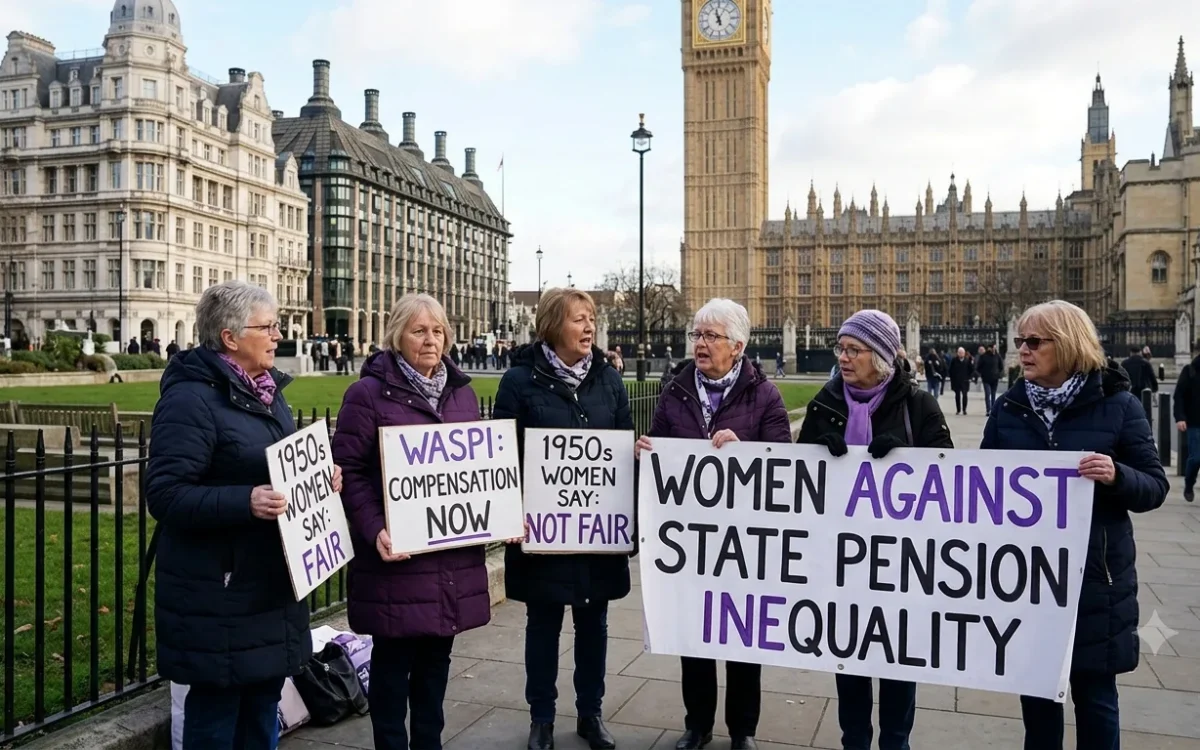
Table of Contents
The Women Against State Pension Inequality, better known as WASPI, campaign remains active in 2026 as women affected by changes to the State Pension age continue their fight over how those changes were communicated.
The dispute mainly concerns women born in the 1950s whose State Pension age increased from 60 towards 65 and later 66.
WASPI does not dispute Parliament’s right to change the pension age. Its central argument is that many women did not receive adequate individual notice early enough to adjust their retirement and financial plans.
The Parliamentary and Health Service Ombudsman found maladministration in the Department for Work and Pensions’ communication of the changes. However, the Government decided again on 29 January 2026 not to establish a financial compensation scheme.
WASPI is challenging that decision through the courts. As of the latest campaign update on 17 August 2026, its fresh judicial review claim was waiting for a High Court judge to decide whether it should receive permission to proceed.
There is therefore currently no confirmed WASPI compensation payment, application form or payment date.
What Is Women Against State Pension Inequality?
Women Against State Pension Inequality was established in 2015 and campaigns on behalf of women affected by State Pension age changes.
Its main affected group covers women born between 6 April 1950 and 5 April 1960. WASPI says millions of women were affected by the changes and the way they were communicated.
The issue dates back to the Pensions Act 1995, which provided for women’s State Pension age to gradually increase from 60 to 65 so that it matched the age for men.
The timetable was subsequently accelerated, including through the Pensions Act 2011. Women’s State Pension age eventually reached 65 in November 2018 before rising to 66 for both men and women.
The central WASPI argument is therefore not that pension ages should never have been equalised.
The campaign focuses on whether women received sufficient and timely information about changes that could significantly affect when they stopped working, claimed their pension and used their savings.
What Did The Ombudsman Find About The DWP?
The Parliamentary and Health Service Ombudsman investigated how the DWP communicated changes to women’s State Pension age.
Its investigation found maladministration relating to the timing of individual notifications.
The Government accepts the finding that there was a 28-month delay in sending letters directly to affected women and has apologised for that delay.
The Ombudsman also examined whether the communication failures caused injustice.
Its final report in March 2024 concluded that the six sample complainants it investigated had suffered injustice. It said they should receive a remedy and asked Parliament to intervene after concluding that the DWP was unlikely to provide the remedy it considered appropriate.
That finding became the basis of the continuing argument over whether affected women should receive compensation.
WASPI Position In 2026
| Issue | Current Position |
| Women Mainly Affected | Born 6 April 1950 to 5 April 1960 |
| DWP Maladministration | 28-month delay accepted |
| Government Apology | Yes |
| Ombudsman Suggested Level | £1,000 to £2,950 for six sample cases |
| Compensation Scheme | Not approved |
| Latest Government Decision | 29 January 2026 |
| WASPI Legal Action | Fresh judicial review |
| Application Form | None |
| Confirmed Payment Date | None |
How Much WASPI Compensation Could Women Receive?
The figure most commonly associated with WASPI compensation is £1,000 to £2,950.
That figure comes from the Ombudsman’s financial remedy scale.
The Ombudsman said it would have recommended Level 4 compensation, between £1,000 and £2,950, for each of the six women whose complaints were investigated. It also said the DWP should provide an appropriate remedy for other women who experienced injustice because of the maladministration.
However, this should not be interpreted as an approved payment.
Women have not automatically been awarded £2,950, and there is no Government scheme currently making payments at this level.
Any future compensation amount would depend on the outcome of legal, political or Government decisions and the eligibility conditions of any scheme eventually created.
Why Has The Government Rejected Compensation?
The Government initially rejected a financial compensation scheme in December 2024 while accepting the finding that letters should have been sent sooner.
That decision was later reconsidered after additional evidence became relevant to the decision-making process.
In November 2025, the Government announced that it would take the decision again. The existing WASPI judicial review was subsequently withdrawn following an agreement under which the Government would reconsider the issue.
A new decision was announced on 29 January 2026.
The Government again decided against introducing financial compensation.
Its published response said factors included fairness, affordability, feasibility, the available evidence and whether earlier letters would necessarily have changed women’s retirement decisions.
The Government also argued that it would not be appropriate to make awards to millions of women when it believed many already knew the pension age was increasing or may not have suffered the same injustice.
WASPI disputes that reasoning and argues that the Government has failed to provide an adequate remedy for the maladministration identified by the Ombudsman.
What Is Happening With The WASPI Judicial Review?
The latest legal challenge is one of the most important developments for Women Against State Pension Inequality in 2026.
After the Government issued its second decision rejecting compensation in January, WASPI began pursuing another judicial review.
Parliamentary answers published in June 2026 confirmed that WASPI was seeking permission from the High Court to challenge the Government’s response to the Ombudsman’s report. The DWP said it would not comment further because the litigation was ongoing.
WASPI’s CrowdJustice update dated 17 August 2026 said its claim was still waiting to be considered by a High Court judge.
The judge must first decide whether the case has permission to proceed to a full judicial review hearing.
This distinction is important.
A permission decision does not determine whether WASPI should receive compensation. It decides whether the legal arguments can move forward to a substantive hearing.
Therefore, reports suggesting that WASPI has already won compensation or that payments are about to begin are inaccurate based on the currently available information.
Key WASPI Timeline
| Date | What Happened |
| 1995 | Legislation introduced increases to women’s State Pension age |
| 2011 | Further legislation accelerated the timetable |
| 2015 | WASPI campaign established |
| 2021 | Ombudsman identified maladministration |
| March 2024 | Ombudsman published its final report |
| December 2024 | Government rejected compensation |
| 2025 | WASPI pursued judicial review |
| November 2025 | Government agreed to reconsider its decision |
| 29 January 2026 | Government again rejected compensation |
| May 2026 | WASPI began a fresh legal challenge |
| August 2026 | Judicial review permission decision remained awaited |
The timeline explains why some older reports about the WASPI court case can now be misleading.
The current legal challenge relates to the January 2026 Government decision, rather than simply continuing the previous proceedings.
Can WASPI Women Apply For Compensation Now?
There is currently no official application process for WASPI compensation.
No Government payment scheme has been approved, so there is no legitimate DWP form that women need to submit to receive a WASPI payment.
Affected women should be cautious about websites, social media advertisements, emails or messages claiming that applications have opened.
They should be particularly careful if someone asks for:
- Bank Account Details
- Card Information
- Upfront Fees
- National Insurance Information Through An Unverified Website
- Payment To Join A Compensation List
WASPI’s own information confirms that compensation has not been agreed.
If the position changes, any genuine Government scheme would need to set out who qualifies, how claims are made and how much successful applicants could receive.
Does Every Woman Born In The 1950s Qualify?
There is currently no compensation scheme, so no final eligibility criteria exist.
WASPI broadly campaigns for women born from 6 April 1950 to 5 April 1960 who were affected by State Pension age changes and communication failures.
However, the Ombudsman’s findings did not establish that every woman experienced identical circumstances or the same level of injustice.
That difference is one of the central areas of disagreement.
The Government argues that some women already knew their State Pension age was changing and that not everyone would have changed their financial plans if individual letters had arrived earlier.
WASPI argues that women affected by the communication failures deserve a fair remedy following the Ombudsman’s findings.
Any eventual compensation scheme would therefore require clear rules covering eligibility and payment levels.
What Happens Next For WASPI Women?
The most immediate development to watch is the High Court.
As of the 17 August 2026 update, WASPI’s latest judicial review application remained at the permission stage.
If permission is granted, the legal challenge could proceed to a fuller hearing where the Government’s January 2026 decision would be examined.
That would still not automatically trigger compensation. A judicial review considers whether a public body’s decision was made lawfully rather than simply replacing that decision with the court’s preferred policy.
For now, three points remain clear:
- DWP Maladministration Was Found: The Government accepts there was a 28-month delay in sending individual letters.
- No Compensation Scheme Exists: The Government’s January 2026 decision remains against financial compensation.
- Legal Action Is Continuing: WASPI is seeking to challenge that decision through judicial review.
The Women Against State Pension Inequality campaign therefore remains unresolved in September 2026.
Until there is a new court ruling, Government announcement or parliamentary development, affected women should be cautious about reports claiming that £2,950 payments, application forms or compensation dates have already been confirmed.
About the Journalist
Lucy reports on London’s boroughs and the capital’s sporting community. Her coverage includes council decisions, neighbourhood developments, community issues, football, tennis, cricket and major sporting events. She focuses on stories that connect local communities and highlight the people and organisations shaping London.