When Will England Host the World Cup Again? Latest Outlook
 Published By
Jermaine
Published By
Jermaine
Published:

Table of Contents
England is one of world football’s most famous nations, with the Premier League, Wembley Stadium and a long history at the heart of the international game. Yet despite that status, the country has hosted the men’s FIFA World Cup only once.
That naturally raises the question: when will England host the World Cup again?
As of August 2026, there is no confirmed date for England to host another men’s FIFA World Cup. The 2030 tournament has already been awarded to Morocco, Portugal and Spain, with three centenary matches taking place in Argentina, Paraguay and Uruguay. Saudi Arabia will then stage the 2034 World Cup.
That means 2038 is the earliest men’s World Cup that has not already been allocated. However, England has not been awarded the 2038 tournament and there is currently no confirmed English bid.
There is another important development, though. England is part of the UK bid for the FIFA Women’s World Cup 2035, which could bring World Cup football back to English stadiums considerably sooner.
Is England Scheduled to Host a Men’s World Cup?
No. England is not currently scheduled to host any upcoming edition of the men’s FIFA World Cup.
The confirmed hosting picture is:
| World Cup | Confirmed host |
| 2026 | Canada, Mexico and United States |
| 2030 | Morocco, Portugal and Spain, plus centenary matches in Argentina, Paraguay and Uruguay |
| 2034 | Saudi Arabia |
| 2038 | Not yet awarded |
FIFA officially appointed Morocco, Portugal and Spain as the main hosts of the 2030 tournament at its Extraordinary Congress in December 2024. Argentina, Paraguay and Uruguay will each stage one special centenary match marking 100 years since the first World Cup in Uruguay in 1930.
At the same Congress, Saudi Arabia was formally appointed to host the 2034 tournament.
For supporters hoping to see another men’s World Cup staged in England, attention therefore has to move beyond 2034.
Could England Host the 2038 World Cup?
2038 is the earliest unallocated men’s FIFA World Cup, making it the first realistic tournament England could potentially target after the confirmed 2030 and 2034 editions.
That does not mean England will host in 2038.
FIFA has not awarded the tournament, and any future English or UK bid would need to go through FIFA’s formal bidding process. Hosting eligibility, bidding regulations, government guarantees, stadium requirements, commercial considerations and competing bids would all influence the outcome.
England could therefore emerge as a candidate for 2038, but at present it would be misleading to describe the country as the expected or confirmed host.
A more accurate answer is that 2038 is England’s earliest possible opportunity for the men’s tournament, rather than a confirmed hosting year.
Why Did England Not Bid for the 2030 World Cup?
There was once considerable discussion about a possible UK and Ireland bid for the 2030 FIFA World Cup.
However, that proposal did not proceed.
In February 2022, the football associations of England, Scotland, Wales, Northern Ireland and the Republic of Ireland announced that they would instead concentrate on bidding for UEFA EURO 2028.
The decision followed a feasibility study examining factors such as economic impact, international football politics and the costs involved in hosting major tournaments.
The associations concluded that concentrating on EURO 2028 offered a similar potential return while involving lower delivery costs and allowing the benefits of hosting a major tournament to arrive sooner. As a result, they specifically confirmed they would not bid for the 2030 FIFA World Cup.
That decision ultimately proved successful because the UK and Ireland were subsequently chosen to host EURO 2028.
When Was the Last World Cup Hosted in England?
England last hosted the men’s FIFA World Cup in 1966.
It remains one of the most important tournaments in English sporting history because England did not simply host the competition — it won it.
The final took place at Wembley on 30 July 1966, with England defeating West Germany 4-2 after extra time.
Geoff Hurst scored a hat-trick, becoming the first man to score three goals in a men’s World Cup final. England captain Bobby Moore then lifted the Jules Rimet Trophy at Wembley.
It remains England’s only men’s World Cup triumph.
By 2038, 72 years will have passed since England last hosted the tournament.
That long gap is one reason speculation about another English World Cup regularly returns whenever FIFA begins discussing future hosts.
Is England Hosting EURO 2028?
Yes, although England is not hosting the tournament alone.
UEFA EURO 2028 will be jointly staged by England, Scotland, Wales, Northern Ireland and the Republic of Ireland.
England will provide several of the competition’s major venues, including:
- Wembley Stadium in London
- Tottenham Hotspur Stadium in London
- Villa Park in Birmingham
- Everton Stadium in Liverpool
- Manchester City Stadium in Manchester
- St James’ Park in Newcastle
UEFA’s current match schedule places both semi-finals and the final at Wembley Stadium, with the final scheduled for 9 July 2028.
EURO 2028 therefore gives England an opportunity to demonstrate its ability to stage another major international tournament before FIFA begins deciding future men’s World Cup hosts.
Successful delivery could become relevant if the Football Association later decides to pursue another World Cup bid.
Could Wembley Host Another World Cup Final?
Wembley would almost certainly be central to any future England or UK World Cup proposal, although FIFA would ultimately have to approve the stadium programme of any successful bid.
The stadium already has extensive experience hosting major international football.
It hosted the 1966 World Cup final at the original Wembley and has continued to stage some of football’s biggest matches following the construction of the current stadium.
For EURO 2028, UEFA’s schedule lists Wembley with a tournament capacity of around 86,000 and assigns it major knockout fixtures, including the two semi-finals and final.
London would consequently be well positioned to play a significant role in any future World Cup staged in England or across the wider UK.
Does England Have Enough Stadiums to Host a World Cup?
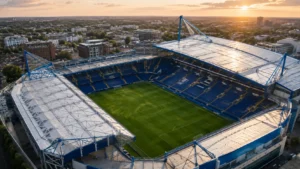
England possesses one of the strongest concentrations of large football stadiums in the world.
In addition to Wembley, potential venues include major grounds in London, Manchester, Liverpool, Birmingham, Newcastle and other English cities.
However, modern World Cup hosting requirements extend well beyond stadium capacity.
A successful bid would have to address areas including:
- training facilities;
- team accommodation;
- transport networks;
- airports and international connections;
- security;
- fan zones;
- broadcasting infrastructure;
- sustainability;
- government guarantees;
- commercial requirements; and
- FIFA’s technical specifications.
England already operates substantial football, hotel and transport infrastructure because of the scale of domestic football and the number of international sporting events regularly held in the country.
EURO 2028 will provide another major test of those capabilities.
Will England Host the Women’s World Cup in 2035?
This is where the World Cup picture becomes particularly interesting.
England could potentially host FIFA World Cup matches in 2035, three years before the earliest currently unallocated men’s tournament.
The football associations of England, Northern Ireland, Scotland and Wales have submitted a joint UK bid to stage the FIFA Women’s World Cup 2035.
The proposal includes 22 stadiums across 16 host cities, with 16 of the proposed stadiums located in England.
The FA has described the proposed competition as potentially the largest single-sport event ever staged in the UK, with plans targeting approximately 4.5 million ticket sales.
FIFA conducted an inspection visit in February 2026, examining stadiums, training facilities, accommodation and other potential tournament infrastructure across the UK. Proposed venues inspected included Wembley Stadium, Tottenham Hotspur Stadium and Brighton’s stadium, alongside locations elsewhere in the UK.
However, the hosting rights have not yet been formally awarded.
FIFA has confirmed that an Extraordinary FIFA Congress intended to appoint the hosts of the 2031 and 2035 Women’s World Cups will take place on 23 November 2026.
Therefore, England currently has a substantially clearer route towards hosting matches at the 2035 Women’s World Cup than it does towards hosting the men’s tournament.
Would a Future Men’s World Cup Be England-Only or a UK Bid?
That remains unknown.
Historically, discussions about bringing the tournament back have included the possibility of both an England-led proposal and a broader UK or UK-and-Ireland approach.
Recent major tournament strategy has increasingly involved cooperation between the Home Nations.
EURO 2028 is being organised across England, Northern Ireland, Scotland, Wales and the Republic of Ireland, while the 2035 Women’s World Cup proposal involves England, Northern Ireland, Scotland and Wales.
A joint proposal can offer a larger collection of stadiums and host cities while sharing infrastructure and organisational costs.
On the other hand, England alone has a particularly large number of suitable stadiums and a vast domestic football market.
No format has been confirmed for any future men’s World Cup campaign, meaning it is currently too early to say whether a prospective 2038 or later bid would come from England alone or involve neighbouring associations.
Why Would England Want to Host the World Cup Again?
Hosting the World Cup would be much more than a football event.
A tournament could generate substantial international tourism, hospitality activity, broadcasting exposure and spending in host cities.
London would be particularly significant because of Wembley Stadium, its airport connections, hotel capacity and international tourism market.
Other English cities could also see major visitor numbers during the tournament.
There could additionally be investment in:
- transport infrastructure;
- stadium upgrades;
- training facilities;
- public spaces;
- tourism;
- grassroots football; and
- major-event infrastructure.
However, hosting a World Cup also involves considerable expenditure and organisational commitments.
Governments considering support for a bid therefore have to weigh projected economic and social benefits against security, transport, infrastructure and tournament delivery costs.
That assessment was one of the factors behind the decision to pursue EURO 2028 rather than the 2030 World Cup.
What Would Have to Happen Before England Could Host Again?
Several stages would need to take place before another men’s World Cup could be confirmed for England.
First, FIFA would have to establish the bidding process and eligibility rules for the relevant tournament.
The Football Association would then need to decide whether it wanted to enter the process, either independently or alongside other football associations.
A serious proposal would require support from governments and public authorities because World Cup bids typically involve extensive guarantees relating to areas such as security, transport, visas, infrastructure and tournament operations.
Proposed stadiums and host cities would then have to be selected.
FIFA would evaluate qualifying bids before the eventual host was appointed through the organisation’s formal decision-making process.
Until those stages begin for a future tournament, speculation about England hosting in 2038 remains exactly that — speculation.
Could EURO 2028 Strengthen a Future World Cup Bid?

It could certainly provide useful evidence of England’s ability to stage a major international competition.
EURO 2028 will involve stadiums throughout the UK and Ireland and will place England at the centre of several of the tournament’s highest-profile matches.
London will be particularly prominent, with Tottenham Hotspur Stadium and Wembley both being used. Wembley is scheduled to stage the final.
Successful tournament organisation would allow England and its neighbouring associations to demonstrate modern stadium infrastructure, transport planning, security operations and the ability to accommodate large numbers of travelling supporters.
None of that guarantees FIFA World Cup hosting rights, but it could form part of the case behind a future bid.
What Is the Most Realistic Timeline for Another England World Cup?
For the men’s FIFA World Cup, the current timeline is straightforward.
The 2030 and 2034 tournaments are already allocated.
That leaves 2038 as the earliest edition England could potentially pursue, assuming England is eligible under the bidding regulations FIFA eventually adopts and the FA decides to submit or participate in a bid.
There is currently no guarantee that England will bid for 2038, let alone win the hosting rights.
The picture for women’s football is more immediate.
The UK has formally submitted its bid for the 2035 FIFA Women’s World Cup, with England expected to provide the majority of proposed venues. FIFA’s formal host appointment is scheduled for November 2026.
That means England could potentially welcome World Cup football in 2035 even if supporters have to wait considerably longer for the men’s tournament to return.
Conclusion
So, when will England host the World Cup again?
For the men’s competition, there is currently no confirmed year. With the 2030 World Cup going to Morocco, Portugal and Spain and the 2034 tournament awarded to Saudi Arabia, 2038 represents the earliest unallocated opportunity for England. Even then, a bid would have to be launched and successfully pass FIFA’s selection process.
Before that, England will play a major role in hosting EURO 2028, including the final at Wembley.
There is also a realistic possibility of World Cup football returning sooner through the women’s game. England, Scotland, Wales and Northern Ireland have submitted a joint bid for the 2035 FIFA Women’s World Cup, with FIFA scheduled to make the formal hosting decision in November 2026.
For now, supporters waiting for another men’s World Cup on English soil will need to look beyond 2034 with 2038 the first possible date, rather than a confirmed one.
Frequently Asked Questions
When will England next host the men’s World Cup?
There is currently no confirmed date. The 2030 and 2034 tournaments have already been awarded, making 2038 the earliest unallocated men’s World Cup.
Is England hosting the 2030 World Cup?
No. Morocco, Portugal and Spain are the main hosts, while Argentina, Paraguay and Uruguay will each stage a centenary celebration match.
Is England hosting the 2034 World Cup?
No. FIFA has awarded the 2034 men’s World Cup to Saudi Arabia.
Could England host the World Cup in 2038?
It is possible, but nothing has been confirmed. FIFA has not awarded the 2038 tournament and England does not currently have confirmed hosting rights.
When did England last host a World Cup?
England last hosted the men’s tournament in 1966, when the national team defeated West Germany 4-2 after extra time in the Wembley final.
Is England hosting EURO 2028?
Yes. England is one of the countries hosting UEFA EURO 2028 alongside Scotland, Wales, Northern Ireland and the Republic of Ireland.
Could England host the Women’s World Cup before another men’s World Cup?
Yes. England is part of the UK bid for the 2035 FIFA Women’s World Cup. The hosting rights are due to be formally decided by FIFA in November 2026.
About the Journalist
Jermaines covers crime, legal affairs and money-related stories for Londoner. His reporting includes police updates, court cases, consumer rights, personal finance and cost-of-living issues. He handles sensitive subjects carefully and clearly distinguishes confirmed facts from allegations, estimates and ongoing investigations.