Why Nine Planes Declared Emergencies at Gatwick Airport?
 Published By
Adam
Published By
Adam
Published:
Updated:
Table of Contents
Fourteen Gatwick-bound flights were diverted after a British Airways aircraft blocked the operating runway. Nine issued near-simultaneous emergency alerts as their crews managed dwindling fuel reserves.
Planes declare emergencies Gatwick Airport – What actually happened?
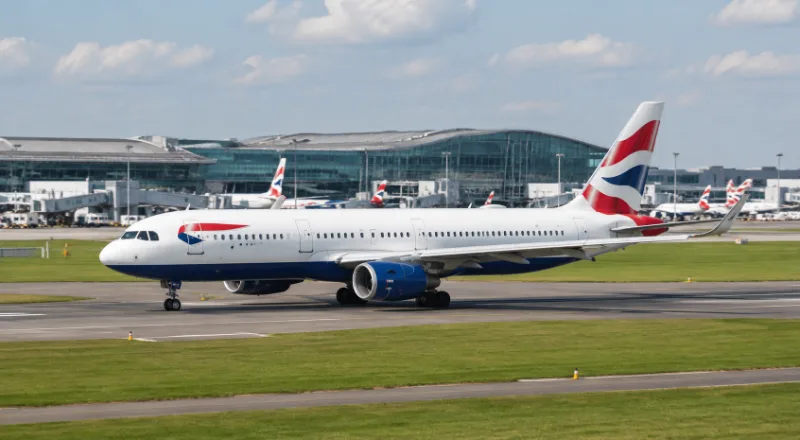
Nine passenger planes declared emergencies near Gatwick Airport after a British Airways Airbus A320 developed a technical problem and stopped on the runway shortly after midnight on Wednesday 15 July.
The aircraft, operating flight BA2673 from Palma de Mallorca, remained on the runway for about 30 minutes and had to be towed away. Fourteen incoming flights were diverted to other airports while Gatwick’s runway was unavailable, according to flight-tracking data.
British Airways said the Palma flight itself had not declared an emergency. Emergency crews met the aircraft as a precaution, while passengers disembarked normally following what the airline described as a “technical fault”.
Flightradar24 reported that the crew had told air traffic control that the aircraft’s nose-wheel steering was unavailable, preventing it from leaving the runway without assistance. However, neither British Airways nor Gatwick has publicly confirmed the precise nature of the fault beyond describing it as a technical issue.
Why Did the Flights Transmit Emergency Code 7700?
The alerts did not indicate that nine separate aircraft had developed mechanical failures.
Incoming flights were initially placed into holding patterns while controllers waited for the British Airways aircraft to be removed. As the closure continued and crews began diverting, nine aircraft declared fuel emergencies and transmitted the general emergency code 7700, which alerts controllers that a flight requires priority handling.
Gatwick has two runways, but they cannot operate simultaneously because of their proximity. Flightradar24 said the main runway was closed during overnight hours that week, meaning the aircraft had blocked the strip then being used for arrivals and departures. That left controllers unable to transfer traffic to another active runway.
Under current UK aviation rules, a fuel emergency must be declared when a crew calculates that the usable fuel expected to remain on landing at the nearest suitable airport will be below the planned final reserve. The declaration secures priority from air traffic control; it does not necessarily mean the aircraft is moments from exhausting its fuel.
There was also a tenth declaration that was not part of the original wave of nine diversions. Flightradar24 said British Airways flight BA2591 from Verona declared a fuel emergency as operations resumed but was able to land at Gatwick.
The widely reported figure of nine therefore refers to the near-simultaneous emergency squawks during the diversion period, rather than every fuel emergency connected with the closure.
Passengers Diverted Across England
The 14 diverted services landed at Heathrow, Stansted, Luton, Birmingham and Bristol. Most subsequently continued to Gatwick after the runway reopened, although some passengers had to arrange onward journeys from their diversion airport.
Passengers on an easyJet flight from Rome were kept aboard at Stansted for more than two hours. The airline said no ground-handling staff were available for the unexpected arrival, leaving the aircraft unable to refuel. Customers eventually disembarked and were told that reasonable onward travel costs would be reimbursed.
Gatwick said the runway had been closed for only a short period and that most diverted flights later returned. Flightradar24 calculated that operations resumed approximately 45 minutes after BA2673 touched down.
The airport has not released further details about the underlying technical fault. Its confirmed position remains that the closure was temporary and that safety procedures were followed while the disabled aircraft was removed.
About the Journalist
Adam reports on London news, events and local developments. His coverage includes festivals, exhibitions, public announcements, community stories and important updates affecting people across the city. He aims to provide timely and accessible reporting on what is happening in London.