Top 10 Oldest Pubs in London: Historic Taverns Worth Visiting
 Published By
Lucy
Published By
Lucy
Published:
Updated:
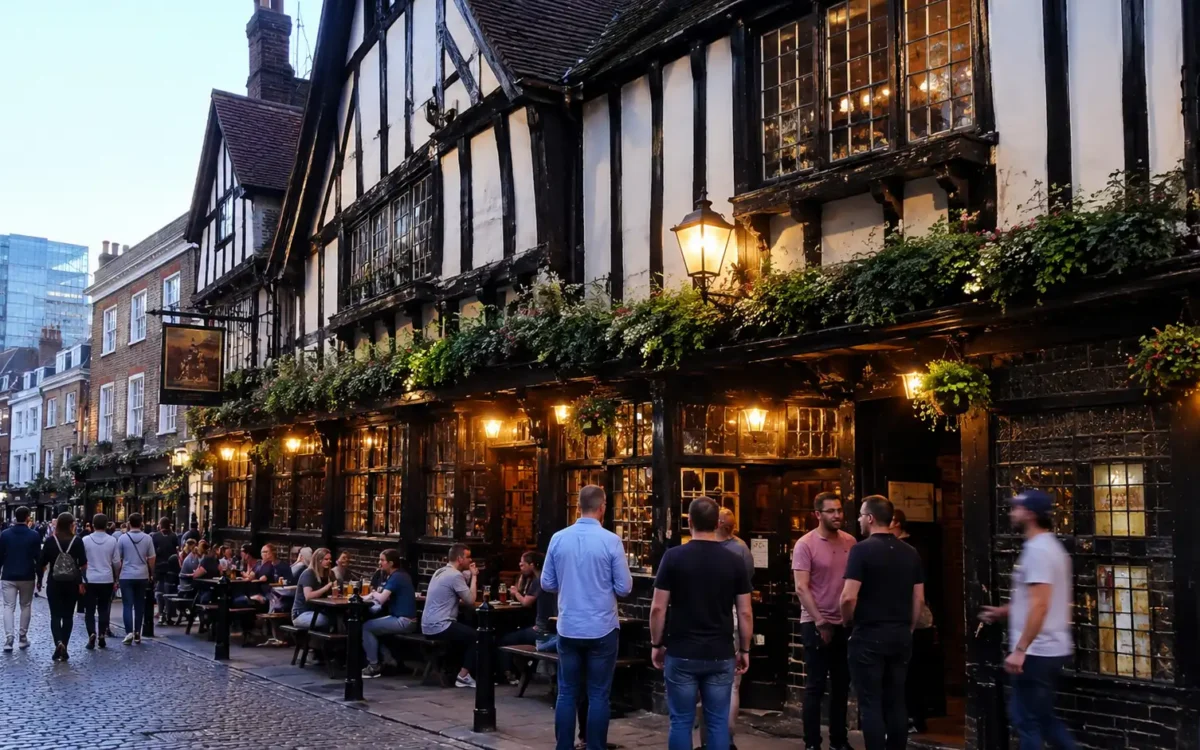
Table of Contents
London’s oldest pubs preserve centuries of social history in their cellars, courtyards, timber frames and secluded drinking rooms. Some began as coaching inns for travellers, while others served dock workers, lawyers, printers, sailors and writers.
However, identifying the single oldest pub in London is not straightforward. A venue may advertise a medieval founding date even though the present building was constructed centuries later. Some historic buildings also operated as homes, shops or wine merchants before becoming pubs.
Based on documentary evidence and surviving historic fabric, The George Inn in Southwark has the strongest claim to being London’s oldest surviving pub. An inn was recorded on its site by around 1542, while part of the present galleried structure dates from its reconstruction in 1677. Ye Olde Cheshire Cheese is another well-supported contender, with a documented reference from 1680 and surviving late-17th-century fabric.
Which Are the 10 Oldest Pubs in London?
| Rank | Pub | Area | Best-supported historic date |
| 1 | The George Inn | Southwark | Inn recorded around 1542; surviving section rebuilt in 1677 |
| 2 | Ye Olde Cheshire Cheese | Fleet Street | Established by 1680; late-17th-century fabric |
| 3 | The Seven Stars | Holborn | Possibly 17th-century in origin |
| 4 | The Spaniards Inn | Hampstead | Surviving 17th-century building |
| 5 | The Old Bell Tavern | Fleet Street | Probably late 17th century |
| 6 | The Lamb and Flag | Covent Garden | Building core from around 1688 or the early 18th century |
| 7 | The Grapes | Limehouse | Current structure generally dated to the 1720s |
| 8 | Ye Olde Mitre | Holborn | Present pub established during the 1770s |
| 9 | The Mayflower | Rotherhithe | Earliest standing sections date from the 1780s |
| 10 | The Prospect of Whitby | Wapping | Present building mainly dates from the 18th and 19th centuries |
1. The George Inn, Southwark
Address: 75–77 Borough High Street, London SE1
Historic claim: Inn recorded around 1542; surviving structure from 1677
The George Inn has the most convincing claim to being the oldest surviving pub in London. A map of Southwark produced around 1542 records an inn on the site, while the 16th-century writer John Stow later included it among the area’s notable inns.
The building was reconstructed during the 1620s and partly rebuilt in 1670. It was then destroyed in the great Southwark fire of 1676, after which tenant Mark Weyland began rebuilding it in 1677.
Part of that 1677 structure remains today. Its timber galleries once provided access to upper-floor bedchambers and make The George London’s only surviving galleried inn. The property is now cared for by the National Trust, although it continues to operate as a working pub.
Its courtyard also provides a vivid reminder of Borough High Street’s former importance as a departure point for stagecoaches travelling south from London.
2. Ye Olde Cheshire Cheese, Fleet Street
Address: 145 Fleet Street, London EC4A
Historic claim: Established by 1680
Ye Olde Cheshire Cheese is one of London’s most atmospheric old pubs, with narrow passages, wood-panelled rooms, steep staircases and a vaulted cellar.
Although a sign outside says that the pub was rebuilt in 1667, Historic England takes a slightly more cautious position. Its earliest architectural features are consistent with a late-17th-century building constructed after the Great Fire of London, while the first known written reference to the Cheshire Cheese appeared in a ballad published in 1680.
The pub was significantly altered during the following centuries, but its brick-vaulted cellar and other late-17th-century elements survive. Its literary reputation was strengthened by associations with Charles Dickens, W. B. Yeats and P. G. Wodehouse.
Visitors should not describe it as a medieval pub that survived the Great Fire. The available evidence indicates that the surviving building was created after the fire.
3. The Seven Stars, Holborn
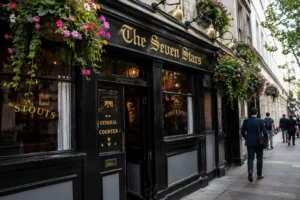
Address: 53–54 Carey Street, London WC2A
Historic claim: Traditionally dated to 1602; probably 17th-century in origin
Located behind the Royal Courts of Justice, The Seven Stars is a compact Grade II-listed pub with an unusually intimate interior.
The date 1602 is frequently associated with the premises. Historic England describes the pub as “perhaps” having 17th-century origins, although the structure has undergone extensive alterations and additions.
Its painted brick exterior conceals parts of an older timber frame. Inside, the two main drinking rooms contain 19th-century bar fittings, mirrored bar backs and a later corner fireplace. These surviving layers demonstrate how London pubs evolved rather than remaining unchanged for hundreds of years.
The Seven Stars is therefore a credible contender among London’s oldest pub buildings, even though 1602 should be treated as a traditional date rather than a fully proven opening year.
4. The Spaniards Inn, Hampstead
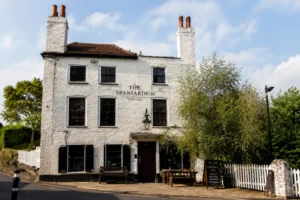
Address: Spaniards Road, Hampstead, London NW3
Historic claim: Traditionally associated with 1585; surviving fabric is 17th century
Standing beside Hampstead Heath, The Spaniards Inn feels more like a historic country inn than a pub within Greater London.
Stories often date its foundation to 1585 and connect it with highwayman Dick Turpin, the Gordon Riots and literary visitors. Some of these accounts are difficult to verify, but the building itself is unquestionably historic.
Historic England identifies the structure as 17th-century brickwork incorporating timber framing and weatherboarding. It also retains internal panelling that may be original, although it has been heavily painted and the building has been altered over time.
Its location, old rooms and garden make it especially appealing to visitors combining a pub visit with a walk across Hampstead Heath.
5. The Old Bell Tavern, Fleet Street
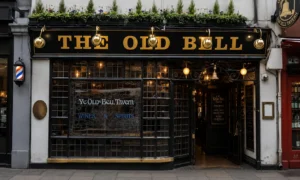
Address: 95–96 Fleet Street, London EC4Y
Historic claim: Probably late 17th century
The Old Bell stands close to St Bride’s Church in the historic printing and newspaper district of Fleet Street.
The pub is sometimes linked with Sir Christopher Wren and the rebuilding of the nearby church after the Great Fire. The safer architectural conclusion comes from Historic England, which dates the Grade II-listed building to the late 17th century while noting that it has been substantially altered.
The surviving structure rises to three storeys beneath a tiled roof. Later work has obscured parts of the original frontage, demonstrating why a pub’s present appearance does not always reveal the true age of the underlying building.
Its proximity to Ye Olde Cheshire Cheese allows visitors to see two genuine late-17th-century Fleet Street pub buildings within a short walk.
6. The Lamb and Flag, Covent Garden
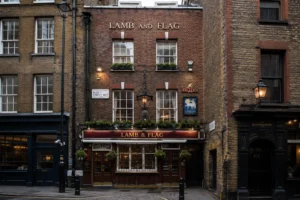
Address: 33 Rose Street, London WC2E
Historic claim: Building core from around 1688 or the early 18th century
Hidden between Covent Garden’s busier streets, The Lamb and Flag occupies a building with a historic core dating from approximately 1688 or the beginning of the 18th century.
Its front was rebuilt in 1958, so the visible façade is considerably newer than the main structure. Historic England records older brickwork at the rear, remnants of an early closet wing, sections of staircase and surviving internal panelling.
The pub is also associated with London’s literary and theatrical culture. Its secluded position in Rose Street helps preserve the feeling of entering an older neighbourhood hidden behind modern Covent Garden.
It is one of the best examples of why historic pubs should be assessed by examining the whole building rather than judging only the street-facing exterior.
7. The Grapes, Limehouse
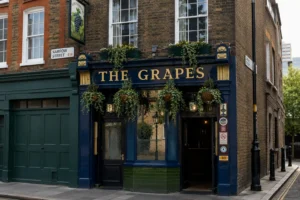
Address: 76 Narrow Street, London E14
Historic claim: Pub tradition associated with the site from 1583; present building from the 1720s
The Grapes stands directly beside the Thames in Limehouse, an area historically connected with shipping, docks and international trade.
A drinking establishment is traditionally said to have occupied the site since 1583. The current narrow riverside structure is generally dated to the 1720s, making it one of London’s oldest surviving riverside pub buildings.
The Grapes’ own history records its long association with Limehouse and notes that it survived bombing during the Second World War. Charles Dickens knew the area and used a recognisable version of the riverside tavern in Our Mutual Friend.
The small rear terrace overlooking the Thames is a major attraction, although space can be limited. The pub is currently associated with leaseholders including actor Ian McKellen, director Sean Mathias and Evgeny Lebedev.
8. Ye Olde Mitre, Holborn
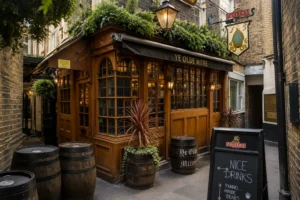
Address: 1 Ely Court, Ely Place, London EC1N
Historic claim: Pub tradition dated to 1546; present establishment from the 1770s
Ye Olde Mitre is concealed in a narrow passage close to Hatton Garden. Its hidden location, low ceilings and small drinking rooms make it appear considerably older than many surrounding buildings.
The pub promotes a foundation date of 1546, when a drinking place is said to have served the household of the Bishop of Ely. However, more recent Historic England research concludes that the estate was taken over by the Crown and redeveloped during the 1770s.
Fire insurance documents identify early licensees from the 1790s, supporting a later date for the present pub than its traditional Tudor origin story suggests.
It remains one of London’s most characterful hidden pubs, but the 1546 date should be presented as part of its traditional history rather than as the confirmed age of the current building.
9. The Mayflower, Rotherhithe
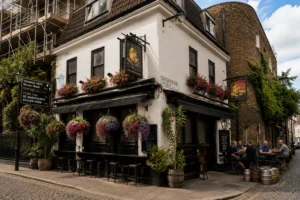
Address: 117 Rotherhithe Street, London SE16
Historic claim: Claimed pub site from around 1550; surviving sections from the 1780s
The Mayflower overlooks the Thames close to the point traditionally associated with the ship that carried English settlers across the Atlantic in 1620.
The premises are sometimes described as having opened around 1550 under the name The Ship. Historic England’s research is more conservative: the earliest parts of the standing building date from the 1780s, when the premises were known as the Spread Eagle and Crown.
Bombing during the Second World War severely damaged the building, leaving mainly the ground floor. It was substantially rebuilt in the late 1950s and renamed The Mayflower to commemorate the area’s maritime history.
Although it cannot confidently claim an intact 16th-century building, its riverside location and connections with Rotherhithe’s seafaring past make it one of London’s most significant historic pubs.
10. The Prospect of Whitby, Wapping
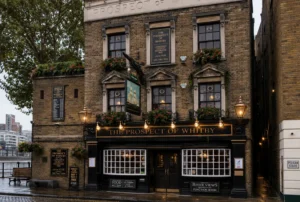
Address: 57 Wapping Wall, London E1W
Historic claim: Traditionally founded in 1520; present building mainly from the 18th and 19th centuries
The Prospect of Whitby frequently advertises itself as England’s oldest riverside tavern, with a claimed foundation date of 1520.
That claim requires qualification. Historic England found that references to a 1520 foundation did not appear until the 1950s and may have resulted from promotional activity rather than archival research. The standing building appears to consist mainly of 18th and 19th-century fabric.
Nevertheless, it remains an important survivor of Wapping’s maritime history. Its Thames frontage, flagstone floors, dark timber and associations with sailors, smugglers and dockside London create one of the capital’s most memorable historic pub settings.
The Prospect is unquestionably old and historically significant, but it should not automatically be presented as London’s oldest surviving pub building.
What Is the Best Historic Pub Crawl Route?
A practical central London route can begin at The George Inn near London Bridge, continue across the river towards Ye Olde Cheshire Cheese and The Old Bell on Fleet Street, and then finish at The Seven Stars and Ye Olde Mitre around Holborn.
The riverside pubs are better treated as a separate itinerary. The Mayflower is in Rotherhithe, while The Prospect of Whitby and The Grapes stand farther east in Wapping and Limehouse. Grouping them geographically avoids turning a relaxed historic pub visit into a rushed journey across London.
Opening hours, food service, private functions and access arrangements can change, so visitors should check each venue’s official website before travelling.
Why Are London’s Oldest-Pub Claims So Difficult to Prove?
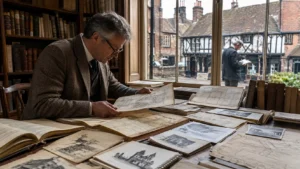
There are four different dates that a pub may use:
- The date when an alehouse or inn first operated somewhere on the site.
- The construction date of the present building.
- The date when the current premises first received a licence.
- The date when the venue adopted its current name.
These dates can be hundreds of years apart. A medieval inn may have been demolished and reconstructed several times, while a genuinely old building may only have become a pub much later.
Historic England’s assessment uses documentary research, archaeology, architectural evidence and, where available, scientific techniques such as tree-ring dating. That approach gives more reliable results than accepting an “established” date displayed on a sign.
Frequently Asked Questions
What is the Oldest Pub in London?
The George Inn in Southwark has the strongest evidence-based claim. An inn was recorded on the site around 1542, and part of the present galleried building survives from the 1677 reconstruction.
Is Ye Olde Cheshire Cheese the Oldest Pub in London?
It is one of the oldest verified surviving pubs, but The George has an earlier documented inn history. Ye Olde Cheshire Cheese was established by 1680 and contains late-17th-century fabric.
Did Ye Olde Cheshire Cheese Survive the Great Fire of London?
The surviving pub was probably constructed after the Great Fire of 1666. Its claim to have been rebuilt in 1667 is plausible, but the earliest confirmed written reference currently identified dates from 1680.
Is the Prospect of Whitby Really From 1520?
The 1520 date is a traditional claim rather than a securely documented construction date. Historic England reports that the claim first appeared during the 1950s, while most of the standing building dates from the 18th and 19th centuries.
Which is London’s Oldest Riverside Pub?
There is no universally certified winner. The Prospect of Whitby and The Mayflower both make early claims, but the present buildings are substantially later than their advertised foundation dates. The Grapes also has a long-established riverside pub tradition and a surviving structure dating from the 1720s.
Which Old London Pub Has the Most Original Historic Character?
The answer is subjective, but The George Inn is distinctive because of its surviving 1677 gallery. Ye Olde Cheshire Cheese is notable for its cellar and enclosed rooms, while The Spaniards Inn preserves substantial 17th-century fabric.
Are All of These Pubs Listed Buildings?
Most are Grade II listed, reflecting their architectural or historic significance. Listing protects important features, but it does not prove every story associated with a pub or confirm the founding date advertised by its owners. Historic England maintains the official National Heritage List for England.
Can Non-drinkers Visit London’s Historic Pubs?
Historic pubs are also places to experience architecture, food and local history. Many provide alcohol-free drinks, although menus and admission arrangements differ. Visitors should check directly with the venue and follow responsible-drinking advice when alcohol is consumed.
About the Journalist
Lucy reports on London’s boroughs and the capital’s sporting community. Her coverage includes council decisions, neighbourhood developments, community issues, football, tennis, cricket and major sporting events. She focuses on stories that connect local communities and highlight the people and organisations shaping London.