Brussels Airport Strike: Flights Cancelled As Belgium Faces Major National Walkout
 Published By
Jermaine
Published:
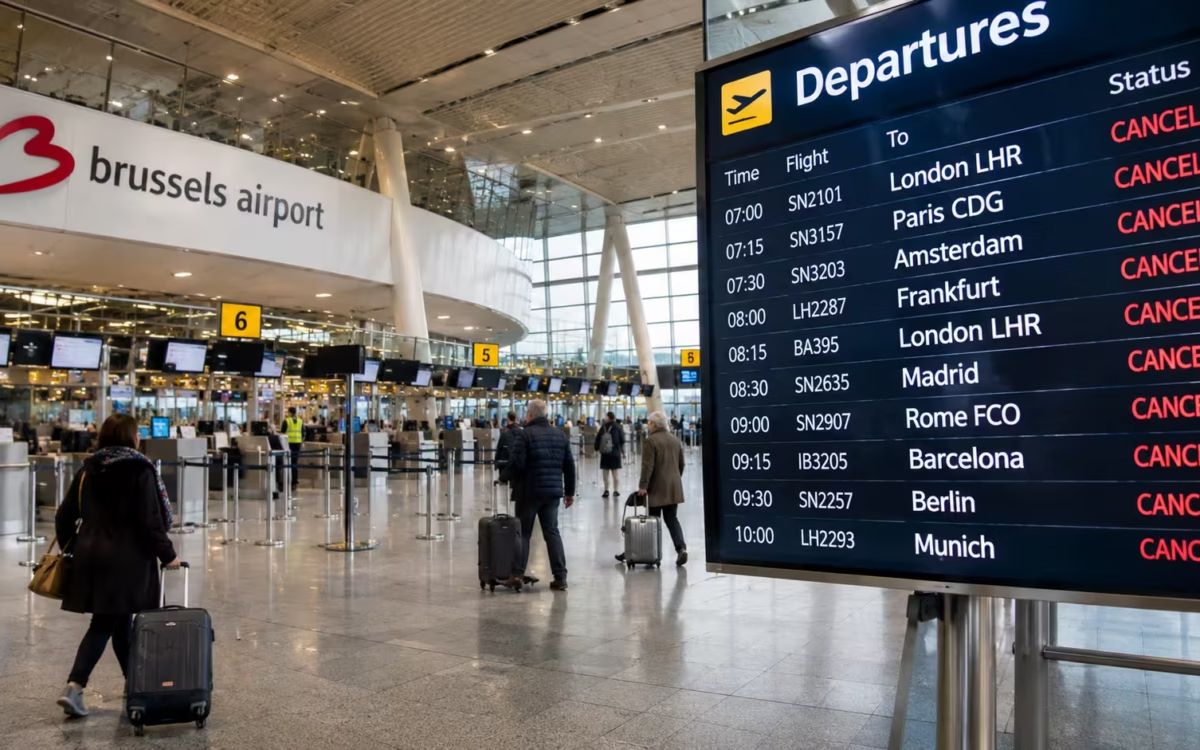
Table of Contents
Brussels Airport has announced widespread flight cancellations on Monday, 23 November 2026, after Belgian air traffic controllers confirmed their participation in a nationwide strike against government austerity measures.
All scheduled arrivals and departures between 7am and 9pm local time have been cancelled, leaving thousands of passengers facing disrupted journeys.
The Brussels Airport strike is also affecting Belgium’s second major international airport, Brussels South Charleroi, while public transport services across the capital face significant interruptions.
Travellers flying between Britain and Belgium are being urged to check their flight status before travelling and contact their airlines about alternative arrangements.
What Flights Are Cancelled During the Brussels Airport Strike?
The strike is expected to cause one of the most significant disruptions to Belgian aviation this year, with scheduled commercial flight operations suspended for 14 hours.
According to an official announcement from Brussels Airport, all arriving and departing flights scheduled between 07:00 and 21:00 Belgian time on 23 November must be cancelled. This corresponds to 6am until 8pm in the UK.
The airport had originally expected approximately 59,500 passengers across 429 flights during Monday’s operating schedule.
These included 213 departures and 216 arrivals, although the published cancellation window does not necessarily mean that every flight outside those hours is affected.
The airport warned that cancellation information may not appear immediately on its departure and arrival boards because individual airlines must register the changes first.
Passengers should therefore prioritise direct communication from their airline rather than assuming a flight will operate simply because it still appears on the schedule.
Brussels South Charleroi Airport is facing similar restrictions. Although airport management had arranged staffing to maintain operations, the interruption to air traffic control means commercial flights cannot operate during the same 14-hour period.
The disruption is particularly serious because the industrial action involves air traffic controllers rather than just terminal or ground-handling employees.
Without sufficient personnel to manage aircraft safely, airports cannot maintain their usual flight movements. Consequently, cancellations are affecting both passengers leaving Belgium and those expecting to arrive from international destinations.
The situation has parallels with the earlier Norwich Airport air traffic strike, which caused flight cancellations and operational restrictions in the UK.
However, the Belgian disruption is considerably broader because the restrictions involve airspace services serving multiple airports.
Why Are Air Traffic Controllers Striking in Belgium?
The Brussels Airport strike forms part of a wider national protest organised by Belgian trade unions against the federal government’s economic and budget policies.
Workers and unions have raised concerns about proposed public spending reductions, pension reforms, employment conditions and the potential impact of austerity measures on household finances.
The demonstrations place additional pressure on Prime Minister Bart De Wever’s coalition government, which has faced difficult negotiations over measures intended to address Belgium’s public finances.
The latest aviation disruption was confirmed after Belgian air navigation service provider Skeyes announced on Saturday, 21 November, that some air traffic controllers would participate in Monday’s industrial action.
Skeyes explained that available staffing would be insufficient to maintain normal air traffic control services under the required safety conditions.
Consequently, standard services would be suspended between 7am and 9pm, with only essential operations, including emergency and safety-related flights, receiving air traffic control support.
Brussels Airlines criticised the late announcement, saying it regretted the short notice after previously anticipating limited disruption.
The walkout also follows several other industrial disputes affecting Belgium’s aviation sector.
According to the Board of Airline Representatives in Belgium, Monday’s action represents the eleventh strike affecting Belgian airspace within an eleven-month period.
The repeated interruptions have raised concerns about reliability for airlines, passengers and businesses dependent on international connections.
For the Belgian government, the demonstrations reflect broader opposition to its economic programme.
Trade unions argue that workers and households should not bear a disproportionate burden from measures designed to reduce public expenditure.
Although the immediate aviation restrictions are scheduled to end on Monday evening, the underlying disagreements between unions and the government remain unresolved.

How Will the Brussels Airport Strike Affect UK Travellers and Public Transport?
British passengers travelling to Belgium are among those likely to experience disruption, particularly anyone booked on flights arriving in Brussels during the affected hours.
Services departing from UK airports may also be cancelled because aircraft cannot complete their scheduled journeys into Belgium.
Passengers connecting through Brussels Airport could encounter further complications if their onward flights are cancelled or replacement seats become limited.
Even after air traffic control services resume, airlines may need additional time to return aircraft and crews to their intended locations.
This means some disruption could extend beyond the official strike period, although further cancellations should not be assumed without airline confirmation.
The problems are not restricted to aviation.
Brussels public transport operator STIB-MIVB has warned that metro, tram and bus services will operate at substantially reduced levels during the national demonstration.
Its preliminary plan identifies metro lines 1 and 5 among the services expected to operate, alongside selected tram and bus routes. However, frequencies are expected to be lower than normal, with services subject to confirmation.
Belgian rail operator SNCB has indicated that its trains are expected to operate normally, although passengers may experience busier services and difficulties connecting with local transport.
The City of Brussels has also confirmed traffic restrictions between approximately 9am and 3pm, with the demonstration travelling from the North Station area towards Midi Station.
Travellers should therefore consider whether their journey involves both a flight cancellation and disruption to the transport they intended to use after landing.
The importance of checking airport connections has previously been highlighted by the Heathrow fire and train disruption, when problems affecting railway infrastructure complicated journeys to the airport.
For anyone already in Belgium, alternative rail connections may be worth exploring, but passengers should confirm services, ticket conditions and availability before making new reservations.
What Should Passengers Do if Their Brussels Airport Flight Is Cancelled?
Passengers affected by the Brussels Airport strike should contact their airline directly and review the available rebooking or refund options.
Brussels Airport has confirmed that airlines will communicate with affected customers, while its online flight information will reflect cancellations as they are registered.
Under applicable UK or EU passenger-rights legislation, travellers whose flights are cancelled are generally entitled to choose between a refund and alternative transport to their destination.
The applicable rules depend on the journey and operating airline. Flights departing the UK are covered by UK passenger-rights law, while flights departing Belgium are covered by EU rules.
Passengers who choose alternative transport may also qualify for assistance while waiting, including reasonable meals, refreshments, accommodation and hotel transfers where necessary.
However, a refund or replacement flight is different from additional financial compensation.
Air traffic control strikes are generally considered circumstances outside an airline’s control. Therefore, passengers affected by Monday’s cancellations may not qualify for fixed-sum compensation, even when they receive less than 14 days’ notice.
The airline must nevertheless establish that the disruption resulted from extraordinary circumstances and that reasonable measures could not have prevented the cancellation.
The distinction between refunds, alternative flights and additional compensation is also relevant to other airport incidents, including the earlier Bristol Airport flight cancellations following a runway defect.
Passengers should retain their booking confirmations, cancellation notices and receipts for reasonable expenses incurred during the disruption.
Those who booked accommodation separately should also check their travel insurance policies, as airlines are not automatically responsible for every related travel cost.
Importantly, travellers should not cancel their own bookings before understanding the airline’s arrangements, because voluntarily cancelling a ticket can affect refund rights.
The immediate priority remains obtaining confirmed information about individual flights.
Brussels Airport’s announced restrictions apply to Monday, 23 November, but passengers travelling on Tuesday, 24 November, should also monitor airline updates in case operational recovery affects subsequent departures.
With Belgium’s industrial dispute continuing to create uncertainty, travellers are advised to remain alert to official announcements and confirm their arrangements before setting off for the airport.
“The Brussels Airport strike has forced a 14-hour suspension of scheduled flights, disrupting thousands of journeys and leaving passengers facing cancellations, delays and uncertainty over alternative travel arrangements.”
— Jermaine, Londoner Editorial
About the Journalist
Jermaines covers crime, legal affairs and money-related stories for Londoner. His reporting includes police updates, court cases, consumer rights, personal finance and cost-of-living issues. He handles sensitive subjects carefully and clearly distinguishes confirmed facts from allegations, estimates and ongoing investigations.