Mobile Phone Use In Schools: Government Announces Tougher Rules As Experts Warn Of Costs
 Published By
Jermaine
Published:
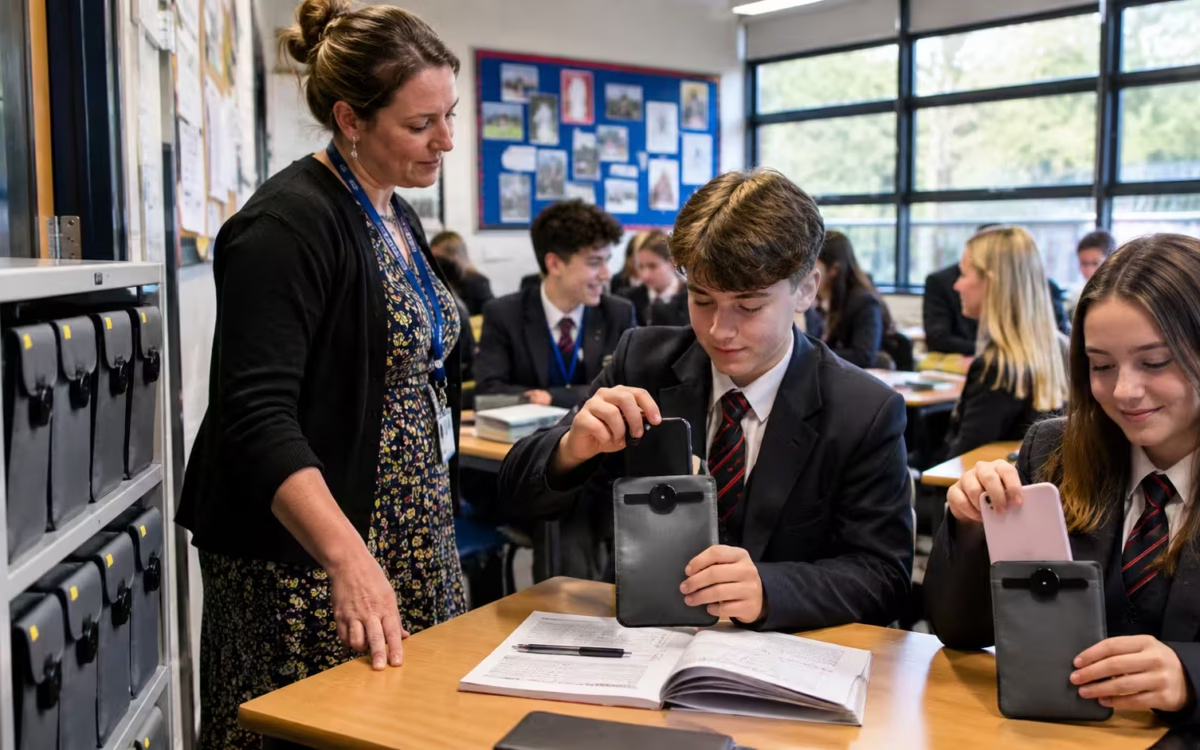
Table of Contents
Schools across England are facing tougher restrictions on mobile phone use after the Government announced plans to strengthen its existing policy, with new guidance expected from September 2027. Education experts have welcomed efforts to reduce classroom distractions but warned that enforcement costs, pupil wellbeing and practical challenges cannot be overlooked.
The Department for Education (DfE) has announced a fresh crackdown on mobile phone use in schools, calling for stronger measures to prevent pupils from accessing smartphones throughout the school day.
The announcement, made on 9 November and reported on 10 November 2026, represents a further shift in the Government’s approach to digital distractions. Ministers want schools to move beyond traditional policies that simply require pupils to keep phones out of sight.
Under the proposed changes, headteachers will be encouraged to introduce more effective restrictions, including lockable phone pouches, secure storage facilities and systems requiring pupils to hand in their devices before lessons begin.
Education Secretary Lucy Powell has made clear that smartphones should not interrupt classroom learning, calling for stronger action to establish genuinely phone-free school environments.
She said:
“Children should not be using smartphones at any point during the school day, full stop.”
The Government’s latest announcement follows growing concern about classroom disruption, social media distractions and the impact of excessive screen exposure on children’s education and wellbeing.
However, the revised guidance is expected to encourage stronger enforcement rather than impose a universal legal requirement for every school to purchase phone pouches or prohibit pupils from bringing devices onto school premises.
The changes are scheduled for September 2027, although schools are being encouraged to strengthen their arrangements sooner where possible.
Why Is the Government Tightening Mobile Phone Rules in Schools?
The latest decision follows the introduction of statutory mobile phone guidance in England, which became legally significant on 29 June 2026 and was expected to be followed by schools from 1 September.
Under the existing rules, schools should prohibit pupils from using mobile phones during lessons, between classes, at breaktimes and during lunch.
Headteachers retain discretion over how to implement those restrictions.
However, new Department for Education research suggests that having a written policy does not necessarily guarantee compliance.
A pupil survey carried out between June and July 2026 found that only around 16% of secondary school pupils believed mobile phone rules were followed all the time.
The results also highlighted substantial differences between age groups.
Among Key Stage 3 pupils, 23% reported that school phone rules were followed consistently. That figure fell to just 8% among Key Stage 4 pupils.
Another finding revealed that 41% of pupils in Years 7 to 13 reported lessons being interrupted by unauthorised mobile device use in at least some classes during the previous week.
Although this was an improvement on the 58% recorded in June 2025, the findings suggest mobile phones remain a persistent classroom management issue.
Separate Government research involving school leaders found that, in June 2026, approximately 70% of secondary school leaders reported operating policies that allowed pupils to bring phones into school provided they remained out of sight.
Only 21% reported arrangements requiring pupils to surrender their phones or store them somewhere inaccessible during the school day.
These findings help explain why ministers are now placing greater emphasis on practical enforcement rather than simply introducing additional written rules.
The Government believes removing direct access to smartphones could reduce opportunities for messaging, social media browsing, unauthorised recording and other activities that distract pupils from learning.
School Leaders Warn Tougher Restrictions Will Require Funding
While the Government’s proposals have received support from child welfare advocates, teaching organisations have raised concerns about implementation costs.
Schools introducing secure storage systems may need to purchase specialist equipment, establish collection procedures and allocate additional staff time to enforcing restrictions.
Paul Whiteman, general secretary of the National Association of Head Teachers (NAHT), warned that stronger enforcement would place further financial pressure on schools.
He said that moving beyond the existing approach “comes at a cost”, adding that schools adopting more robust measures would need additional funding and support.
Pepe Di’Iasio, general secretary of the Association of School and College Leaders (ASCL), also questioned whether schools could afford widespread investment in secure phone storage.
He warned:
“This is not feasible unless the Government puts in the funding required to meet these costs.”
The concerns are particularly relevant for large secondary schools accommodating hundreds or thousands of pupils, where a whole-school phone storage system may involve significant upfront expenditure and ongoing administrative responsibilities.
School leaders have also emphasised that institutions differ considerably in size, pupil needs and available resources.
A policy suitable for a small primary school may be difficult to replicate in a large urban secondary school with pupils arriving through multiple entrances.
The Government has not announced a dedicated funding package for the proposed phone storage measures.
What Are Experts Saying About the Impact of School Phone Bans?
Research into the effectiveness of smartphone restrictions presents a more complicated picture than the assumption that banning phones automatically improves educational outcomes.
A study published by the University of Birmingham in March 2026 examined the experiences of 177 pupils, parents and school staff across seven secondary schools operating different mobile phone policies.
Researchers identified advantages associated with restrictive policies, including greater opportunities for face-to-face interaction during the school day.
However, they also found unintended consequences.
Some pupils attending schools with restrictive policies reported spending additional time on smartphones after returning home, occasionally sacrificing sleep, homework or physical activity.
Professor Victoria Goodyear, chief investigator of the SMART Schools research project at the University of Birmingham, cautioned that restrictions alone cannot solve every problem associated with adolescent technology use.
She explained that:
“smartphone policies are not the silver bullet for addressing attainment, wellbeing or behaviour in schools.”
The findings suggest that smartphone restrictions may be more effective when combined with digital literacy education, parental engagement and wider support for children’s online wellbeing.
A separate study published by King’s College London in August 2026 examined the introduction of lockable smartphone pouches in Northern Ireland secondary schools.
The pilot involved nine schools, eight of which participated fully, and identified reductions in smartphone use alongside reported improvements in classroom behaviour and social interaction.
Nevertheless, researchers found that implementation difficulties, including damaged pouches, insufficient unlocking facilities and inconsistent enforcement, could undermine the effectiveness of the system.
Dr Nicky Kalk, an adjunct senior lecturer at King’s College London, highlighted the importance of carefully implementing restrictions and providing alternative educational technology where necessary.
The research indicates that while physical restrictions can reduce access to smartphones, their wider effects depend heavily on how schools introduce and manage them.
London Schools Are Already Testing Stronger Restrictions
Several schools across London have already introduced approaches resembling those now being encouraged nationally.
Chace Community School in Enfield adopted lockable Yondr pouches during the 2025–26 academic year, requiring pupils to secure their phones when arriving and unlock them at the end of the school day.
The approach allows pupils to retain possession of their devices while preventing access during lessons and breaks.
In June 2026, the school hosted education leaders and public representatives to demonstrate its phone-free arrangements.
Tanya Douglas, headteacher at Chace Community School, described the introduction of the system as transformational.
She reported that it had:
“created calmer corridors, more purposeful classrooms, and a greater sense of focus across the school day.”
According to the school’s reported experience, staff observed fewer conflicts related to phone confiscations, improved concentration and fewer disruptions associated with social media activity.
These outcomes represent the school’s own reported experience rather than proof that identical measures will produce the same results nationally.
Elsewhere in London, Lewisham’s education support service issued updated guidance in September 2026, reminding schools of their responsibilities under the statutory mobile phone policy.
The borough also developed a model policy for primary schools, including arrangements for storing devices and making reasonable adjustments for individual pupils.
These examples suggest that London schools are approaching the issue through a combination of stronger restrictions, locally developed procedures and safeguarding considerations.

What Will the New Rules Mean for Parents and Pupils?
For families, the proposed changes could affect how children use and access their mobile phones between arriving at school and leaving at the end of the day.
However, the announcement does not mean every child in England will be prohibited from owning a smartphone or carrying one on the journey to school.
Schools will continue to determine the most appropriate method of enforcement, taking account of their circumstances and legal responsibilities.
Under the current statutory guidance, exceptions and reasonable adjustments may be necessary for pupils with disabilities, medical requirements or other individual needs.
For example, a pupil who uses a connected device for glucose monitoring may require access during the school day.
Schools may also need to consider the circumstances of young carers and pupils who depend on assistive technology.
Sixth-form students can be subject to different arrangements, including limited access in designated areas, provided those arrangements do not undermine restrictions for younger pupils.
Parents concerned about emergency contact arrangements are generally expected to communicate through the school office rather than contact their children directly during lessons.
Schools adopting secure phone storage can also return devices at the end of the day, allowing pupils to use them while travelling home.
The Department for Education expects schools to communicate their rules clearly to parents and pupils and ensure that staff apply them consistently.
Ofsted is also expected to consider schools’ mobile phone policies and their implementation during inspections.
The wider policy discussion is extending beyond personal smartphones.
The Government has announced plans to consult on independent safety certification for educational technology, raising further questions about how schools assess the digital tools used in classrooms.
This distinction is important: restricting personal smartphone use does not automatically mean eliminating laptops, tablets or other educational technologies used for legitimate learning.
With tougher guidance expected in September 2027, the debate over mobile phone use in schools is increasingly shifting from whether restrictions are necessary to how schools can enforce them fairly, affordably and effectively.
The challenge for ministers and education leaders will be ensuring that stricter rules reduce distractions without creating additional financial burdens or overlooking pupils who depend on technology for legitimate reasons.
About the Journalist
Jermaines covers crime, legal affairs and money-related stories for Londoner. His reporting includes police updates, court cases, consumer rights, personal finance and cost-of-living issues. He handles sensitive subjects carefully and clearly distinguishes confirmed facts from allegations, estimates and ongoing investigations.