Lewis Graham Kirkcudbright Business Success: Young Entrepreneur Builds Three Ventures And Wins Major Award
 Published By
Adam
Published:

Table of Contents
A 27-year-old entrepreneur is making a name for himself in Scotland’s hospitality industry after building three businesses in the small harbour town of Kirkcudbright, creating local employment opportunities and earning recognition at one of the region’s leading tourism awards.
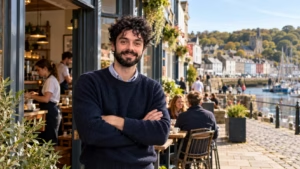
Lewis Graham, widely known as Lewie, has attracted attention for his growing business portfolio, which includes Feast Café, coffee-roasting brand Kirk-Coo-Brew and Italian restaurant Portobello.
Together with business partner Robyn Goodare, Graham has established a hospitality operation employing up to 20 people, demonstrating how independent businesses can develop beyond Scotland’s major cities.
His achievements were recognised when he won the Rising Star Award at the 2026 South of Scotland Thistle Awards, held at Peebles Hydro on 8 October.
The recognition has brought renewed attention to Kirkcudbright’s business community and the opportunities available to young entrepreneurs willing to invest in rural areas.
Originally from Herefordshire, Graham has discovered that the quieter pace of life in Dumfries and Galloway comes with commercial opportunities that may be more difficult to access in expensive urban locations.
Speaking in an interview published on 25 October, he explained that comparatively affordable operating costs had helped make his business ambitions achievable.
“Opportunity here is really good because the costs are fairly low,” Graham said.
His story highlights an increasingly important question for Britain’s hospitality sector: whether smaller towns can provide a more accessible starting point for entrepreneurs than established city-centre markets.
From One Kirkcudbright Café to Three Hospitality Businesses
Graham’s business journey began with Feast Café, which he and Goodare took over in January 2024.
The café, located on St Cuthbert Street, specialises in Mediterranean-inspired home cooking, with vegetarian and vegan dishes forming an important part of its offering.
Rather than immediately expanding into multiple premises, the pair concentrated on developing their existing operation and identifying opportunities to introduce complementary products.
That approach eventually led to Kirk-Coo-Brew, a coffee-roasting brand created to bring locally roasted coffee to customers in southwest Scotland.
According to a business case study published by Business Gateway in April 2025, the entrepreneurs experimented with different coffee beans and roasting methods before launching the brand.
The business sources beans from fair trade cooperatives and aims to make freshly roasted coffee accessible to customers in the surrounding region.
The new venture also received support through Business Gateway, which introduced the entrepreneurs to an adviser and directed them towards the Enterprise Seed Fund 2024.
The funding programme offered early-stage businesses access to financial support of up to £3,000. The pair used funding towards start-up costs, particularly the equipment needed for roasting coffee.
Goodare previously described the experience as an opportunity to introduce fresh ideas while preserving the character of the original café.
“We have loved getting to bring Kirk-Coo-Brew to our cafe,” she said in the Business Gateway case study.
The development of the coffee brand created another potential revenue stream, with customers able to enjoy the product at Feast or purchase coffee to prepare at home.
Their business portfolio subsequently expanded to include Portobello, an Italian restaurant situated close to the café.
The three ventures now provide different customer experiences while remaining geographically close enough for the owners to supervise operations and support their teams.
For independent hospitality operators, this model offers a practical example of diversification without spreading management resources across distant locations.
It also creates opportunities for shared local knowledge, customer relationships, and operational experience, although the financial performance of the individual businesses has not been publicly disclosed.
Lewis Graham’s Business Growth Highlights Rural Scotland’s Opportunities and Challenges
Despite his success, Graham has acknowledged that operating businesses in Kirkcudbright presents difficulties that entrepreneurs in larger cities may not encounter to the same extent.
One significant challenge is recruitment.
In his recent interview, Graham discussed the difficulties of finding a suitable chef for Portobello, explaining that personal recommendations were crucial to completing the recruitment process.
Although he eventually identified someone for the position, the experience demonstrated how smaller labour markets can complicate business expansion.
Businesses in rural communities often have a more limited pool of applicants to draw upon, particularly when recruiting experienced hospitality workers for specialist positions.
Seasonal demand is another consideration.
Kirkcudbright attracts visitors through its coastal setting, cultural attractions and established reputation as an artists’ town. However, the quieter winter months can create uncertainty for businesses that benefit from tourism.
Graham has acknowledged that winter trading conditions can be challenging, even as the town offers lifestyle advantages and comparatively accessible business opportunities.
For the entrepreneur, the benefits of operating in rural Scotland appear to outweigh these difficulties.
His assessment is that launching similar ventures in Edinburgh or parts of England would require substantially greater investment.
That view reflects his personal experience rather than a verified comparison of commercial property costs across the UK.
Nevertheless, the underlying business consideration is significant. Entrepreneurs must balance rental costs, equipment investment, staffing requirements and customer demand when selecting a location.
Lower premises costs can reduce the financial barriers to entry, but a smaller customer base and seasonal fluctuations can introduce different risks.
Graham’s experience also illustrates the importance of retaining employees.
He has said that full-time staff have remained with the business throughout their current period of ownership, with departures largely associated with education.
For smaller hospitality employers, experienced employees can provide operational continuity and help maintain customer relationships.
The entrepreneur has indicated that further expansion is not an immediate priority.
His business partner has encouraged a pause in growth, and any additional venture would need to remain close to the existing operations and workforce.
Such caution suggests that the next phase of development may focus more on consolidating the businesses than increasing their number.
The approach is particularly relevant in hospitality, where rapid expansion can increase staffing pressures, management complexity and operational costs.
Tourism Leaders Recognise Graham’s Contribution to the Local Economy
Graham’s Rising Star Award was presented as part of the South of Scotland Thistle Awards, which celebrated 40 finalists across 15 categories in 2026.
The awards recognise businesses and individuals contributing to the visitor economy across Dumfries and Galloway and the Scottish Borders.
Following his victory, Graham expressed appreciation for the people who had contributed to his achievements, ending his official winners’ statement with an enthusiastic message:
“Scotland is open for business!”
His recognition comes at a time when tourism organisations are emphasising the importance of local enterprise, employment and innovation to the region’s wider economy.
David Hope-Jones OBE, Chief Executive of the South of Scotland Destination Alliance, praised the efforts of businesses and individuals recognised at the awards.
He highlighted the commitment behind successful tourism ventures, describing the people involved as “brilliant people working incredibly hard”.
His comments underline the broader economic contribution of businesses that provide hospitality services while supporting employment and encouraging visitors to spend in local communities.
Russel Griggs, Chair of South of Scotland Enterprise, similarly emphasised the importance of the region’s tourism and hospitality sector.
He identified its economic contribution as including “creating jobs, supporting communities and attracting investment”.
These observations provide an important context for Graham’s achievements.
Although a workforce of up to 20 employees might be relatively modest in a major city, it can represent a meaningful source of employment in a smaller town.
Independent hospitality businesses can also support other parts of a local economy through purchases from suppliers, customer spending and partnerships with neighbouring enterprises.
Graham’s coffee-roasting venture, for example, was developed partly with the ambition of supplying other businesses in the area.
Such commercial relationships could help local companies develop additional opportunities, although the scale of Kirk-Coo-Brew’s wholesale activity has not been publicly confirmed.
The South of Scotland Thistle Awards also offer winners opportunities for wider recognition, with regional award recipients progressing to the national Scottish Thistle Awards finals in November 2026.
For Graham, the next stage could therefore bring greater visibility beyond Kirkcudbright and Dumfries and Galloway.
His success also offers a broader illustration of what smaller communities can provide for entrepreneurs.
The appeal is not simply lower operating costs. The opportunity to build customer relationships, develop complementary businesses and retain a close connection with employees can influence whether an independent venture succeeds.
At the same time, Graham’s experience shows that rural entrepreneurship requires careful planning.
Recruitment difficulties, seasonal customer demand and limited local markets remain genuine commercial considerations.
The achievements of Graham and Goodare demonstrate how business development can take different forms outside Britain’s major economic centres.
Starting with an established café, introducing a locally roasted coffee brand and expanding into restaurant operations has allowed the partners to build a recognisable presence in Kirkcudbright.
Their experience does not guarantee that the same model would work in every rural community. But it provides an example of how entrepreneurs can identify opportunities within a particular location and develop them gradually.
For now, Graham’s focus remains on the businesses and employees already under his care.
Having secured regional recognition at just 27, he has positioned himself among the South of Scotland’s emerging hospitality entrepreneurs.
And with national tourism awards approaching, the Kirkcudbright businessman may soon receive attention from an even wider audience.
About the Journalist
Adam reports on London news, events and local developments. His coverage includes festivals, exhibitions, public announcements, community stories and important updates affecting people across the city. He aims to provide timely and accessible reporting on what is happening in London.