IMF Warning on UK Tax System: Britain Faces Growing Tax Crisis Ahead of Budget
 Published By
Jermaine
Published:
Updated:

Table of Contents
Published: 26 October 2026 | UK Economy & Finance News
The International Monetary Fund (IMF) has issued a significant warning over Britain’s increasingly stretched tax system, raising concerns that further tax increases could damage economic growth, discourage investment and put additional pressure on households and businesses.
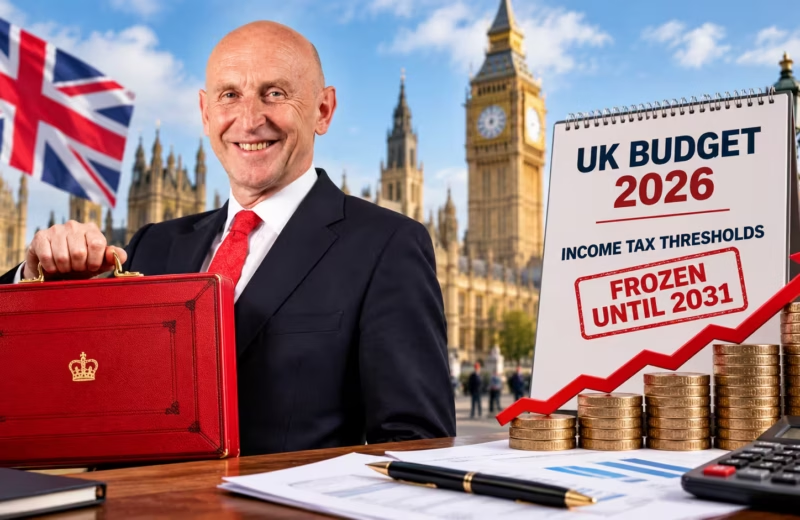
The warning comes just days before Chancellor John Healey delivers his first Autumn Budget on 28 October 2026, with the government facing difficult decisions over public spending, borrowing and how to generate additional revenue without weakening the economy.
The IMF believes Britain’s tax burden is approaching historically high levels, leaving policymakers with increasingly limited opportunities to raise substantial additional revenue through conventional tax increases.
Its assessment has intensified the debate over whether the UK needs fundamental tax reform rather than another round of increases affecting workers, businesses and investors.
Economists have also highlighted growing concerns about the complexity of Britain’s tax arrangements, including frozen income tax thresholds, property taxation, National Insurance contributions and the treatment of capital gains.
The central question facing the Treasury is no longer simply how much additional tax the government can collect, but whether the current system can raise that money without undermining the economic activity needed to fund public services.
IMF Warns Britain Is Running Out of Room for Higher Taxes
The IMF’s latest intervention follows its July 2026 assessment of the UK economy, which warned that the country’s capacity to raise more revenue was increasingly constrained.
According to the organisation, Britain’s tax system already places considerable pressure on several important sources of revenue.
During the IMF’s annual meetings in Bangkok on 16 October, Helge Berger, deputy director of its European Department, cautioned against further increases in taxes on employment.
“We would not recommend increasing labour taxes,” Berger told reporters.
He suggested that reforming property taxation and broadening the VAT base could offer more economically sustainable alternatives.
The IMF also highlighted that government tax receipts are equivalent to approximately 40% of Britain’s gross domestic product, a historically high level for the country.
That figure does not mean individuals pay a flat 40% tax rate. Instead, it represents the overall value of tax revenue compared with the size of the UK economy.
The distinction is important because the IMF’s concerns extend beyond headline tax rates. Its analysis suggests the structure of taxation can influence whether businesses invest, employees work additional hours and households make major financial decisions.
The organisation has warned that further increases in labour taxation could eventually produce diminishing economic benefits as workers and employers adjust their behaviour.
For businesses, that could mean reduced recruitment, delayed expansion or lower investment. For individual taxpayers, unusually high effective marginal tax rates can make additional earnings less financially attractive.
These concerns arrive when Britain is already struggling with weak productivity growth, rising public spending commitments and pressure to improve living standards.
The IMF’s July report also estimated that ageing, defence commitments and the transition towards a lower-carbon economy could increase public spending pressures by around seven percentage points of GDP by 2050.
Meeting those long-term costs entirely through higher taxes, the organisation warned, could weaken growth unless accompanied by fundamental reform.
Could Britain’s Tax System Face Major Changes?
One of the most significant proposals discussed by the IMF involves reforming Council Tax.
The organisation has previously suggested replacing the existing arrangements with a recurrent property tax based on updated property valuations.
Supporters argue that such a system could more accurately reflect differences in property values and address some of the inequalities associated with outdated Council Tax bands.
However, any reform could produce both winners and losers.
Households occupying high-value properties could face increased liabilities under certain designs, while others might benefit from lower bills. The final impact would depend on the tax rates, exemptions, reliefs and transitional protections introduced.
The IMF has also identified VAT as an area where the government could consider broadening the tax base.
Rather than necessarily increasing the standard 20% VAT rate, policymakers could examine existing exemptions and reduced-rate categories to identify opportunities to generate additional revenue.
Such proposals would be politically sensitive, particularly if they increased household spending on essential goods or services.
Another area highlighted in the IMF’s assessment is Capital Gains Tax, with the organisation suggesting that its treatment could be brought closer to income taxation.
However, the government has not announced that these specific IMF proposals will be adopted in the October Budget.
The distinction between an international economic recommendation and an actual government policy decision remains essential.
Helen Miller, director of the Institute for Fiscal Studies (IFS), has similarly argued that policymakers should pay greater attention to how the tax system is designed.
In an interview published by Tax Journal on 14 October, Miller said:
“But the tax base – the definition of what is actually being taxed – is at least as important.”
Miller also criticised Stamp Duty Land Tax, arguing that taxing property transactions can discourage people from moving home or relocating for employment.
She suggested that reforming Council Tax using more up-to-date property valuations could provide a more effective approach to raising revenue.
These arguments reflect a wider debate among economists about whether Britain should prioritise improving the efficiency of existing taxes rather than continually introducing additional levies.
The problem is that meaningful reform often creates immediate political opposition, even when economists believe it could improve economic performance over the longer term.
Meanwhile, Britain’s frozen income tax thresholds remain another concern.
As wages increase while allowances remain unchanged, more employees can move into higher tax bands without any corresponding increase in the headline rates of income tax.
This process, commonly described as fiscal drag, can increase the effective tax burden on households over time.
The system also contains sharp marginal tax increases around certain income thresholds, particularly where allowances or benefits are withdrawn.
For higher-earning employees, those arrangements can weaken incentives to accept additional work or promotions.
Tax policy expert Dan Neidle has raised similar concerns about the complexity and instability of the British system.
Writing in City AM earlier in October, Neidle argued that complicated taxation can discourage investment and interfere with business decisions.
“Businesses can cope with taxes they dislike,” he observed.
His wider argument was that companies find it substantially harder to plan when tax rules are constantly changing or when future government decisions become unpredictable.
That issue is particularly relevant for businesses considering long-term investment, hiring additional employees or expanding operations.
For London, where financial services, technology businesses and professional firms contribute significantly to economic activity, predictable taxation is an important factor in maintaining international competitiveness.
Bank Tax Proposals Add Pressure Ahead of Budget

The IMF’s warning has also complicated the government’s consideration of higher taxes on banks.
Reports suggest Chancellor John Healey has been examining a possible increase in the corporation tax surcharge paid by banking institutions.
One reported option involves raising the surcharge from 3% to 8%, although no final decision has been confirmed.
The banking sector already contributes significant corporation tax revenue, and industry representatives have argued that further increases could undermine Britain’s appeal as a global financial centre.
Rain Newton-Smith, chief executive of the Confederation of British Industry (CBI), warned against imposing additional financial burdens on the sector.
“Adding to that would be an own goal for our competitiveness,” Newton-Smith said in remarks issued ahead of the Budget.
The CBI has argued that London’s financial services industry supports economic activity across the country, including hundreds of thousands of jobs outside the capital.
Its concern is that higher sector-specific taxes could discourage investment and ultimately affect wider employment and business growth.
The IMF has not ruled out taxing banks more heavily, but it has suggested that other fiscal measures should receive greater priority.
This creates a difficult balance for the Chancellor.
Increasing taxes on profitable financial institutions could provide additional government revenue and help finance public priorities. However, there are also potential consequences for lending, business investment and Britain’s competitive position.
The outcome will depend on the precise measures announced and how financial institutions respond.
The government must also consider the consequences of reducing spending instead of raising taxes.
The Institute for Fiscal Studies has warned that the Chancellor faces substantial pressure from inflation, debt servicing costs and existing spending commitments.
In its October 2026 Green Budget analysis, the IFS explained that even if the government continues to meet its formal fiscal rules, higher inflation could substantially reduce the real value of departmental budgets.
Without additional funding or spending adjustments, this could mean difficult decisions affecting the delivery of public services.
The challenge therefore extends beyond taxation alone.
It involves balancing the government’s responsibility to fund essential services against the need to encourage investment, protect employment and maintain sustainable public finances.
Chancellor Healey has defended the government’s commitment to fiscal discipline, arguing that economic stability is necessary to provide greater security for households and businesses.
During the IMF meetings earlier this month, he said:
“Fiscal discipline is the foundation for supporting families and businesses today, and building hope for the future.”
The Treasury has also emphasised improving public sector productivity and controlling government costs as part of its wider economic approach.
Those commitments will face scrutiny when the Chancellor outlines his Budget.
For ordinary taxpayers, the IMF warning does not mean an immediate increase in Income Tax, National Insurance, VAT or Council Tax.
Instead, it signals growing concern that Britain’s existing tax framework may struggle to meet future spending demands without more substantial changes.
For employers and small businesses, the debate could influence future decisions about corporation tax, business rates, recruitment costs and investment incentives.
Property owners may also be watching closely for any indication that the government intends to revisit Council Tax arrangements or other property-related charges.
However, households should distinguish between proposals being discussed by economists and changes formally announced by the Treasury.
The October Budget will determine whether the government chooses immediate revenue-raising measures, spending restraint, structural tax reform or a combination of those approaches.
With economic growth still vulnerable to international uncertainty, the IMF’s message is particularly significant: increasing taxation cannot be treated as a limitless solution to Britain’s fiscal challenges.
The organisation’s broader analysis suggests that a sustainable response requires more efficient taxation, stronger productivity and credible spending decisions.
As the 28 October Budget approaches, pressure is mounting on the Chancellor to demonstrate that Britain can repair its finances without imposing additional economic costs that ultimately weaken growth.
For now, the IMF warning has brought renewed attention to a difficult question facing the government: how can Britain fund its future without making its tax system an increasing obstacle to economic growth?
About the Journalist
Jermaines covers crime, legal affairs and money-related stories for Londoner. His reporting includes police updates, court cases, consumer rights, personal finance and cost-of-living issues. He handles sensitive subjects carefully and clearly distinguishes confirmed facts from allegations, estimates and ongoing investigations.