My Child Gets DLA, What Else Am I Entitled To? UK Support in 2026/27
 Published By
Jermaine
Published By
Jermaine
Published:
Updated:

Table of Contents
If your child receives Disability Living Allowance, the DLA payment may not be the only financial support available to your family. A DLA award can increase certain means-tested benefits and may also open access to help with caring, transport, childcare, Council Tax and home adaptations.
For 2026/27, Child DLA can be worth between £30.30 and £194.60 per week, depending on the care and mobility components awarded. DLA is tax-free and is not affected by the parents’ income or savings.
However, much of the additional support is not awarded automatically. Parents may need to report the DLA decision to Universal Credit, apply separately for Carer’s Allowance or contact their local council. What a family can receive depends on the DLA rate, the care provided and the household’s wider circumstances.
What Extra Benefits Can I Get If My Child Receives DLA?
One of the first benefits parents should check is Universal Credit.
If a household already receives Universal Credit and a child is awarded DLA, the claim may include an additional disabled child amount.
For 2026/27, the lower disabled child addition is £164.79 per month, while the higher disabled child addition is £514.71 per month.
The higher amount generally applies when a child receives the highest rate of the DLA care component. Children receiving another qualifying DLA rate will usually attract the lower amount.
This payment is separate from the ordinary Universal Credit child element.
Parents should report the DLA award through their Universal Credit account as soon as the decision is received. It is important not to assume that Universal Credit will update automatically simply because DLA has been awarded.
Where DLA has been backdated, the disabled child addition may also be due from an earlier Universal Credit assessment period. This can matter when the DLA decision has taken several weeks or months.
Families that do not currently receive Universal Credit may also want to check whether they qualify. Entitlement depends on household earnings, savings, rent, childcare costs and family circumstances.
DLA itself is generally ignored as income when Universal Credit is calculated, so receiving it does not simply reduce Universal Credit pound for pound.
Can I Claim Carer’s Allowance If My Child Gets DLA?
A parent or another person who provides substantial care for a disabled child may be able to claim Carer’s Allowance.
The child generally needs to receive either the middle or highest rate of the DLA care component. The person claiming must usually provide at least 35 hours of care each week.
Caring can include helping with washing, dressing, eating, medication, supervision, communication, medical appointments and keeping the child safe.
For 2026/27, Carer’s Allowance is £86.45 per week. Parents who work may still qualify, although earnings generally need to be £204 per week or less after permitted deductions.
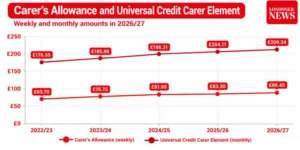
Households receiving Universal Credit should also check the carer element.
For 2026/27, it is worth £209.34 per month and can normally be included where someone provides at least 35 hours of care per week for a person receiving a qualifying disability benefit.
Some families can therefore receive both a disabled child addition and a carer element within the same Universal Credit award.
However, Carer’s Allowance is normally counted as income for Universal Credit. Universal Credit is usually reduced by an equivalent amount, so the two payments are not simply added together in full.
Carer’s Allowance still provides Class 1 National Insurance credits, which can help protect the carer’s contribution record.
Parents who cannot receive Carer’s Allowance should also check Carer’s Credit. It does not provide a cash payment but can help protect National Insurance entitlement for people providing regular care.
What Transport, Council Tax and Housing Help Can My Child Get?
DLA can also unlock support outside the main benefits system.
Children aged three or over who receive the higher rate mobility component of DLA may qualify for the Motability Scheme.
The qualifying mobility payment can be used towards leasing a car, wheelchair accessible vehicle, powered wheelchair or mobility scooter.
Higher-rate mobility DLA can also give access to vehicle tax exemption for an eligible vehicle used for the disabled child’s needs.
Parents should also check Blue Badge eligibility. In England, a child aged three or over who receives the higher-rate mobility component of DLA can normally qualify for a Blue Badge without the full discretionary assessment.
A Blue Badge can make it easier to park closer to hospitals, schools, shops and other destinations, although local parking rules still apply. London families should also check whether their borough provides additional transport concessions.
Council Tax is another area worth reviewing. A child receiving DLA does not automatically mean the household gets a discount.
However, the Disabled Band Reduction Scheme may apply where the home contains specific features needed because of the child’s disability.
Examples include an additional bathroom, kitchen or room mainly required because of the disability, or extra indoor space needed for wheelchair use.
Where the conditions are met, Council Tax can usually be charged as though the property were in the band immediately below its actual band. Homes already in Band A can receive a reduction instead.
Families who need major changes to their home should also investigate a Disabled Facilities Grant.
In England, this can provide up to £30,000 towards eligible adaptations such as ramps, accessible bathrooms, wider doorways or other essential changes.
Where the application is for a disabled child under 18, the parents’ income is not normally included in the standard means test.
What Childcare and Other Support Should Parents Check?
Childcare can be more expensive for families raising a disabled child, particularly where specialist support is needed.
Eligible working parents may be able to use Tax-Free Childcare. For most children, the maximum government contribution is £2,000 per year. For a disabled child, this can increase to up to £4,000 per year.
Tax-Free Childcare can generally remain available until the September after a disabled child turns 16, provided the other conditions are met.
However, Tax-Free Childcare cannot normally be received at the same time as Universal Credit childcare support. Families receiving Universal Credit should compare both options before changing how they pay for childcare.
Local councils may also provide specialist childcare, short breaks, respite support, holiday activities and other services through children’s disability teams.
Parents should check their council’s Local Offer, which brings together information about services for children and young people with special educational needs or disabilities.
Some families may also qualify for charitable grants for items such as specialist beds, sensory equipment, computers, clothing, mobility equipment or family breaks.
After a DLA award, parents should carry out a wider benefits check rather than viewing DLA as a standalone payment.
Check exactly which care and mobility components have been awarded and the date the award begins. If the household receives Universal Credit, report the DLA award and check the disabled child addition and carer element.
If your child receives the middle or highest care rate, check Carer’s Allowance. If the higher mobility rate has been awarded, look at Motability, vehicle tax exemption and Blue Badge eligibility.
Parents should also contact their local authority where relevant to check Council Tax help, Disabled Facilities Grants, specialist childcare and short-break services.
Keep the DLA award letter safely because departments, councils and other organisations may ask for evidence of entitlement.
Review these benefits again if the child’s DLA award changes, as a different care or mobility rate can alter what additional support is available.
About the Journalist
Jermaines covers crime, legal affairs and money-related stories for Londoner. His reporting includes police updates, court cases, consumer rights, personal finance and cost-of-living issues. He handles sensitive subjects carefully and clearly distinguishes confirmed facts from allegations, estimates and ongoing investigations.