List Of Tax Codes And What They Mean: UK PAYE Guide For 2026/27
 Published By
Henry
Published By
Henry
Published:
Updated:

Table of Contents
A tax code can look like a random combination of numbers and letters on a payslip, but it plays an important role in determining how much Income Tax an employer or pension provider deducts.
For millions of workers and pensioners, the most familiar code is 1257L. However, codes such as BR, D0, D1, 0T, K, M, N, NT, SBR and CBR can also appear depending on a person’s income, location and circumstances.
For the 2026/27 tax year, running from 6 April 2026 to 5 April 2027, the standard Personal Allowance remains £12,570. HMRC also confirms that 1257L continues to be the code used for most people with one job or pension.
Below is a detailed list of tax codes and what they mean, including the codes London workers are most likely to encounter.
What Is a Tax Code?
A tax code tells an employer or pension provider how much Income Tax should normally be deducted through PAYE.
HM Revenue and Customs (HMRC) determines the code and sends it to the employer or pension provider. People with more than one employment or pension can have a separate tax code for each source of PAYE income.
A typical tax code contains:
- A number, such as 1257
- A letter, such as L
The number generally indicates how much tax-free income is allocated to that employment or pension, while the letter explains the taxpayer’s circumstances or the way the allowance should be applied.
What Does the Number in a Tax Code Mean?
For ordinary tax codes, the number can usually be multiplied by 10 to give an approximate indication of the amount of tax-free income allocated through that code.
For example:
1257 × 10 = £12,570
Therefore, the tax code 1257L normally gives an employee £12,570 of tax-free income through that employment before Income Tax starts being deducted.
HMRC may reduce the number where it needs to account for untaxed income, taxable employment benefits or certain other amounts through PAYE.
For example, HMRC gives the case of somebody entitled to a £12,570 Personal Allowance who receives £1,570 of taxable medical insurance. After deducting the benefit, £11,000 remains as the tax-free amount, potentially resulting in a code of 1100L.
A lower number therefore does not automatically mean an error. It can reflect adjustments HMRC has made to the person’s tax position.
List of Common UK Tax Codes and What They Mean
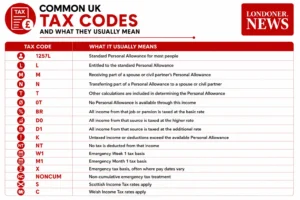
Here is a quick reference table for the main PAYE codes.
| Tax Code | What It Usually Means |
| 1257L | Standard Personal Allowance for most people |
| L | Entitled to the standard Personal Allowance |
| M | Receiving part of a spouse or civil partner’s Personal Allowance |
| N | Transferring part of a Personal Allowance to a spouse or civil partner |
| T | Other calculations are included in determining the Personal Allowance |
| 0T | No Personal Allowance is available through this income |
| BR | All income from that job or pension is taxed at the basic rate |
| D0 | All income from that source is taxed at the higher rate |
| D1 | All income from that source is taxed at the additional rate |
| K | Untaxed income or deductions exceed the available Personal Allowance |
| NT | No tax is deducted from that income |
| W1 | Emergency Week 1 tax basis |
| M1 | Emergency Month 1 tax basis |
| X | Emergency tax basis, often where pay dates vary |
| NONCUM | Non-cumulative emergency tax treatment |
| S | Scottish Income Tax rates apply |
| C | Welsh Income Tax rates apply |
HMRC provides these definitions as part of its current PAYE tax-code guidance.
What Does Tax Code 1257L Mean?
1257L is the standard tax code for many employees and pensioners.
The number 1257 corresponds to the standard £12,570 Personal Allowance, while the letter L means the taxpayer is entitled to the standard Personal Allowance.
For the 2026/27 tax year, the Personal Allowance remains £12,570.
Someone earning £35,000 a year with a straightforward 1257L code would therefore normally have £12,570 covered by their Personal Allowance, with Income Tax calculated on the remaining taxable income.
However, having 1257L does not mean a person pays no tax unless their total taxable income stays within the allowance.
For most London employees with one straightforward PAYE job and no significant adjustments, 1257L is likely to be the code they recognise on their payslip.
What Does an L Tax Code Mean?
The letter L means the taxpayer is entitled to the standard tax-free Personal Allowance.
Examples might include:
- 1257L
- 1100L
- 900L
The number can differ if HMRC has adjusted the amount of allowance allocated to the employment.
For example, someone could still have an L code but have a number below 1257 because HMRC is accounting for a taxable benefit or another adjustment.
What Does Tax Code BR Mean?
BR means Basic Rate.
Under a BR code, all income from that particular job or pension is taxed at the basic rate, with no Personal Allowance allocated to it.
BR is often used for a second job or pension where a person’s Personal Allowance has already been allocated to their main income.
For England and Northern Ireland, the basic Income Tax rate is 20% in 2026/27.
For example, someone may have:
| Income | Possible Tax Code |
| Main job | 1257L |
| Second job | BR |
This does not necessarily mean the second-job tax code is wrong. It may simply prevent the employee from receiving the Personal Allowance twice.
However, someone with substantial total income may need a different code if taxing all of the second income at 20% would leave them underpaying tax.
What Does Tax Code D0 Mean?
D0 means all income from that employment or pension is taxed at the higher rate.
For England and Northern Ireland, the higher rate is 40% in 2026/27.
D0 is commonly associated with additional jobs or pensions where HMRC expects the taxpayer’s income from that particular source to fall within the higher-rate band.
Unlike an ordinary numbered code, D0 does not allocate a Personal Allowance to that income source.
What Does Tax Code D1 Mean?
D1 means all income from that particular job or pension is taxed at the additional rate.
For England and Northern Ireland, the additional Income Tax rate is 45% for the 2026/27 tax year.
It can be used for an additional employment or pension where HMRC expects the income to be taxable at the additional rate.
Again, D1 relates to the treatment of that particular PAYE source rather than necessarily describing the taxpayer’s entire tax position.
What Does Tax Code 0T Mean?
A 0T tax code means there is no Personal Allowance available against that particular employment or pension.
HMRC says 0T can be used where:
- A person’s Personal Allowance has been used up
- An employee starts a job without providing enough information for the employer to determine the correct tax code
Unlike BR, which taxes everything at the basic rate, 0T allows the normal tax bands to apply without giving a Personal Allowance.
This distinction can become important for higher earners.
Why Might a High Earner Have a 0T Code?
The standard Personal Allowance is gradually withdrawn once adjusted net income exceeds £100,000.
For every £2 of adjusted net income above £100,000, the Personal Allowance falls by £1. It becomes zero when adjusted net income reaches £125,140.
Consequently, a high earner may legitimately have no Personal Allowance.
A 0T code should therefore not automatically be interpreted as an emergency or an HMRC mistake.
What Does a K Tax Code Mean?
A K code works differently from most other tax codes.
HMRC uses K codes where amounts that need to be taken into account through PAYE are greater than the person’s available Personal Allowance.
This can happen where there is significant:
- Untaxed income
- State Pension income
- Taxable employment benefits
- Tax owed from an earlier period
Instead of giving additional tax-free income, a K code effectively increases the amount of income treated as taxable for PAYE purposes.
For example, HMRC explains that K475 can result in £4,750 being added to taxable income when PAYE is calculated.
There is, however, an important protection: tax deducted through a K code cannot normally exceed 50% of the employee’s pre-tax pay or pension for that pay period.
Anyone seeing an unexpected K code should check HMRC’s calculation carefully because it often indicates that substantial adjustments are being collected through PAYE.
What Does Tax Code M Mean?
An M tax code relates to Marriage Allowance.
It means the taxpayer has received a transfer of 10% of their spouse or civil partner’s Personal Allowance.
Their available allowance can consequently be higher than the ordinary amount.
HMRC’s coding number will reflect the allowance available after the transfer and any other adjustments.
What Does Tax Code N Mean?
An N code is essentially the opposite of an M code.
It indicates that the taxpayer has transferred 10% of their Personal Allowance to an eligible spouse or civil partner through Marriage Allowance.
Their own tax-free allowance is therefore reduced.
What Does Tax Code T Mean?
A tax code ending in T means HMRC has included other calculations when working out the taxpayer’s Personal Allowance.
For example, a person might see a code such as:
800T
The presence of T does not by itself mean anything is wrong. It indicates that HMRC’s calculation involves circumstances that differ from a straightforward standard Personal Allowance code.
Anyone unsure about the adjustment can inspect their tax-code calculation through HMRC’s online services.
What Does Tax Code NT Mean?
NT means No Tax.
Where NT applies, no Income Tax is deducted from the income covered by that code.
NT is not the same as receiving the normal Personal Allowance. It is a special tax treatment and should only normally appear where HMRC has instructed an employer or pension provider to use it.
Workers should not assume they qualify for an NT code simply because their annual earnings are below £12,570.
What Are Emergency Tax Codes?
Emergency tax codes are commonly encountered after starting a new job, particularly when an employer or HMRC does not yet have complete information about previous income.
For 2026/27, the emergency code is based on 1257L.
It can appear as:
- 1257L W1
- 1257L M1
- 1257L X
HMRC confirms these as the emergency codes applying from 6 April 2026.
Some payroll systems may instead display NONCUM, meaning non-cumulative.
What Does W1 Mean?
W1 stands for Week 1.
Instead of considering earnings and tax paid earlier in the tax year, PAYE is calculated using only the current week’s pay.
What Does M1 Mean?
M1 stands for Month 1.
It operates on the same principle as W1 but is used for monthly payroll.
Tax is calculated using the current month’s earnings without fully taking earlier pay and tax for the year into account.
What Does X Mean?
An X suffix is also an emergency tax code marker and can be used where pay dates vary.
Is 1257L Always an Emergency Tax Code?
No.
This is an important distinction.
1257L on its own is not an emergency tax code.
It becomes an emergency code when accompanied by W1, M1 or X, or where the payroll system shows equivalent non-cumulative treatment.
Why Can Emergency Tax Make Someone Pay Too Much?
PAYE normally looks at a taxpayer’s cumulative income and tax position during the tax year.
An emergency code instead calculates tax primarily using the current pay period.
For someone receiving an unusually large first salary payment, bonus or irregular payment, this can lead to more or less tax being deducted than ultimately proves necessary.
This does not always mean the money has been permanently lost. Once HMRC has sufficient information, the tax position can be corrected.
What Do Scottish Tax Codes Mean?
Scottish taxpayers normally have an S prefix on their PAYE tax code because Scotland has its own Income Tax bands and rates for non-savings, non-dividend income.
Examples include:
| Scottish Code | Meaning |
| S1257L | Scottish taxpayer with an allowance represented by 1257L |
| S0T | No Personal Allowance through that income |
| SBR | All income from the source taxed at Scottish basic rate |
| SD0 | All income from the source taxed at Scottish intermediate rate |
| SD1 | All income from the source taxed at Scottish higher rate |
| SD2 | All income from the source taxed at Scottish advanced rate |
| SD3 | All income from the source taxed at Scottish top rate |
HMRC’s current guidance identifies all of these Scottish codes.
For 2026/27, Scotland continues to operate more Income Tax bands than England and Northern Ireland, including starter, basic, intermediate, higher, advanced and top rates.
What Do Welsh Tax Codes Mean?
Welsh taxpayers normally have a C prefix.
Common examples include:
| Welsh Code | Meaning |
| C1257L | Welsh tax rates apply with the relevant Personal Allowance |
| C0T | No Personal Allowance through that income |
| CBR | Income from the source taxed at the Welsh basic rate |
| CD0 | Income from the source taxed at the Welsh higher rate |
| CD1 | Income from the source taxed at the Welsh additional rate |
HMRC confirms that the C prefix identifies income being taxed using Welsh rates.
Do London Workers Need S or C Tax Codes?
Most people whose main home is in London will normally fall under the England Income Tax system and will therefore not have an S or C prefix.
An employee’s place of work alone does not determine whether Scottish or Welsh Income Tax treatment applies.
HMRC uses taxpayer residence status, including the person’s main place of residence, to determine whether Scottish or Welsh rates should apply. HMRC’s PAYE guidance specifies S codes for Scottish taxpayers and C codes for Welsh taxpayers.
This can matter to people who work for a London company while living elsewhere in the UK.
Why Has My Tax Code Changed?
A tax-code change does not necessarily mean something has gone wrong.
HMRC can change a code when a person’s circumstances change.
According to HMRC, common reasons include:
- Starting a new job
- Receiving taxable state benefits
- Starting another job
- Beginning to receive a pension
- Changes to State Pension income
- Receiving taxable employee benefits
- Savings interest exceeding the relevant allowance
- Claiming Marriage Allowance
- Claiming tax relief on employment expenses
- Collecting certain tax charges through PAYE
- Recovering previously underpaid tax
HMRC may also issue an emergency code when a new employer does not have sufficient details about a worker’s previous income.
Why Do People With Two Jobs Have Different Tax Codes?
Each employment can have its own PAYE code.
For example, a person earning £35,000 from their main job and £8,000 from a second job might have their Personal Allowance applied to the main job while the second income is taxed separately.
A simplified arrangement could look like:
| Employment | Example Code |
| Main employment | 1257L |
| Second employment | BR |
But the correct code depends on total income.
Someone already paying higher-rate tax through their main employment could potentially have D0 applied to another source instead of BR.
That is why simply comparing a second-job tax code with somebody else’s code can be misleading.
Where Can You Find Your Tax Code?
Tax codes can normally be found on:
- Payslips
- The HMRC app
- HMRC’s online Income Tax service
- A Tax Code Notice issued by HMRC
A person with several jobs or pensions should check the code attached to each source, rather than assuming one code covers everything.
How Can You Check Whether Your Tax Code Is Correct?

A useful first check is to compare the code with the person’s actual circumstances.
Questions to consider include:
- Is this the main or second job?
- Has employment recently changed?
- Is there a workplace pension or private pension?
- Is State Pension income being received?
- Are there taxable company benefits?
- Has Marriage Allowance been claimed?
- Is HMRC collecting previously unpaid tax?
- Has annual income moved above £100,000?
- Is an old employer still showing on HMRC’s records?
HMRC provides an online tax-code checker that can explain the numbers and letters, estimate the tax due and show deductions included in the code. The checker was updated for the 2026/27 rates from 6 April 2026.
What Should You Do If Your Tax Code Is Wrong?
The employer usually cannot simply invent or permanently change an HMRC-issued tax code because an employee believes it looks incorrect.
The underlying information held by HMRC needs to be corrected.
HMRC advises taxpayers to use its online Income Tax service and review details including:
- Employment
- Pensions
- Estimated taxable income
- Company benefits
- Employment expenses
If information is wrong or missing, it can be updated through the service.
If HMRC decides the tax code needs changing, it says it will update the code and notify the taxpayer and employer, normally within 15 working days.
For monthly-paid workers, the new code should generally appear on the next or following payslip. Weekly-paid workers should normally see it by their third payslip.
Can a Wrong Tax Code Lead to a Tax Refund?
Yes.
If an incorrect tax code causes too much Income Tax to be deducted, HMRC can calculate the difference once it has sufficient income information.
Where the correction happens during the tax year, a refund may sometimes be made through payroll after the employer receives the updated code.
Conversely, if too little tax has been paid, HMRC may alter the tax code so that some or all of the shortfall is collected through future wages or pension payments.
A tax code should therefore not be ignored simply because the person’s take-home pay has increased.
Does Your Tax Code Determine National Insurance?
No.
A PAYE tax code relates primarily to Income Tax.
National Insurance contributions are calculated separately and use National Insurance category letters, which should not be confused with Income Tax code letters.
For example, an employee might have an Income Tax code of 1257L while also having a National Insurance category of A.
They are two different parts of payroll.
Is the Same Tax Code Used Every Year?
Not necessarily.
HMRC can change tax codes when:
- Personal Allowances change
- Tax rules change
- Income changes
- Benefits change
- A taxpayer changes jobs
- New information becomes available
However, the standard Personal Allowance has remained at £12,570 for 2026/27, which is why 1257L continues to be widely used.
Employees should still check their first payslip after the start of a new tax year, especially where they have multiple jobs, pensions or taxable benefits.
Quick Tax Code Examples
To make the system easier to understand, consider these simplified examples.
Example 1: 1257L
A London employee has one job and is entitled to the full standard Personal Allowance.
Likely code: 1257L
The code allocates £12,570 of tax-free income through PAYE.
Example 2: BR
An employee already receives their Personal Allowance through their main job and takes a second job.
Possible second-job code: BR
All earnings from that second job are taxed at the basic rate.
Example 3: D0
A higher-rate taxpayer takes another PAYE job.
Possible code: D0
All income from that employment is taxed at the higher rate.
Example 4: 0T
A high earner no longer has any Personal Allowance, or HMRC does not have sufficient information for a new employment.
Possible code: 0T
No Personal Allowance is allocated through the employment.
Example 5: K Code
A taxpayer receives substantial untaxed income or taxable benefits that exceed their available Personal Allowance.
Possible code: K500
The K-code calculation effectively adds an amount to taxable PAYE income rather than providing a tax-free allowance.
Example 6: 1257L M1
A worker starts a new monthly-paid job and HMRC does not yet have all the information required for a cumulative calculation.
Possible code: 1257L M1
This is an emergency Month 1 code.
Final Thoughts
Understanding the list of tax codes and what they mean can make it much easier to spot why take-home pay has changed.
For many London workers, 1257L will remain the familiar code during the 2026/27 tax year. Other codes such as BR, D0, D1, 0T and K are not automatically signs of a problem; they usually indicate that HMRC is treating a particular source of income differently because of the taxpayer’s wider circumstances.
The important point is to check rather than guess. Anyone who sees an unexpected code should compare it with their jobs, pensions, benefits and other taxable income using HMRC’s current records. If the information is wrong, correcting it early can help reduce the risk of paying too much tax or facing an unexpected tax bill later.
Frequently Asked Questions
What is the most common tax code in the UK?
The most common tax code is 1257L, which HMRC says is currently used for most people with one job or pension. It reflects the standard £12,570 Personal Allowance.
What does 1257L mean on a payslip?
The number 1257 generally represents £12,570 of tax-free allowance, while L means the person is entitled to the standard Personal Allowance.
Does BR mean I am being emergency taxed?
Not necessarily. BR means all income from that job or pension is taxed at the basic rate. It is often used for secondary income. Emergency codes normally include W1, M1, X or NONCUM.
Is 0T an emergency tax code?
0T can be used where HMRC or an employer lacks sufficient information, but it can also be a legitimate code where a person’s Personal Allowance has been fully used or reduced to zero.
What does D0 mean on a payslip?
D0 means all income from that PAYE source is taxed at the higher rate. In England and Northern Ireland, that rate is 40% for 2026/27.
What does D1 mean?
D1 means all income from that particular PAYE source is taxed at the additional rate, currently 45% in England and Northern Ireland.
Why has my tax code changed from 1257L?
Possible reasons include a second job, pension income, taxable benefits, savings income, Marriage Allowance, previously unpaid tax or a change in estimated income.
Can an employer change my tax code?
Employers apply tax codes through payroll, but HMRC normally determines and issues the code. If the underlying code is wrong, the taxpayer will generally need to correct their information with HMRC.
About the Journalist
Henry is the editorial head and lead author at Londoner. He oversees the publication’s editorial direction, article quality, source verification and corrections process. He also reviews major stories before publication to ensure they meet Londoner’s standards for accuracy, fairness and transparency.