UK Benefit Fraud Account Checks Begin As DWP Introduces New Bank Monitoring Powers
 Published By
Ben
Published:
Updated:
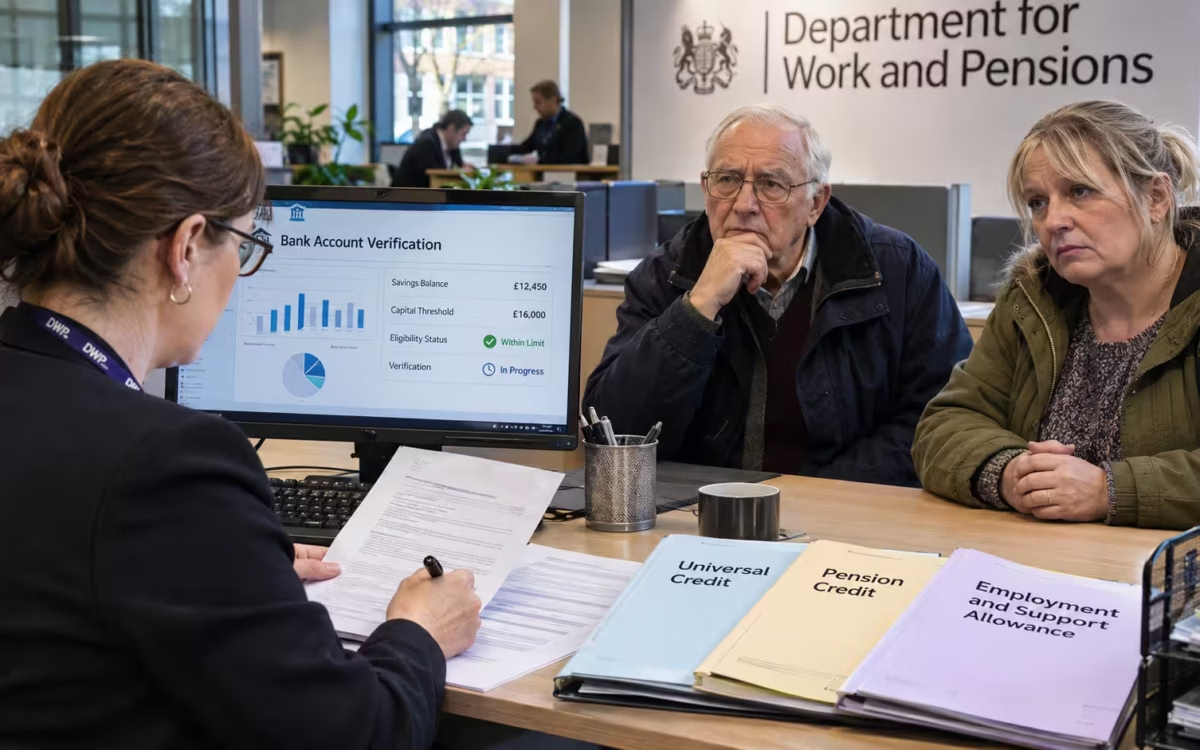
Millions of Universal Credit, Pension Credit and Employment and Support Allowance claimants could face additional eligibility checks as the Department for Work and Pensions (DWP) begins using new powers requiring banks to flag accounts that may not meet benefit rules.
The UK government has taken a significant step in its crackdown on benefit fraud after issuing its first Eligibility Verification Notice on 26 October 2026.
The move allows the DWP to require banks and other financial institutions to identify accounts showing potential discrepancies involving savings, capital or time spent overseas.
The measures, introduced under the Public Authorities (Fraud, Error and Recovery) Act 2025, are expected to save taxpayers £1.2 billion by the end of the 2030/31 financial year.
However, the changes have also generated concerns about financial privacy, the potential for incorrect account flags and the impact on vulnerable benefit recipients.
The latest developments follow growing public interest in whether government departments can examine personal bank accounts, particularly those belonging to pensioners, low-income households and people receiving financial assistance.
Despite widespread discussion about bank surveillance, the new system does not permit DWP officials to access claimants’ online banking accounts directly or continuously monitor their transactions.
Instead, financial institutions will examine relevant accounts against specific eligibility indicators supplied by the department and return limited information when those indicators are met.
The government has confirmed that the scheme is initially operating through a controlled testing phase rather than an immediate nationwide rollout.
Minister for Innovation, Fraud and Debt Lilian Greenwood defended the approach when the first notice was announced.
“Benefit fraudsters should be looking over their shoulder,” Greenwood said in the government’s 26 October statement.
She also sought to reassure claimants that everyday spending was not the focus of the investigations, stating:
“We are not interested in where people do their weekly shop.”
The government’s position is that identifying potential problems earlier will reduce fraudulent claims while preventing people from accumulating large overpayment debts through genuine mistakes.
Which Bank Accounts Will the DWP Check?
According to official government guidance, the Eligibility Verification Measure currently covers three benefits: Universal Credit, Pension Credit and New Style Employment and Support Allowance.
The State Pension itself is not included in the new eligibility verification powers, meaning someone receiving only their State Pension will not have their account checked under this particular measure.
However, pensioners who also receive Pension Credit may come within its scope.
The checks focus on identifying financial information that could suggest a claimant no longer meets the eligibility conditions attached to their benefit.
One significant area involves Universal Credit savings limits.
Under existing rules, most Universal Credit claimants must have no more than £16,000 in countable capital to remain eligible.
Savings exceeding £6,000 can also reduce monthly payments, although exemptions and special circumstances may apply.
For example, someone receiving Universal Credit whose relevant bank accounts contain substantial undeclared savings could have their account flagged for further examination.
The same principle applies to certain overseas activity.
Some benefits restrict how long recipients can remain outside Great Britain while continuing to receive payments.
The new system allows banks to identify account information that may indicate a claimant has spent longer abroad than the applicable benefit rules permit.
Financial institutions may provide the names of account holders, account numbers, sort codes, relevant balances and the dates of overseas transactions.
Linked and joint accounts can also fall within the checks.
In some circumstances, this means information relating to someone who does not personally claim benefits may be included where their account is linked to a relevant benefit-receiving account.
However, the DWP cannot obtain a complete record of purchases or access someone’s live banking activity through this system.
Banks are specifically prohibited from supplying full transaction histories, detailed spending information, specific transaction locations or protected sensitive personal information through an Eligibility Verification Notice.
This distinction matters because a financial irregularity is not automatically evidence of dishonesty.
A large bank balance, for instance, could include money that is legally disregarded for benefit calculations, such as certain compensation payments.
Officials must consider the claimant’s actual circumstances before deciding whether their entitlement has changed.
Experts Warn About Privacy and Incorrect Fraud Flags
The introduction of bank account checks has renewed debate over the balance between protecting public money and safeguarding personal financial information.
In February 2026, the House of Commons Public Accounts Committee warned that the DWP’s additional financial investigation and debt recovery powers must be exercised proportionately.
Committee chair Sir Geoffrey Clifton-Brown raised concerns about the potential impact on ordinary claimants.
“Make no mistake, the DWP’s new powers to reach further into citizens’ lives are significant,” he said.
The committee supported efforts to reduce fraudulent and incorrect payments but called for stronger attention to departmental mistakes, transparency and the danger of excessive enforcement.
Its findings also highlighted previous failures involving Carer’s Allowance overpayments, which resulted in some people being wrongly pursued for debts.
Those cases illustrate why accurate checks and opportunities to challenge decisions are particularly important when government action affects a household’s essential income.
Civil liberties campaigners have voiced similar concerns about the wider package of welfare enforcement powers.
In an earlier interview with LBC, Silkie Carlo, director of Big Brother Watch, warned that some claimants were navigating a complicated system while experiencing serious financial hardship.
“We’re talking about many people who are living on the poverty line,” she said.
Her comments concerned the government’s broader proposals, including recovering benefit debts directly from bank accounts, rather than specifically the October launch of eligibility verification.
Nevertheless, they reflect an important concern surrounding the current changes: financial enforcement should distinguish deliberate fraud from genuine errors and avoid disproportionately affecting vulnerable individuals.
The government says the eligibility verification system includes safeguards intended to prevent that outcome.
A bank flag cannot independently establish fraud, and benefit decisions must continue to be made by DWP staff after considering additional information.
Claimants may be asked to explain discrepancies, provide evidence or clarify changes in their financial circumstances.
Where the department reaches an adverse decision, established routes for challenging benefit decisions remain available.
The DWP also says the system will be subject to independent oversight, with annual reports examining how the powers are used.
The scale of the government’s challenge is substantial.
According to the DWP’s latest annual fraud and error estimates, approximately £9.9 billion in benefits was overpaid during the financial year ending 2026, equivalent to 3.2% of total benefit expenditure.
These figures include fraud, claimant error and official error, meaning the entire amount cannot be attributed to deliberate fraudulent activity.
The department also estimated that £1.2 billion was underpaid due to official error, showing that payment accuracy remains a problem in both directions.
For ministers, the new account-checking powers represent an opportunity to reduce losses and identify incorrect payments sooner.
For critics, their effectiveness will depend on the accuracy of the information supplied, the treatment of innocent claimants and whether the promised safeguards operate properly in practice.

The next stage of implementation remains important.
In a parliamentary answer on 3 November 2026, Greenwood confirmed that the department had not set a fixed target for the number of Eligibility Verification Notices it would issue during the testing phase.
Further notices are expected, but the government has not publicly identified all the financial institutions involved in the initial tests or announced a definitive timetable for full implementation.
For people currently receiving benefits, the main advice is to ensure that savings, income, changes in household circumstances and relevant overseas travel are reported accurately to the DWP.
A claimant whose account is flagged may be contacted through their Universal Credit journal, by letter, telephone or text message and asked to provide further information.
Ignoring a legitimate request for evidence could lead to delays or interruption of payments, while an incorrect decision can be challenged through the mandatory reconsideration process.
The DWP’s new account checks therefore mark a significant change in how benefit eligibility can be verified across Britain.
Yet their longer-term impact will depend not simply on the amount of public money recovered, but on whether the system can reliably identify incorrect claims without penalising people who remain entitled to support.
About the Journalist
Ben covers business, transport and global developments for Londoner. His reporting focuses on London’s economy, major companies, infrastructure, public transport and international stories that may affect people and businesses across the capital. He explains complex developments clearly using reliable sources and relevant context.