UK State Pension Age Retirement Changes: Millions Face Later Pension Dates as Rise to 67 Begins
 Published By
Olivia
Published By
Olivia
Published:

Table of Contents
Millions of people approaching retirement are beginning to feel the effect of major UK State Pension age retirement changes, with the age at which people can first claim their State Pension now gradually increasing from 66 to 67.
The change began in April 2026 and will continue in stages until March 2028, meaning people born in different months around 1960 and 1961 can have different State Pension ages.
Government records confirm that the increase is already under way rather than being a future proposal. By March 2028, the State Pension age for men and women will have reached 67.
At the same time, uncertainty remains over what happens after 67. A further increase to 68 is already contained in existing legislation for 2044 to 2046, but the Government’s ongoing third State Pension age review could influence whether that timetable changes.
What Are the UK State Pension Age Retirement Changes?
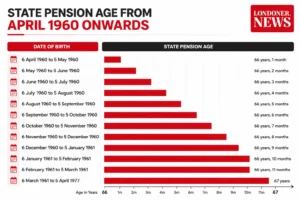
The most immediate change affects people born from 6 April 1960 onwards.
Until April 2026, the State Pension age was effectively 66 for people reaching pension age under the relevant timetable. It is now rising month by month.
Under the Government’s legislated schedule:
| Date of Birth | State Pension Age |
| 6 April 1960 to 5 May 1960 | 66 years, 1 month |
| 6 May 1960 to 5 June 1960 | 66 years, 2 months |
| 6 June 1960 to 5 July 1960 | 66 years, 3 months |
| 6 July 1960 to 5 August 1960 | 66 years, 4 months |
| 6 August 1960 to 5 September 1960 | 66 years, 5 months |
| 6 September 1960 to 5 October 1960 | 66 years, 6 months |
| 6 October 1960 to 5 November 1960 | 66 years, 7 months |
| 6 November 1960 to 5 December 1960 | 66 years, 8 months |
| 6 December 1960 to 5 January 1961 | 66 years, 9 months |
| 6 January 1961 to 5 February 1961 | 66 years, 10 months |
| 6 February 1961 to 5 March 1961 | 66 years, 11 months |
| 6 March 1961 to 5 April 1977 | 67 |
The Government’s official timetable confirms that people born from 6 March 1961 to 5 April 1977 currently have a State Pension age of 67.
That makes checking an exact date of birth increasingly important. Two people born only a few months apart may become eligible for their State Pension at different ages during the transition.
When Will the State Pension Age Reach 67?
The transition started in April 2026 and is scheduled to finish in March 2028.
The Department for Work and Pensions confirmed in its 2025/26 annual report that the State Pension age began increasing from 66 in April 2026 and will reach 67 by March 2028.
The department has also been contacting people affected by the change. Around four million reminder letters relating to a State Pension age of 67 were sent during 2025/26 as part of efforts to make people aware of their retirement timetable.
For London workers planning to stop work within the next few years, the change could therefore alter the point at which State Pension income begins.
Does a State Pension Age of 67 Mean People Must Work Until 67?
No.
The State Pension age is the earliest age at which someone can normally start receiving their State Pension. It is not a compulsory retirement age.
There is no general default retirement age of 65 in the UK, and people can continue working after reaching State Pension age. Some people may also be able to access workplace or private pensions before their State Pension begins, depending on the rules of those schemes.
This distinction is increasingly important as the State Pension age rises.
Someone could, for example, stop working at 64 using private savings or pension income and then claim their State Pension when they reach their individual State Pension age.
Others may decide to work beyond 67 and defer their State Pension.
Is the State Pension Age Going Up to 68?
Under current legislation, yes, but not immediately.
The existing legal timetable provides for the State Pension age to increase from 67 to 68 between April 2044 and April 2046. People born from 6 April 1978 onwards currently have a State Pension age of 68 under that schedule.
However, the timing of that increase remains an important political and financial question.
Previous governments examined bringing the rise to 68 forward, but the 2023 State Pension age review ultimately left the legislated 2044-46 timetable unchanged pending another review.
Therefore, reports suggesting that an earlier move to 68 has already been confirmed should be treated cautiously.
What Is the Third State Pension Age Review?
The Government launched its third State Pension age review in July 2025.
The review is examining whether the existing retirement-age rules remain appropriate, taking into account factors including:
- Life expectancy
- The financial sustainability of the State Pension
- The impact of previous age increases
- The position of people heavily dependent on State Pension income
- Britain’s ageing population
- Opportunities for older people to remain in work
The process includes evidence from the Government Actuary and an independent report led by Dr Suzy Morrissey.
The DWP has said it plans to publish the overall review by the end of March 2029.
Until a new decision is announced and any necessary legislation passes Parliament, the existing timetable remains the relevant one.
Could the Rise to 68 Be Brought Forward?
It remains possible.
A previous 2017 review proposed moving the increase to 68 forward to 2037-39. However, that proposal was not subsequently enacted into the current State Pension age legislation.
The 2023 review instead kept the existing 2044-46 schedule while leaving the issue open for reconsideration. Government guidance also states that Parliament would need to approve future changes before they became law.
The third review will therefore be closely watched by workers currently in their 40s and 50s.
A significantly earlier move to 68 could require some people to fund an additional period between leaving employment and receiving the State Pension.
Why Is the Government Reviewing the Retirement Age Again?
The central issue is the long-term sustainability of the State Pension.
As Britain’s population ages, the number of people receiving pension payments is expected to grow relative to the working-age population funding the system through taxation and National Insurance.
Government Actuary projections published in 2026 highlighted the longer-term demographic challenge, with pension expenditure expected to face increasing pressure as the population structure changes.
Life expectancy is another important part of the calculation.
However, deciding State Pension age solely according to average life expectancy can be controversial because healthy life expectancy, regional differences, occupation and income can substantially affect people’s experiences of later working life.
The review is therefore considering a broader range of social and economic factors.
What Does the Change Mean for Retirement Planning?
For anyone approaching retirement, the biggest practical lesson is not to assume that State Pension automatically begins on their 66th birthday.
People born during the transition period should check their individual State Pension age and consider how it fits alongside workplace pensions, private pensions, savings and employment income.
The amount eventually received matters as well as the age at which it begins. Recent earnings figures have increased attention on possible future uprating, with State Pension wage growth potentially influencing the April 2027 increase under the triple lock.
The full new State Pension is £241.30 a week in the 2026/27 tax year, although an individual’s actual entitlement depends on their National Insurance record.
Could Working Longer Affect Tax?
Potentially.
The State Pension is taxable income, although tax is not normally deducted directly from the State Pension payment itself.
Someone who continues working while receiving the State Pension could find that their total taxable income increases. HMRC may adjust the PAYE code applied to employment or another pension to collect the correct tax.
Understanding UK tax code rules can therefore become particularly important for people combining employment with retirement income.
Older households with substantial cash deposits may also need to consider forthcoming savings interest tax changes when planning their finances beyond retirement.
Why Could the Changes Hit Some Retirees Harder?
A later State Pension age does not affect every household equally.
People with substantial private pensions and savings may have more flexibility over when they stop working. Someone relying heavily on the State Pension may have fewer options if eligibility is pushed back.
There are already concerns about financial pressure among some older households. Recent analysis of pensioner poverty rates has highlighted particularly difficult circumstances for some single retirees and women living alone.
People in physically demanding jobs may also find extending their working lives more difficult than those who can comfortably remain in less strenuous employment.
These differences are likely to remain central to the debate as ministers consider the future timetable beyond age 67.
What Should People Approaching Retirement Do Now?

Anyone expecting to retire in the next few years should first confirm their exact State Pension age rather than relying on the old assumption that it is 66.
They should also check their State Pension forecast and National Insurance record to understand both when payments can start and approximately how much they could receive.
People with workplace or private pensions should separately check when those funds can be accessed, as private pension ages do not automatically match State Pension age.
Most importantly, the current increase to 67 should be treated differently from speculation about age 68.
The rise from 66 to 67 is already happening and is set in law. A future rise to 68 is also legislated for 2044-46, but whether that timetable remains unchanged will be reconsidered through the current State Pension age review.
What Happens Next?
For people close to retirement, the most important dates are already known: the transition to State Pension age 67 continues until March 2028.
For younger workers, attention will increasingly turn to the third State Pension age review and whether ministers eventually decide that the rise to 68 should happen earlier than the current 2044-46 timetable.
The Government says that review is expected to be published by the end of March 2029. Until then, there has been no confirmed new acceleration to age 68.
That means the UK’s retirement landscape is changing, but not every possible future increase has yet been decided.
For millions of workers, checking an individual State Pension age rather than assuming retirement begins at 65 or 66 is now an increasingly important part of financial planning.
About the Journalist
Olivia covers London life, culture and lifestyle for Londoner. Her work includes food, shopping, neighbourhood trends, attractions, local experiences and practical guides for residents and visitors. She focuses on engaging stories that reflect everyday life across the capital.