Has Prince Andrew Been Arrested? Latest Update As Court Rules Police Raids Unlawful
 Published By
Jermaine
Published By
Jermaine
Published:
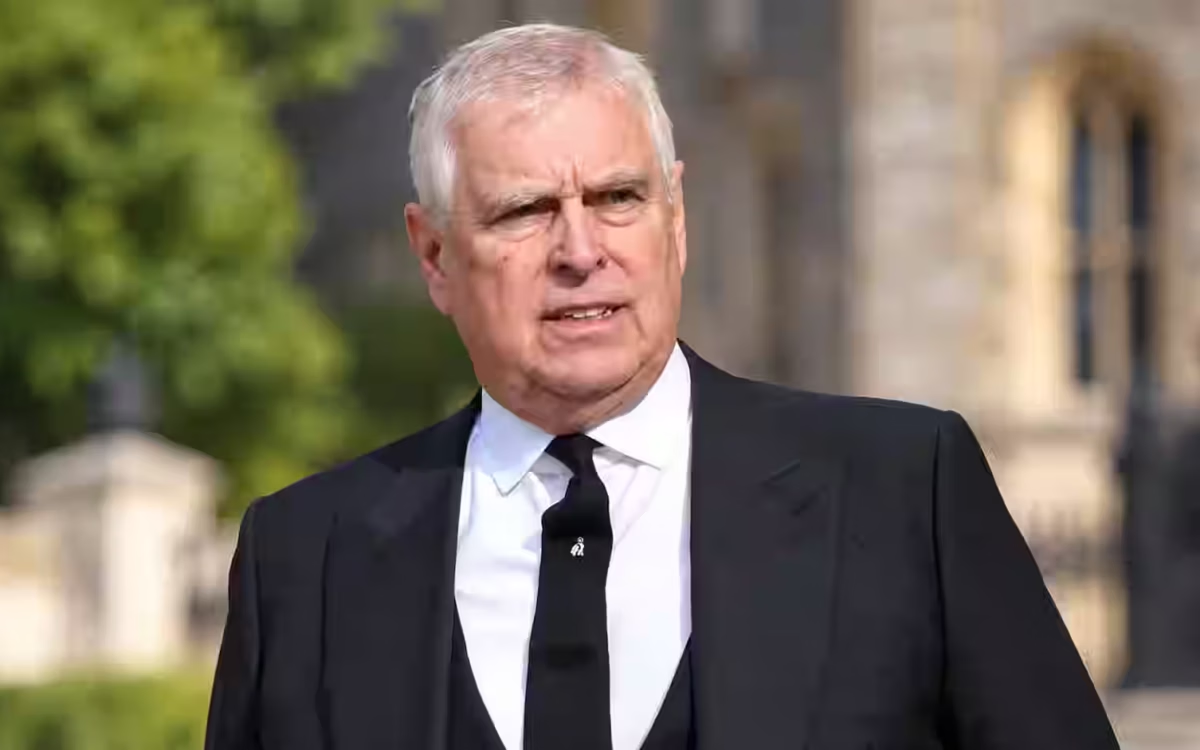
Table of Contents
Andrew Mountbatten-Windsor, formerly known as Prince Andrew, was arrested on 19 February 2026 on suspicion of misconduct in public office, marking an extraordinary development for the British royal family. The younger brother of King Charles III was questioned by Thames Valley Police for approximately 11 hours before being released under investigation without charge.
The case returned to the headlines on 8 October 2026 after the High Court in London confirmed that search warrants used to raid two of Andrew’s properties were unlawful. Despite the ruling, police have confirmed that their criminal investigation remains active.
The 66-year-old former Duke of York was arrested at Sandringham in Norfolk on his birthday following allegations connected to his relationship with the late convicted sex offender Jeffrey Epstein.
Investigators are examining claims that Andrew shared sensitive government information with Epstein while serving as the UK’s special representative for trade and investment between 2001 and 2011.
The allegations gained renewed attention after the US Department of Justice released documents connected to Epstein and his associates. Andrew has consistently denied wrongdoing in relation to Epstein and previously expressed regret over their friendship.
His arrest represented an unprecedented event in modern royal history, raising questions about accountability, police powers and the continuing consequences of the Epstein scandal.
However, being arrested does not mean Andrew has been found guilty of any offence. He has not been charged, and the investigation remains ongoing.
Why Were Prince Andrew’s Police Raids Ruled Unlawful?
The latest development came on Thursday, 8 October, when Mr Justice Nicholas Hilliard confirmed that Thames Valley Police and Andrew’s legal representatives had agreed the warrants authorising searches of his properties were unlawful.
Officers searched his residence on the Sandringham Estate and his former home, Royal Lodge in Windsor, during the February investigation. Documents and electronic devices were among the materials seized.
The legal dispute concerned the powers used to obtain the warrants under the Police and Criminal Evidence Act 1984.
The court heard that the warrants had been granted using an incorrect statutory procedure, with insufficient consideration of protections applying to legally privileged information and certain categories of material.
Mr Justice Hilliard explained that the cancellation of the warrants did not invalidate the wider police investigation.
The High Court’s decision is a significant legal victory for Andrew, but it does not amount to an acquittal or a ruling that his arrest itself was unlawful.
Police are now seeking permission to retain material seized during the searches, while Andrew opposes that application. Further proceedings are expected in 2027.
London lawyer Mark Stephens, of Howard Kennedy, who is not involved in the case, told the Associated Press that the decision:
“opens a door to Andrew Mountbatten-Windsor’s lawyers to start to chisel away”
at evidence obtained through the unlawful warrants.
Stephens explained that British courts may still permit the retention or use of material obtained through an unlawful search, depending on the applicable legal rules.
The dispute could therefore have important consequences for how investigators handle evidence, although there is currently no ruling excluding all the material seized.
Thames Valley Police acknowledged that the warrants had been improperly issued but maintained that the investigation was continuing.
The force said further legal proceedings would determine whether it could lawfully retain material connected to the case.
How Did King Charles Respond to Prince Andrew’s Arrest?
King Charles III publicly addressed his younger brother’s arrest in February, expressing serious concern while making clear that the authorities should be allowed to investigate without interference.
In his official statement published by the Royal Family, the monarch declared:
“Let me state clearly: the law must take its course.”
The King also expressed support and co-operation with the investigative process.
The controversy has intensified scrutiny of Andrew’s position within the monarchy, particularly after he withdrew from public duties in 2019 following his widely criticised BBC Newsnight interview about Epstein.
In October 2025, King Charles moved to remove Andrew’s remaining royal titles and honours amid further revelations about his relationship with the convicted sex offender.
Recent reports also indicate that Buckingham Palace has made clear that private financial support provided by the King must not be used to fund Andrew’s legal challenge against the police.
The palace’s position reinforces the separation between the ongoing criminal investigation and the wider activities of the royal family.
Andrew has not publicly commented on the latest High Court ruling.
What Happens Next in the Prince Andrew Investigation?
The immediate focus is now on whether Thames Valley Police can retain evidence obtained during the February searches.
The High Court is expected to consider the dispute in further proceedings during 2027, while investigators continue examining allegations relating to Andrew’s previous public role.
Any decision to bring criminal charges would depend on the available evidence and the applicable prosecution tests. No such charges had been announced in the latest reports available on 9 October 2026.
The distinction between an arrest, a criminal charge and a conviction remains central to the case.
Prince Andrew was arrested on suspicion of misconduct in public office, a serious allegation under English criminal law.
Nevertheless, he remains entitled to the presumption of innocence, and the cancellation of search warrants does not establish either guilt or innocence.
For now, the answer to the question “Has Prince Andrew been arrested?” is yes. He was arrested in February 2026, subsequently released without charge, and remains under investigation.
The latest court ruling has created a significant challenge over police evidence-gathering, but it has not brought the case to an end. Further developments will depend on the continuing investigation and the court’s decisions concerning the seized material.
About the Journalist
Jermaines covers crime, legal affairs and money-related stories for Londoner. His reporting includes police updates, court cases, consumer rights, personal finance and cost-of-living issues. He handles sensitive subjects carefully and clearly distinguishes confirmed facts from allegations, estimates and ongoing investigations.